La renfe fent de les seves. La meva filla ha sortir a les 9 de Vilanova i la Geltrú i encara no ha arribat. Va per Gava i es moria de ganes de veure el show. Ni en cap de setmana .Aguanteu la porta 🙏
@sempresaludava@enpeyu@neussi
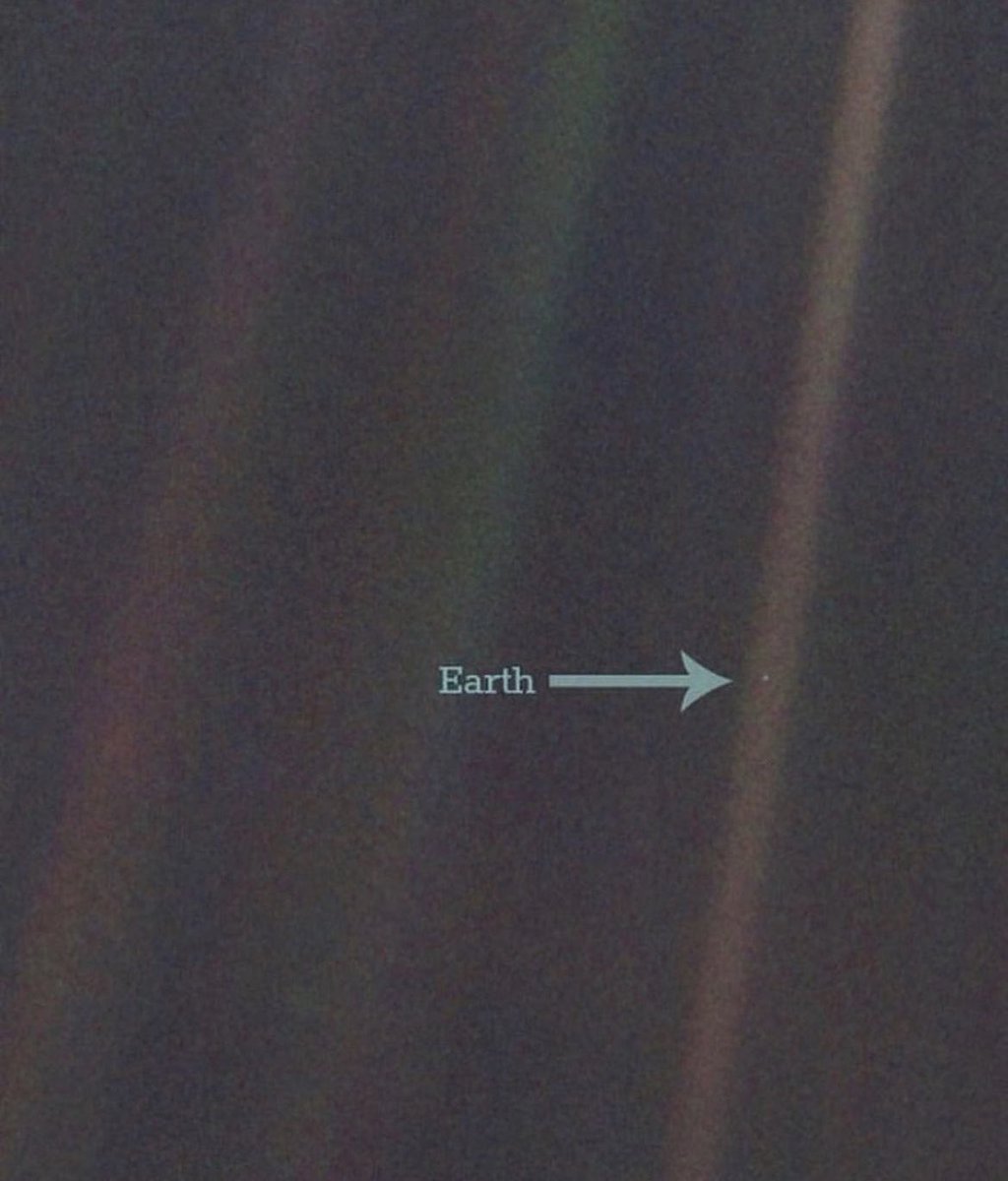
Pale Blue Dot is a photo of Earth that was taken by the Voyager 1 space probe in 1990 from a distance of about 6 billion kilometers (3.7 billion miles) as it was leaving our solar system. This is what Carl Sagan said about the photo:
"Look again at that dot. That's here. That's home. That's us. On it, everyone you love, everyone you know, everyone you ever heard of, every human being who ever was, lived out their lives. The aggregate of our joy and suffering, thousands of confident religions, ideologies, and economic doctrines, every hunter and forager, every hero and coward, every creator and destroyer of civilization, every king and peasant, every young couple in love, every mother and father, hopeful child, inventor, and explorer, every teacher of morals, every corrupt politician, every 'superstar,' every 'supreme leader,' every saint and sinner in the history of our species lived there — on a mote of dust suspended in a sunbeam.
The Earth is the only world known so far to harbor life. There is nowhere else, at least in the near future, to which our species could migrate. Visit, yes. Settle, not yet. Like it or not, for the moment the Earth is where we make our stand. It has been said that astronomy is a humbling and character-building experience. There is perhaps no better demonstration of the folly of human conceits than this distant image of our tiny world. To me, it underscores our responsibility to deal more kindly with one another, and to preserve and cherish the pale blue dot, the only home we've ever known.”
A concept everyone needs to understand:
The 7 Types of Rest
Burnout has become a common phenomenon of the modern era.
We all need a plan for rest, but there's more to rest than meets the eye.
Author and speaker Dr. Saundra Dalton-Smith proposed that there are 7 Types of Rest:
1. Physical Rest: Can be passive (sleeping, napping) or active (yoga, stretching, massage).
2. Mental Rest: Take short breaks between tasks and meetings, create a power-down ritual to separate work from personal, meditate.
3. Sensory Rest: Turn off social media, get away from screens and bright lights, switch from Zoom to phone call.
4. Creative Rest: Can be natural (taking in a sunrise/sunset, walking in the woods) or man-made (going to a museum, experiencing new music).
5. Emotional Rest: Spend time alone or with people with whom you can be your full, authentic self.
6. Social Rest: Spend less time with people who drain your energy and more time with people who give you energy.
7. Spiritual Rest: Connect with something bigger than yourself. Can be through volunteering, working on a purpose-driven job, or participating in spiritual or faith-based activities.
While this may seem like a lot, you can actually hit multiple types of rest with simple additions to your weekly routine.
For example, adding a daily tech-free walk in nature is a perfect way to hit physical, mental sensory, creative, and emotional rest.
As you think about your days, make sure you are finding ways to incorporate the seven types of rest into your life. You'll feel more comprehensively recharged and ready to take on life's challenges as a result.
Reframe rest and recovery as a core part of your daily systems, not a reward for your efforts.
You don’t need to “earn” your recovery—it should be a central part of your ritual that allows you to thrive.
If you enjoyed this or learned something, follow me @SahilBloom for more in the future.
Acabo de llegar de Islandia. Precioso. He visitado 4 glaciares. En todos, la misma historia: "en los 80 calculamos el ritmo de deshielo, y dijimos que el glaciar desaparecerá en el año x. Cada año, acortamos la predicción. Desaparecerán mucho antes, el proceso acelera". (Sigo)
Artificial intelligence vs. human brain - a love-hate relationship
As AI models (neural networks) have become more performant they have surpassed the human brain at multiple tasks
Neural networks are fundamentally modeled on the human brains.
Here is how they are similar
Neurons vs. Nodes -
Biological neurons - The brain receive signals from other neurons through dendrites, processes them, and then passes them on through axons.
Artificial neurons - Nodes in the network receive inputs, add some mathematical transformation and produce an output. So the fundamental workflow is the same.
Learning mechanisms are similar -
Brain Learning: When we learn, the strengths of the neuron connections (synapses) change. For example, if you touch a flame and get burned, your brain strengthens the "fire = hot & painful" connection.
Network Learning: Neural networks adjust their weights (connections) based on errors in prediction
Layered architecture -
Brain's Hierarchical Processing: The human brain processes information in a hierarchical manner. Different parts of the brain are responsible for different functions.
Layers in Neural Networks: Neural networks, especially deep networks, also employ a hierarchical structure. The initial layers often capture low-level features (like edges in images), and deeper layers capture high-level abstract features.
But while they share these basic concepts, this is where the similarity ends!
AI models excel at
Specific tasks - on narrow defined tasks, AI models can easily outpace the human brain. For example, AI can search the entire web and recollect information from the web way better than the brain
Games - AI models have outplayed humans in some games like Chess and Go
Processing Speed: AI models can crunch numbers and process data much faster than the human brain
However, they are still very behind the human brain in these key abilities
Learning and Generalization - The human brain needs very few examples to learn and can easily apply the learning from one context to another. AI needs thousands of examples to learn and can't easily generalize the learning
Energy Consumption - AI models consume way more energy than the human brain. Your brain only uses about 20 watts, which is like a dim light bulb. Yet, you still get bright ideas!
The Super Cool Stuff - No, GPT-4 is not secretly in love with you! AI models don't have feelings, dreams, consciousness or intuition. This is what makes us human, AI models have none of this!
In summary, the human brain is versatile, creative and adaptable while AI models are brilliant at specialized tasks.
Lately, there has been a lot of hate, fear and loathing of AI models, with some people claiming that AI threatens our very existence
In reality, the human brain is far more sophisticated and complex than AI and we should embrace and love AI models whose creation have been inspired by our brains. They can be great tools that can transform our lives for the better and unlock the mysteries of the universe
We’re rolling out a bunch of small updates to improve the ChatGPT experience. Shipping over the next week:
1. Prompt examples: A blank page can be intimidating. At the beginning of a new chat, you’ll now see examples to help you get started.
2. Suggested replies: Go deeper with a click. ChatGPT now suggests relevant ways to continue your conversation.
3. GPT-4 by default, finally: When starting a new chat as a Plus user, ChatGPT will remember your previously selected model — no more defaulting back to GPT-3.5.
4. Upload multiple files: You can now ask ChatGPT to analyze data and generate insights across multiple files. This is available with the Code Interpreter beta for all Plus users.
5. Stay logged in: You’ll no longer be logged out every 2 weeks! When you do need to log in, you’ll be greeted with a much more welcoming page.
6. Keyboard shortcuts: Work faster with shortcuts, like ⌘ (Ctrl) + Shift + ; to copy last code block. Try ⌘ (Ctrl) + / to see the complete list.
Generative AI is on track to unleash the next wave of productivity. 💡
Take a first look at where business value could accrue and what the potential impacts are on the workforce
👉 https://t.co/CHHVhuhF9E
#GenerativeAI#ArtificialIntelligence#McKinseyonAI#McKinseyDigital