Everything in life can pretty much be reduced to:
> Define the outcome you want.
> Identify the highest-leverage actions that produce that outcome.
> Execute those actions consistently until the next-best use of your time has a higher expected return.
> Measure results, update your beliefs, and repeat.
When @Qullamaggie famously says: “Nobody is smarter than the moving averages.”
What he is really saying is:
“Nobody is smarter than the prevailing trend.”
And that principle has remained true now for decades, likely centuries, if we had the data.
Elon Musk just put a price tag on obedience. It costs $200,000.
Musk: “You don’t need college to learn stuff. Everything is available basically for free. You can learn anything you want for free.”
Every lecture. Every textbook. Every framework ever written. Free on any screen in any country right now. The entire knowledge monopoly collapsed in a decade. Nobody updated the price tag.
Musk: “Colleges are basically for fun and to prove you can do your chores. But they’re not for learning.”
Strip the ivy and the branding. What’s underneath is a four-year obedience trial. Can this person follow instructions on a schedule without asking why.
Musk: “There is a value that colleges have, which is seeing whether somebody can work hard at something, including a bunch of annoying homework assignments, and still do their homework assignments.”
That is the entire six-figure value proposition. Not what you know. Not what you can build. Whether you can be managed. The establishment doesn’t need you educated. It needs you domesticated.
Musk: “If you’re trying to do something exceptional, you must have evidence of exceptional ability. I don’t consider going to college evidence of exceptional ability.”
The system doesn’t produce exceptional. It produces manageable. It takes the most creative years of your life and teaches you to wait for instructions. That is not education. That is containment.
Musk: “Gates is a pretty smart guy, he dropped out. Jobs is pretty smart, he dropped out. Larry Ellison, smart guy, he dropped out.”
They didn’t leave because they couldn’t keep up. They left because the ceiling was underground.
8 billion people now carry the same library in their pocket. The one these institutions charged a lifetime of debt to access.
The only product the university still sells is the belief that you need one.
Merry Christmas, here's some genuine free alpha that you can use
Funding Rate vs Realized Drift
automation not required
most of y'all think of the funding rate like RSI; negative = oversold, positive = overbought
but you're wrong, it's way more specific
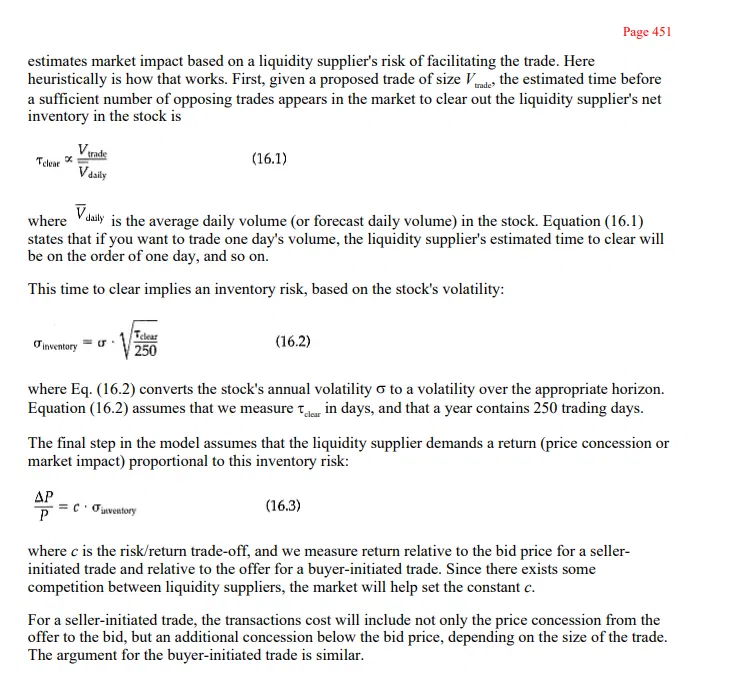
why your strategy's live results are worse than the backtest, and it gets worse the more you scale.
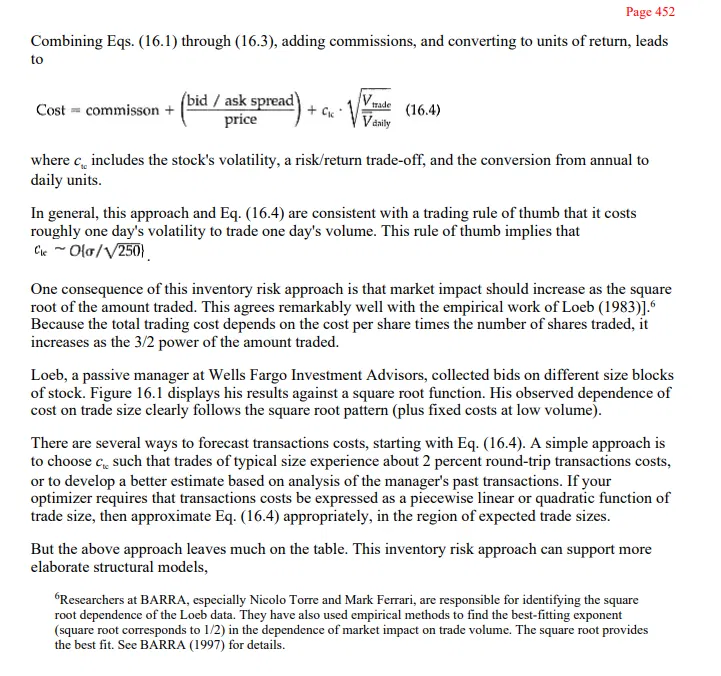
from Grinold & Kahn's Active Portfolio Management.
the rule of thumb: it costs roughly one day's volatility to trade one day's volume.
and the real issue, market impact doesn't scale linearly with size. it scales with the square root.
that means if you double your position size, your cost doesn't double. it goes up by ~41%. trade 4x the size? cost doubles. trade 100x? cost goes up 10x.
it's actually worse than that for your wallet. since total cost = cost per share × shares traded, your total dollar cost scales with the 3/2 power. double your size and total cost climbs ~2.83x.
look at the chart (Figure 16.1), actual empirical data from tracking bids on different block sizes. the square root fit is almost perfect.
this is why a strategy that looks incredible at $10K can look mediocre at $100K and completely break at $5m . your backtest assumed zero market impact. but on newer markets and especially anything pre market / after hours, these costs exist.
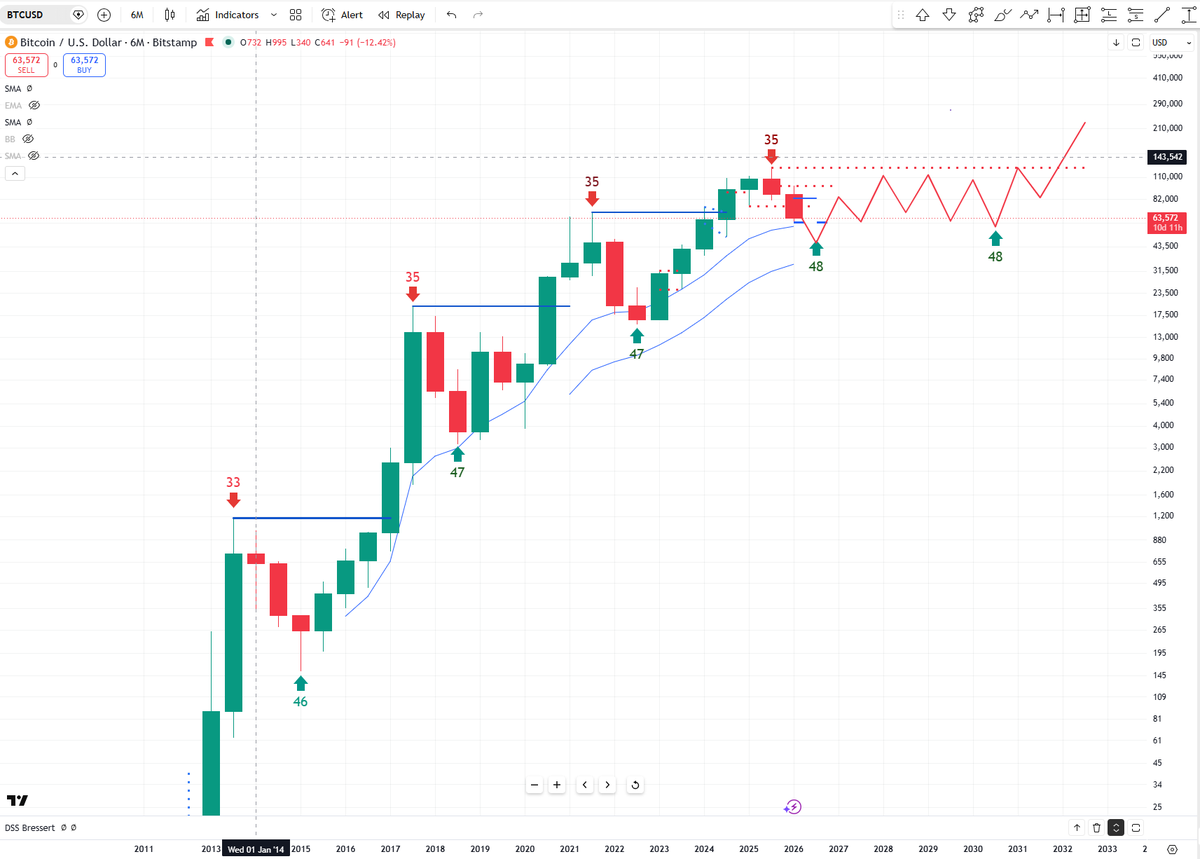
If the Bitcoin thesis is purely a SOV play, then in a world of AI capturing all the attention/capital, coupled with quantum fear, an outcome similar to this for the next 4 yr cycle would not be a big surprise, to me.
Would also align with a secular crypto bull market having peaked (as seen in alt's and bitcoin poor performance).
Ken Griffin, CEO of Citadel, on how he handled the AI hype inside a $60 billion hedge fund:
"i said, 'i want a list of all the GenAI-based projects that we have at Citadel.' he came back with 200 projects."
"i said, 'no, no. five. we're going to do five.'"
"'what about the other 195?'"
"'we're going to kill all those. we're going to do five. we're going to push them really hard. we're going to see what works and what doesn't.'"
"we can't afford to let everybody be pursuing random ad hoc projects. it's too expensive. it's too much of a distraction."
"of the five that we pursued, we had real success with just over half."
"i don't think we incurred any cost of killing 195 projects."
this is one of the most important lessons in strategy development too. you don't need 200 ideas in research. you need 5 that you push hard enough to actually validate. most traders spread themselves across too many ideas and end up with none that are live.
Timothy Masters has a degree in statistics, built missile guidance systems for the Department of Defense, then spent decades developing trading systems with David Aronson.
he's written books on statistical validation of trading strategies.
when asked the most common error strategy developers make, his answer was immediate:
"that's easy. it's reusing out-of-sample data."
then he gives an example that will make you rethink everything:
you have two developers, John and Mary. each builds a system independently. you test both on out-of-sample data. Mary's is better. you trade Mary's.
"her out-of-sample performance is now optimistically biased."
"a moment ago it was unbiased. now suddenly it's biased. how did that happen?"
"the answer is that you are about to trade 'the better of John and Mary's system.' that's different from Mary's system, even though Mary's system happened to be the better one."
the moment you compare two systems on the same out-of-sample data and pick the winner, you've selected for luck, not skill.
this applies to every trader who has ever tested 12 variations of a strategy, picked the best performer, and assumed it would keep working live.
13 things i'd tell my 18-year-old self about trading after 7 years:
1. if you can't explain your edge in 5 minutes, you don't have one
2. it takes 3-4 years to know if you're actually any good
3. comfort and returns are inversely related
4. process beats outcome, a good trade can lose and a bad trade can win
5. one strategy is unstable. a portfolio is a business
6. the field is always improving, standing still is falling behind
7. position sizing kills more accounts than bad entries
8. drawdowns are the cost of being in this game
9. overfitting is the enemy, a 9 sharpe backtest is a fairy tale
10. edges decay, you're a caretaker, not an owner
11. one deployed mediocre algo teaches more than 10 beautiful backtests
12. you're not a trader. you're a researcher who occasionally hits buttons
13. automate earlier than you think you should
Robert Carver explaining one of the most fundamental concepts in trading, the different risk premiums and why they exist.
take 3 minutes this Sunday and watch this.
+63.9% this year with -16.9% drawdown so far.
And I will share 100% of the rules here.
Not from AI.
Not from some complex quant model.
Just a very basic monthly Nasdaq 100 rotational system.
The rules:
* Trade only when $NDX is above its 200-day moving average
* Every month scan Nasdaq 100 stocks
* Keep only stocks above their own 200-day moving average
* Keep only stocks with positive 250-day percentage change
* Rank them by 250-day percentage change
* Buy the top 10
* Hold for one month
* Repeat
That is it.
No prediction.
No macro forecasting.
No discretionary chart reading.
No secret sauce.
Just:
market regime filter
stock trend filter
momentum ranking
monthly rebalance
Of course, not every year will look like this.
Some years will be choppy.
Some years will underperform buy and hold.
Some years will feel too simple to trust.
But this is exactly why I trade systematically.
The edge is not in predicting the next winner.
The edge is in building a repeatable process.
And once you understand the basic concept, you can push it much further.
A great way to start testing this properly:
RealTest + Norgate data.
Especially because Norgate gives you survivorship-bias-free Nasdaq 100 constituents through history, so you are not accidentally testing today’s winners in the past.
The Bitcoin 4 Year Cycle Journey ‘Model Portfolio’ has made its first buy in 3.5yrs. Picking up 10BTC at $65,000. Moving up to around a 60% BTC allocation.
The model can always be found here >> https://t.co/cYCKmcJ4TZ
A new 4 YR Cycle video will be published tomorrow morning.
FYI - I very much doubt the 4 Yr Cycle has bottomed, however at this level it makes sense to begin some re accumulation, as the possibility of only a retest of the Feb lows to mark the 4yr cycle low is possible. That would be the best Bull Case. Dry powder remains for a more tradition Cycle Low around the Q3 period.
Reminder - The 4 Year Model is not designed to trade often, intends to always have solid allocation to Bitcoin (even when a top is defined), does not try to time tops, but rather waits for trend breakdown on a monthly timeframe, and is ultimately designed as a HODL strategy with strategic (well defined HTF) trades to add Bitcoin over time. As evident by only 8 trades in 8 years.
If you're looking for more aggressive Spot positioning over the Weekly and 4 year Cycles that content is published on the Bitcoin Live website.
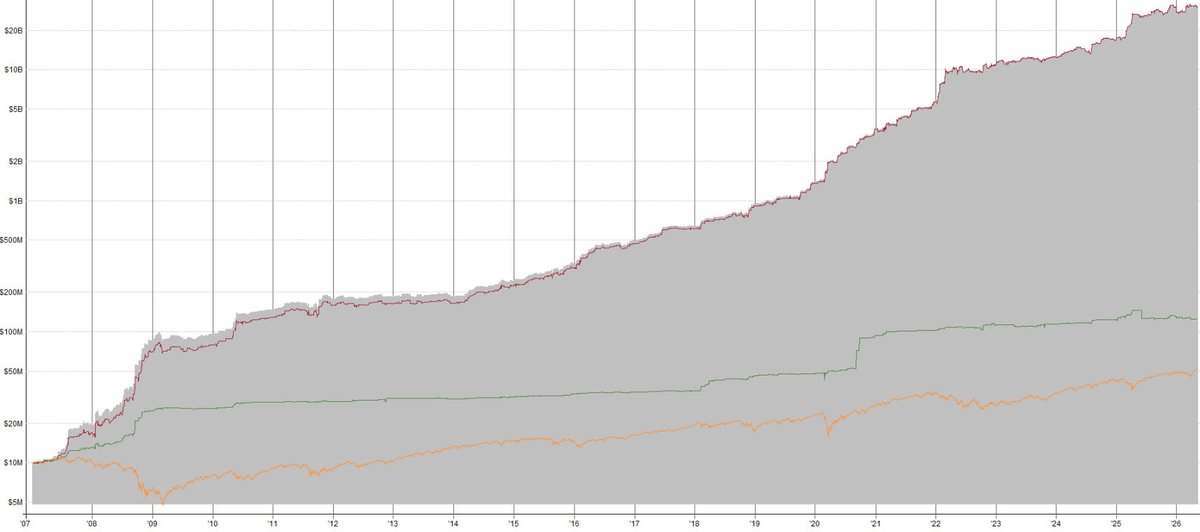
The red and green lines are the same strategy. Red assumes that we can forever risk the same % of our account. Green limits trade size to at most 0.5% of the markets total dollarvolume. Imo a nice visualization as to why small accounts can generate much higher pct returns
🚨 Incredible stage 4 breast cancer recovery story from Dr. John Campbell!
An 83-year-old woman was diagnosed with metastatic breast cancer that had spread to her liver, spine, bones, and lungs — basically a death sentence. She declined chemo, went on hospice, but started taking 222 mg fenbendazole daily. After 8 months:
Tumor marker (CA27.29) crashed from 316 → 36
PET scan showed ZERO abnormal metabolic activity indicating cancer
Dr. Campbell walks through the full case — mind-blowing results. Fenbendazole is getting serious attention for its potential anticancer actions (microtubule disruption, apoptosis induction, angiogenesis inhibition & more).
What do you think — should repurposed medicines like this get more research?
a lot of replies to this are "how do you compete against that?"
you don't. that's the point.
if you're getting into algo trading, you are not going to beat Jane Street at market making. you are not going to out-speed them on order book inefficiencies. you are not going to win at anything that requires sub-millisecond execution.
that is not how you win.
here's how you actually find something you can win in:
1. trade on higher timeframes where speed doesn't matter. trend following, momentum, mean reversion on daily or weekly bars, none of these require nanosecond execution.
2. go where the big funds can't. less liquid markets, newer asset classes, niche sub markets. the capital they manage is too large for those markets to matter to them, but they can matter to you.
3. harvest risk premiums. that doesn't get arbitraged away very fast and can persists because the underlying risk is real.
the biggest mistake I see newer algo traders make is spending months building something that "tries" to compete directly with firms like this. it's a fun project, but it's not going to work.
know which game you're playing. and more importantly, know which game you're not.
a member asked me how i deal with the fear of a strategy losing its edge.
the answer depends entirely on why it works.
if your strategy captures a risk premium, you're getting paid to take on risk that other participants don't want. that often doesn't just disappear overnight. momentum, mean reversion, these have worked for decades because the underlying reason hasn't changed much.
if your strategy exploits an inefficiency or arbitrage, something that works because there is a structural exploit, etc then yes, you should be nervous. that edge can and will get crowded.
risk premiums often require patience. inefficiencies require speed.
knowing which one you're trading changes about how you manage it.
I have spent a ridiculous amount of time and money to learn from the top health practitioners in the world.
The best practices all come down to crushing the basics of sleep, exercise, diet, & stress. Supplements and peptides were afterthoughts.
Bryan’s list is a great start, but maybe underemphasizes impact of stress (-) & community (+).
If curious, check out this interview I did after working w Andy Galpin & Chris Perry: https://t.co/XxwvvnQxz3
Small correction here.
You don’t need to reach a core temperature of 102.3°F to activate HSP expression. And you definitely don’t need to sit in a 200°F sauna for 30 minutes.
The research shows HSP expression can increase by ~50% after 30 minutes at 163°F, with core body temperature rising to only about 101°F.
Sauna benefits (even those related to HSPs) don’t require extreme heat or pushing core temperature that high.