Let me remind all $NBIS bulls that just a few weeks ago Nebius' CCO Tom Blackwell literally told me "demand from hyperscalers is INFINITE".
Nebius "only" makes 50% of their revenue from hyperscalers by choice.
The margin from selling to enterprises directly is higher.
Hyperscaler demand is definitely not weaking.
just "trust me bro" on this one.
That being said I have no idea how long market will panic irrationally over a nonissue. Sometimes it just does its thing 🤷🏻♂️
SCOOP: The Pentagon is creating a new czar that control procurement for almost all drone efforts in the building, per a memo obtained by Breaking Defense. https://t.co/MwYxJoXncy
Thank you @POTUS for your support. Micron is proud to be part of this historic initiative, which complements our over $200 billion investment in U.S. memory manufacturing and R&D, creating over 90,000 jobs across the country.
$MU is investing $250M into Trump Accounts.
President Trump called it the “biggest corporate investment of its kind” and said it will help “millions of American children and families get a strong start in life.”
Basically pre-market right now with the Neoclouds like $NBIS in simpler terms.
Costco: sells $5 chickens.
Walmart: mass buys those rotisserie chickens and sells excess as “Walmart Chickens”.
Stock Market: sells off Costco.
$META is now reportedly building an AI cloud business.
Of course, bots have tanked $NBIS in premarket, which basically means bots are retards.
First, Meta is late to this party. Whatever they build over the next three years, they would already have that today had they started three years ago, when they probably should have.
Second, Nebius is likely ahead on agent-native cloud stack and inference. Meta is the one that needs to catch up, not Nebius. If anything, this validates Nebius.
Third, compute is supply-constrained, and this does not take anything away from Nebius. If anything, a business like Meta joining the AI cloud race is a positive signal for ROI on AI cloud capex.
In short, this is great news for Meta, Nebius, and the AI cloud sector.
$NBIS should be up 10% on this news.
(Not investment advice.)
So $META is up on news of it selling AI compute. But all the companies providing that compute to META are down? Do the finance bros know where CPUs, GPUs & memory come from? $NVDA $MU $AMD $INTC
SanDisk may have a hidden edge in the AI memory boom, according to Bernstein.
As AI demand shifts from raw compute toward memory-heavy data architecture, analysts are increasingly treating memory as a strategic asset. Micron $MU CEO Sanjay Mehrotra has called memory critical to AI, while the phrase “AI equals memory” has become a core theme for investors watching the next phase of the AI trade.
But Bernstein says SanDisk $SNDK may be better positioned than the market realizes because of its long-term contract structure.
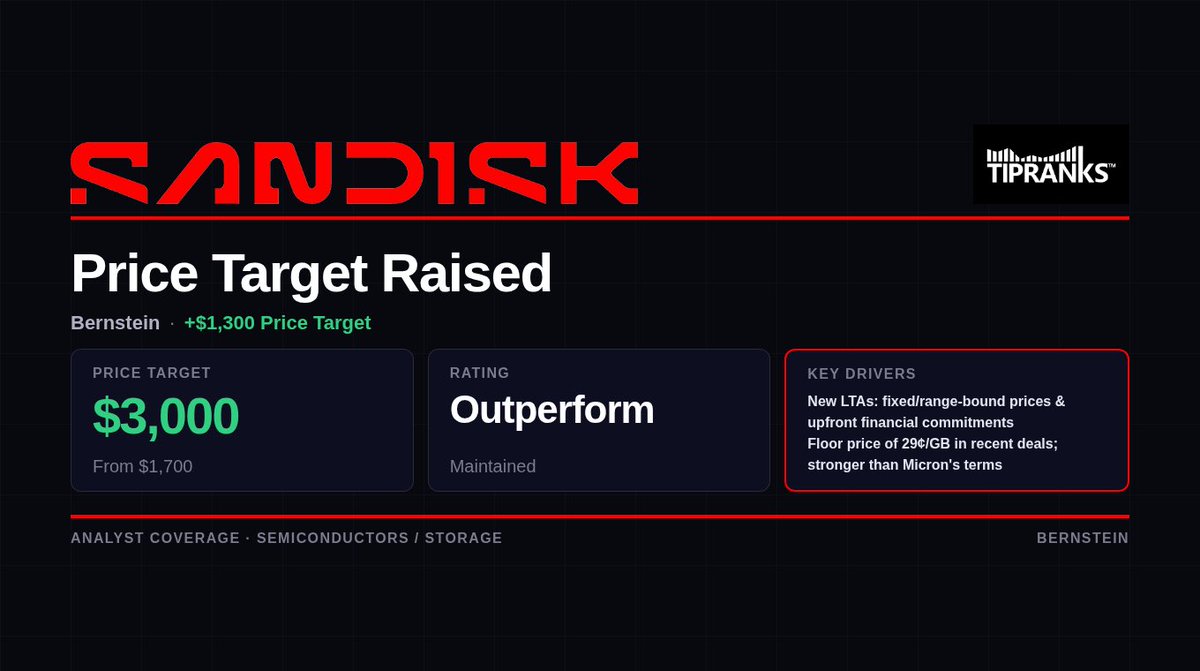
The firm raised its SanDisk price target to $3,000, implying more than 46% upside, citing newly signed long-term agreements that it believes offer real downside protection.
The key difference is flexibility. Bernstein says Micron relies on more rigid five-year contracts, while SanDisk’s three-to-five-year contracts are more “dynamic.” As revenue is recognized over time, the remaining contract value declines, meaning the same financial guarantee covers a smaller obligation later in the agreement.
That structure could give SanDisk stronger earnings protection if memory prices collapse.
Bernstein estimates SanDisk has a higher floor price of $0.29 per GB. Even in a severe downturn, the firm projects SanDisk’s fiscal 2030 EPS could hold at $214. Without those contracts, EPS could fall to $81.
SanDisk shares have already surged more than 763% year-to-date.
The bigger message: if AI really is becoming a memory race, Bernstein thinks SanDisk’s contract structure could make it one of the biggest winners.
Bernstein analyst Mark Newman raised the firm's price target on SanDisk $SNDK to $3,000 from $1,700 and keeps an Outperform rating on the shares.
The firm noted that new memory long-term agreements, or LTAs, are different from older ones, as old LTAs were written in favor of the customer, while newer LTAs have fixed or range bound prices, include upfront financial commitments to lock-in customers and protect downside, and have longer terms.
Based on the data provided by companies, the firm estimates SanDisk's floor price in recently signed LAs is 29c per GB, which compares to a floor price for Micron meaningfully below Q2 levels, the analyst tells investors in a research note.