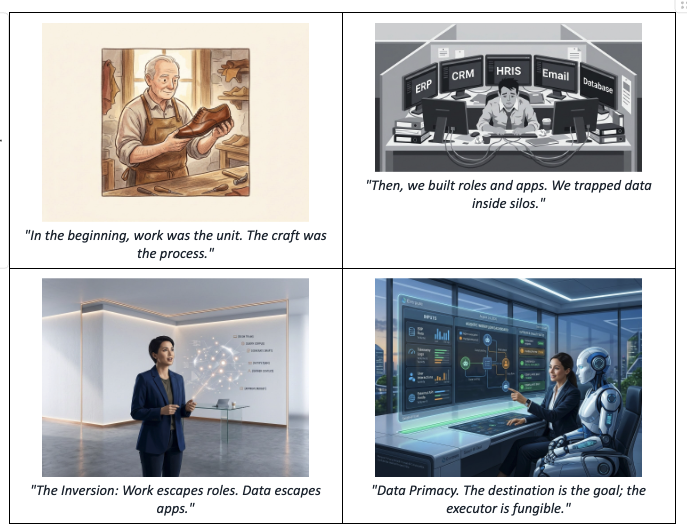
So what is the future of work, process, applications and data in the world of AI? Charles Giancarlo, our contributors and I share our observations and choices in this detailed analysis of the history of work going back to the craftsman, through the various eras of Data Processing, MIS, Information Technology, Information Security and AI & Data Primacy.
We make the case for Data Primacy and describe the thinking behind it and what you need to do to get started in adopting it.
You can find the full document here https://t.co/8jR7ELexVE
If you prefer the TLDR version which lays out step by step insights you can view that here. https://t.co/WMtfWWIugj
Charles Giancarlo and I have been colleagues and later friends pretty much from the day I landed in America in August of 1997. We have stayed in touch over what is now 30 years and for the last 11 we have worked together on the @zscaler board, and for 6+ years on the @EverpureData board. It was fun to work together on this post and gather the sum of our experience on either side of the country and also globally.
All feedback welcome and will be incorporated into future versions of this post or Part 2.
#DataPrimacy #AI #CEO #COO #OperatingModel #BusinessManagement
Big news: @CrowdStrike has signed a definitive agreement to acquire @zscaler, the pioneer of zero trust.
The endpoint is where the AI agent runs. The network is where it goes. After closing, we’ll secure both.
Welcome, @zscaler!
See important information: https://t.co/1kRAdzY406
Learn more: https://t.co/e8jKSMUJVe
@ScottGottliebMD the reason for the behavior you identify on measles / MMR is lack of trust caused largely by you and others pushing the COVID vaccines, whose side effects are dreadful. Now the pushback is a direct reaction to the psyop.
@CNBC when are you going to hold Scott and his friends accountable. @JoeSquawk tried last time he was on, but tbh, removing him from your programming and maybe replacing him with one of the doctors who were de-platformed during COVID might help provide some balance.
Today, the NIH released a landmark analysis showing high evidence of the human carcinogenity of glyphosate.
This evidence ensures the upcoming EPA review of glyphosate to move from “not likely to be carcinogenic to humans” (the sham finding currently drafted) to “likely to be carcinogenic to humans” as it is unprecedented (and highly legally problematic) for the EPA to go against NIH findings.
This new study from the NIH shows “sufficient evidence” (the highest evidentiary bar) of cancer in animals and “limited evidence” (the second highest bar meaning “studies show a positive association, and causation is credible.”) for humans. These represent definitive NIH assessments that are upgrades cancer risk from current levels.
It is unprecedented for the EPA to go against gold standard NIEHS findings in their review. If they keep the sham “not likely to be carcinogenic” conclusion, they would ensure the finding would be legally invalid (like the last one, where Bayer was found to ghost write research).
As I have said, there was tremendous pressure from the Senate and parts of the U.S. government including Nancy Beck at EPA to prevent this research from taking place. Nancy and other EPA staff attempted to work with industry and farm state senators to discourage research like this from taking place.
Early in the administration, Secretary Kennedy’s team instructed NIH to make sure gold standard science was robustly conducted.
With these findings, glyphosate meets every EPA criteria for a substance to be “likely carcinogenic to humans”:
✅A plausible link between human exposure and cancer, usually with supporting biological or experimental evidence, even if causation remains uncertain.
✅Positive animal findings across more than one species, sex, strain, tumor site, or exposure route, even when human evidence is unavailable.
✅A positive animal tumor study with features that heighten concern, such as highly malignant tumors or unusually early onset.
✅A rare tumor in a single animal experiment, where the response is assumed to be relevant to humans.
✅A positive tumor study reinforced by another line of evidence, such as a plausible human cancer link or evidence of a relevant biological process like DNA reactivity or altered control of cell growth.
I would note that senior leaders at the EPA told us the glyphosate review is already drafted and currently says the chemical is “not likely to be carcinogenic” - it is of course peculiar and notable the review is done before the comment period to consider evidence is complete.
The EPA now has a decision of whether to listen to the NIH (it would be unprecedented for the EPA not to follow the science of the U.S. government) or Nancy Beck (the pesticide industry lobbyist currently working at EPA to do whatever humanly possible to ensure the glyphosate review says the chemical doesn’t cause cancer - which is the top goal of her real boss @Bayer).
I like Lee Zeldin and trust he will do the obviously right scientific, legal, political and moral thing here. I think he understands the review would be invalid if they reject these decisive NIEHS findings and it would be disastrous for him politically to concede to the disgusting corporate capture of Nancy Beck - most of which hasn’t been disclosed.
I don’t know @PalmerLuckey and have never met him and i know people will mistake my next comment here as somehow agreeing with anything or everything he says, despite my comment having zero to do with that, BUT…I thought Palmer was by far the most impressive interview at @andrewrsorkin’s Dealbook conference last week.
https://t.co/b0uGyzcNHY
Great quotes Bobby... Seems that they ring true with people like Charlie Kirk and many others unfairly persecuted and prosecuted.
It's the 63rd anniversary of an event that happened in 1963, and I am 63 and I have 5/29 in common with JFK. I also have the Daily Record from the day of JFKs murder, the original documents from his inauguration and many other pieces of JFK memorabilia.
It's time to put this to right.
Continue to be the force for good we backed you to be, and after listening to Calley's interview on @joeroganhq show the whole world what you are made of in the next 2 years...
Here is a quote from a man who refused to back down from what he believed...
Today is the 63rd anniversary of my uncle’s assassination. Friday would have been my Dad’s 101st Birthday.
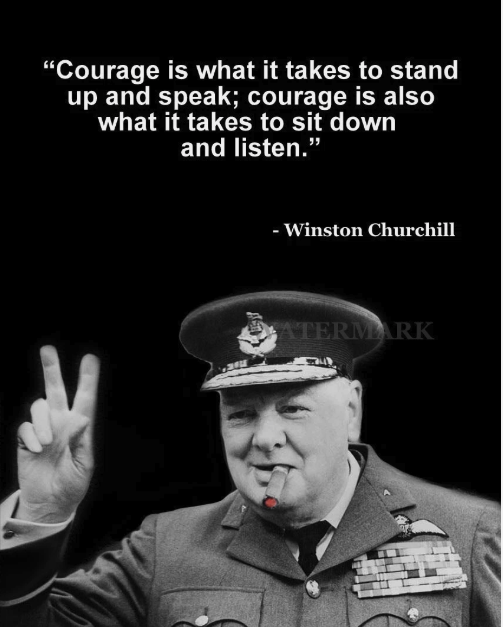
“A man does what he must—in spite of personal consequences, in spite of obstacles and dangers, and pressures—and that is the basis of all human morality.”
— John F. Kennedy, 1956
“Few men are willing to brave the disapproval of their fellows… Yet it is the one essential, vital quality for those who seek to change a world which yields most painfully to change.”
— Robert F. Kennedy, 1966
How the City of London runs the money for the globalists
In the middle of London there is a square mile that is not quite part of Britain.
The City of London has its own government, older than Parliament, its own Lord Mayor and its own police. It is the only place in the country where businesses vote in local elections, and the business votes outnumber the residents about two to one. It even keeps an official, the Remembrancer, who sits in Parliament to watch every law that might touch the City's interests.
There, in the late 1950s, the banks invented money without a country. Dollars held in London were outside America's rules and outside Britain's: the Eurodollar market. For the first time, enormous sums lived in no nation's jurisdiction.
Around the City grew a web of islands: Jersey, Guernsey, the Cayman Islands, the British Virgin Islands. British enough to be trusted, foreign enough to escape the rules. The money is booked on the islands and managed in London.
Today about 38% of all the world's currency trading goes through Britain, more than through New York. The City is the main switchboard of stateless money.
Who uses it? Everyone whose money does not want a homeland. Russian oligarchs, who made it "Londongrad". Kleptocrats from half the world. Multinationals that pay their taxes nowhere in particular. And the political class that owes loyalty to no nation – the globalists.
From the City, money became a tool of politics. In 2021, Mark Carney, a former Governor of the Bank of England, gathered banks holding tens of trillions in assets to align all their lending with net zero. No parliament voted for it. Credit was simply to flow to the approved and dry up for everyone else. And in 2023 one of the City's oldest banks closed Nigel Farage's account for his views. Permission is the currency, and the City issues the permission.
None of this needs a conspiracy. It is a structure. Money without a country serves people without a country, and the people who handle it end up thinking like them: rules are for nations, and nations are for the little people.
The structure also shows its weakness. When America turned against the climate cartel, the banks walked out one by one, and in 2025 the alliance shut down. Stateless money is strong only as long as states let it stay stateless.
So the answer is not to hate finance. It is to bring money back under the law of nations. Money that answers to no nation will naturally end up working against the nations.
If you listen to the secret societies speech again and again, you know that he (JFK) knew. He just didn’t know what lengths they would go to. His mistake was not staying covert. His brother knew. The great lie has been a strategy since November 22nd 1963. When Trump advocates say what JFK started, Trump is going to finish, that is not a prediction, it’s a promise! @RobertKennedyJr@SecKennedy Plenty of wood still to chop, but the light is shining through the trees.
Here's how the AI bubble bursting will make Elon Musk and SpaceX win.
Let's start with what Democrats figured out.
In the midterms, they won by running against data centers. Bernie Sanders wants a national moratorium. And they understood one thing: AI can't really be regulated anymore. The models are everywhere, many of them are open source, and they run on millions of machines.
But a bubble can be popped.
And today's AI sits on a mountain of debt. The labs lose more money than they make. Big Tech will spend over $800 billion on infrastructure this year, more than their businesses generate in cash. Lenders are getting nervous. Blocking data centers is aiming exactly where it hurts.
I think some of them have run the math, consciously or not.
First, superintelligence is going to become a commodity. Like an operating system. Like Linux. When ten models do the same thing and open source is six months behind, there's no moat at the model layer. Nobody pays a premium for intelligence that can be copied.
Second, value is going to move to infrastructure. Chips, energy, cooling, launch. The ones who own the atoms, not the ones renting someone else's.
And two players stand out. Google on Earth, with its own chips, its own cloud, and twenty years of ad money funding it all. And Elon Musk in space, with SpaceX, which absorbed xAI in February for one reason: to put compute in orbit, where the sun almost never sets.
Third, the two big labs, OpenAI and Anthropic, are the most exposed. Massive valuations, massive losses, rising debt. If the money stops flowing, they could go down.
So the logic is simple: if you can't regulate AI, starve it of capital. And if the American economy, which now leans heavily on that investment, goes down with it, so be it. When your power rests on scarcity, you'd rather have a recession than abundance.
But they forgot one thing.
A bursting bubble doesn't kill a technology. It kills the fragile.
In 2000, the dot-com bubble burst. https://t.co/vAW0rIhzhu shut down. Then WorldCom and Global Crossing went bankrupt. Amazon lost more than 90% of its value. Everyone declared the internet dead.
Twenty years later, Amazon is worth trillions, and the fiber laid by the companies that went bust carries the entire web.
The crash didn't kill the internet. It sorted the winners from the losers. And it handed the keys to the most antifragile.
This time will be no different. The labs living off fundraising will suffer. The ones who own the infrastructure will buy up assets at fire-sale prices and come out stronger.
And the most antifragile of them all is Elon. SpaceX has a business that runs without AI: launch and Starlink. And his bet is compute that needs neither the power grid nor a local building permit.
You can vote a moratorium in every county on Earth.
You can't vote one in orbit.
🚨BREAKING: President Trump, Putin and Xi just released a joint declaration after their HISTORIC trilateral — and it involves REFORMING THE UNITED NATIONS and DEGRADING globalist ICC influence
WOW!
The three leaders agreed to:
- Reform the UN so it actually serves its mission of peace and security
- Ramp up production and supply of refined petroleum for all nations
- Rein in the International Criminal Court and similar bodies from abusing their jurisdiction
- Open talks on reducing nuclear risks and stopping proliferation
They also reaffirmed that "a nuclear war cannot be won and must never be fought"
It was the FIRST-EVER three-way meeting between the leaders, running 1 hour+ at Kylin Villa
Secretary of State Marco Rubio has already vowed to "dismantle the ICC, piece by piece." 🔥
Now Russia and China are on board against it too...
President Trump is getting it done for us!
@EricLDaugh 🔗
🚨ALERT🚨
@CaptKylePatriots
On Telegram
(with an s)
@CaptKylePatriot
On X
(without an s)
@BeckyQuick@JoeSquawk It is totally for real. Fool me once shame on you, Fool me twice shame on me. I think we are at about 20 causes of serendipity that are public…After a while that is not serendipity. Anyone who has worked in the tech world for more than 5 minutes knows what is happening here. You probably think I am just a Joe on X, Maybe look me up.
“Patching is causing the disturbance” … really?
Clearly Patchgeddon is real and is causing a lot of trouble. Read the embedded post though to really understand. The question in the NSA hack is not whether they were penetrated, but what was exfiltrated. PS that is the question in EVERY CASE.
Jay Clayton is great, amazing actually, but he is not a cyber expert. Bring on someone from @THG_Global to talk to your audience, like their CEO. The average age of a cyber criminal is 19. NINETEEN.
I haven’t lived here in awhile, but I see no other way to answer the hundreds of texts/DMs asking me if the world is, indeed, ending.
In the span of six days, we’ve experienced;
11/12 — Microsoft outage
11/13 — Nationwide FAA ground stop
11/16 — Major US banking disruptions
11/17 — NSA’s classified internal network goes down
We need far more analysis of why so much is breaking at once. I don’t want to get out over my skis here, and what I am hearing does not contradict the messaging that most of this is the result of screwy updates.
But stepping back, the dots are starting to form a collective picture. We are seeing:
• An explosion in severe and critical vulnerabilities, with AI accelerating discovery to 3X the number of vulnerabilities discovered in the same period last year. This is collectively being referred to as “vulnageddon” or “the vulnpocalypse.”
• Mean time to exploit those vulnerabilities has collapsed to NEGATIVE SEVEN DAYS. AI allows attackers to find/exploit vulns far faster than software makers have time to fix them.
• Powerful AI-enabled offensive tools like ARTEX have been thrown into the hands of every third tier nation state, cybercriminal and digital arsonist, which logically creates havoc.
• This creates enormous pressure to compress patching windows and accelerate software updates, increasing the likelihood these fixes break things in unexpected, cascading ways.
• Pressure to just “AI everything” means we are rolling out automated AI tooling on top of brittle infrastructure that can’t support it.
My generation grew up in an extraordinary period of technological stability. We worked our way up the software stack, abstracting away layer after layer, until we lost a fundamental understanding of how the underlying systems actually work.
We were told to “move fast and break things.” VCS told us to celebrate the idea that “software would eat the world.” Now we’re telling ourselves we can simply “roll out AI” across everything, as though nothing underneath will buckle.
We never stopped to ask: SHOULD WE?
Should we be digitizing every last nook and cranny of our companies, infrastructure, healthcare, homes, cars, bodies, lives? Especially when the complexity, interdependence, and fragility we were introducing overwhelmed our ability to understand/secure/maintain the systems we built?
Nobody every asked: What if, in the name of progress, we were creating the ripest attack surface in human history?
We are now entirely dependent on software systems that almost nobody understands end to end, that increasingly few people can repair, and that attackers can now probe at machine speed. We are hearing that incident response firms, the 911 for breach victims, are backlogged six months. Even those paid on retainer lack the bandwidth to triage every incident. The cavalry is disappearing.
We are entering a period of unprecedented technological instability.
“Software Beirut” is an incredibly apt analogy. We are in for a period of cascading failures, whether triggered by attackers, bad updates, or our own accumulated complexity.
This, I’m sorry to say, is just the opening chapter.
Scott Bessent's team pleaded with The Wall Street Journal not to put photos of his home out there, but they did it anyway.
Now he's had to move onto a military base after threats from Iran.
The editor-in-chief who signed off on it is Emma Tucker.
Absolute scumbag.
Instead of attacking a duly elected president, with two years left to serve, how about you do something constructive for the American people. If the best you’ve got is more lawfare and this kind of vitriol your reputation will never be what it could have been. History won’t remember you fondly; it will reflect on what you could have done if you had been a leader instead of a detractor.