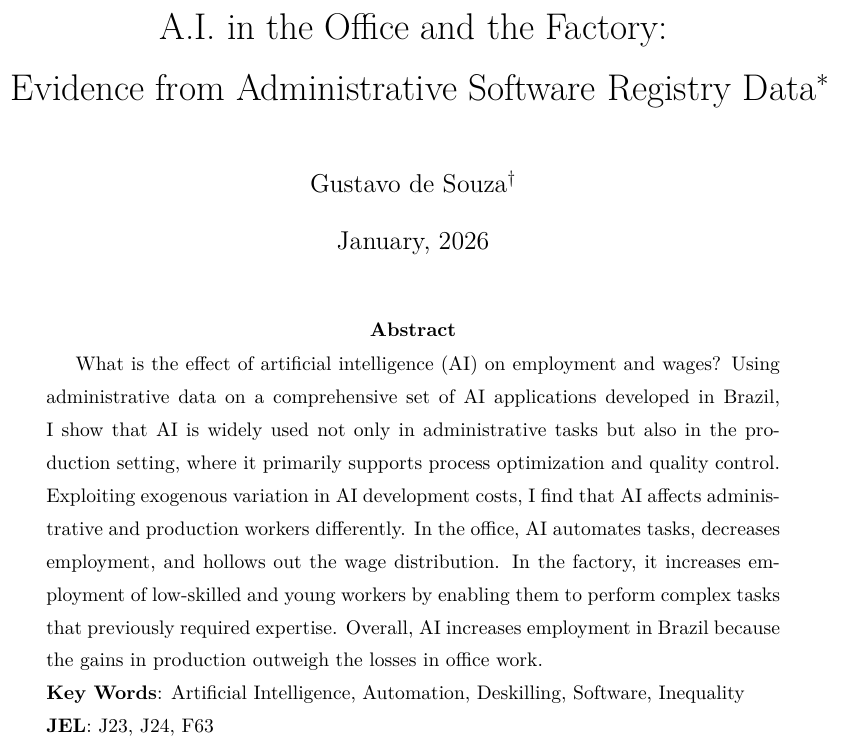
🚨New WP🚨
I used to think AI would replace workers.
Studying a database with the near universe of commercial AI (including GenAI + factory, and office tools) I found the opposite:
AI increases employment by giving low-skilled workers expert knowledge.🧵
The @UChi_Economics rule is 2 minutes per slide. Mike Golosov also added that each slide should have at most four bullets. I found this rule to only be viable at @UChi_Economics . Audiences show a wide range of interaction, most way below the Uchicago level. So I follow this rule:
- each slide should have only one idea, at most four bullets, and a bullet can never break a line
- if I know that the audience wants interaction, I follow the Uchicago gold standard
- if I am uncertain, I do one minute per slide and adjust during the talk.
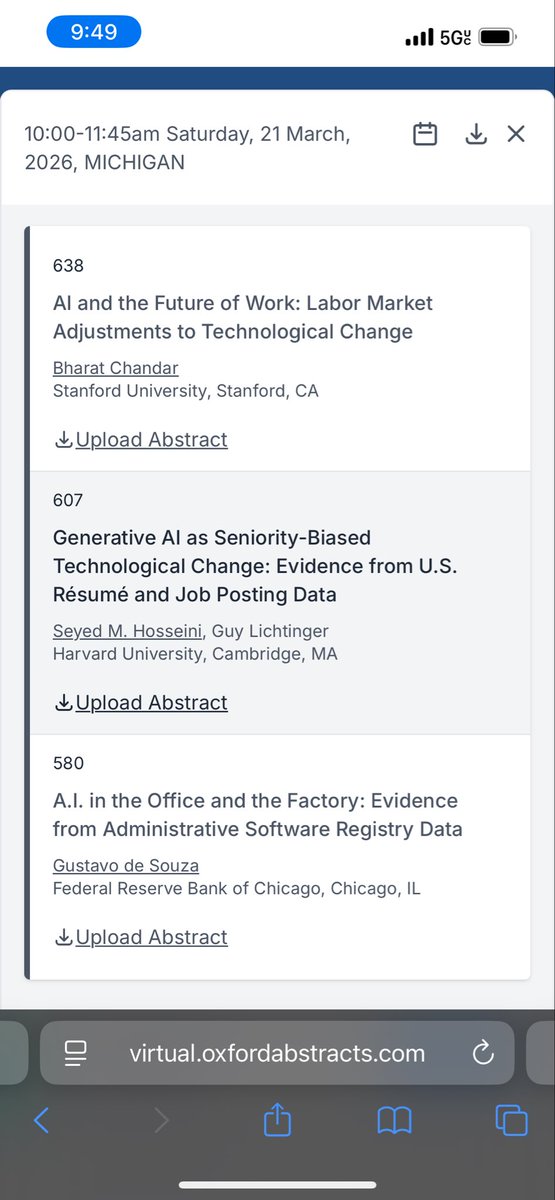
Excited to share the program for our third AI in Finance Conference on June 8 at the University of Maryland - Robert H. Smith School of Business!
https://t.co/M5fEXz3npZ
Grateful to our amazing paper review team, all the authors who submitted their work, and the discussants.
This week, I am visiting Hong Kong to present my paper on the effects of AI at @HKUniversity, @hkust, and @CUHKofficial.
Come to my talk to hear how and why AI is increasing employment.
I don't know (or care) what makes one person win a Nobel and another not.
But I know what doesn't: AI generated text. AI-generated text is not only repetitive; it is also soulless. “Not only this, but also that” is not how people talk.
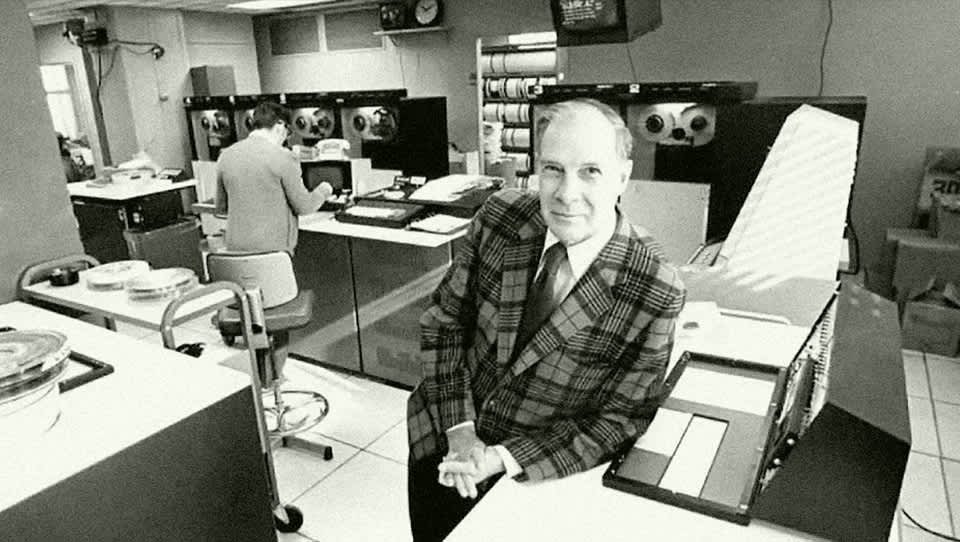
Also, Richard Hamming could never have concluded that open doors predicted success at Bell Labs. Bell Labs had a famous open-door policy. All researchers had to keep their doors open at all times to invite interaction with colleagues.
A mathematician who shared an office with Claude Shannon at Bell Labs gave one lecture in 1986 that explains why some people win Nobel Prizes and other equally smart people spend their whole lives doing forgettable work.
His name was Richard Hamming. He won the Turing Award. He invented error-correcting codes that made modern computing possible. And he spent 30 years at Bell Labs sitting in a cafeteria at lunch watching which scientists became legendary and which ones faded into nothing.
In March 1986, he walked into a Bellcore auditorium in front of 200 researchers and told them exactly what he had seen.
Here's the framework that has been quoted by every serious scientist for the last 40 years.
His opening line landed like a punch. He said most scientists he worked with at Bell Labs were just as smart as the Nobel Prize winners. Just as hardworking. Just as credentialed. And yet at the end of a 40-year career, one group had changed entire fields and the other group was forgotten by the time they retired.
He wanted to know what the difference actually was. And he said it wasn't luck. It wasn't IQ. It was a specific set of habits that almost nobody is willing to follow.
The first habit was the one that hurts the most to hear. He said most scientists deliberately avoid the most important problem in their field because the odds of failure are too high. They pick a safe adjacent problem, solve it cleanly, publish it, and move on. And because they never swing at the hard problem, they never hit it. He said if you do not work on an important problem, it is unlikely you will do important work. That is not a motivational line. That is a logical one.
The second habit was about doors. Literal doors. He noticed that the scientists at Bell Labs who kept their office doors closed got more done in the short term because they had no interruptions. But the scientists who kept their doors open got more done over a career. The open-door scientists were interrupted constantly. They also absorbed every new idea passing through the hallway. Ten years in, they were working on problems the closed-door scientists did not even know existed.
The third habit was inversion. When Bell Labs refused to give him the team of programmers he wanted, Hamming sat with the rejection for weeks. Then he flipped the question. Instead of asking for programmers to write the programs, he asked why machines could not write the programs themselves. That single inversion pushed him into the frontier of computer science. He said the pattern repeats everywhere. What looks like a defect, if you flip it correctly, becomes the exact thing that pushes you ahead of everyone else.
The fourth habit was the one that hit me the hardest. He said knowledge and productivity compound like interest. Someone who works 10 percent harder than you does not produce 10 percent more over a career. They produce twice as much. The gap doesn't add. It multiplies. And it compounds silently for years before anyone notices.
He finished the lecture with a line I have never been able to shake.
He said Pasteur's famous quote is right. Luck favors the prepared mind. But he meant it literally. You don't hope for luck. You engineer the conditions where luck can land on you. Open doors. Important problems. Inverted questions. Compounded hours. Those are not traits. Those are choices you make every single day.
The transcript has been sitting on the University of Virginia's computer science website for almost 30 years. The video is free on YouTube. Stripe Press reprinted the full lectures as a book in 2020 and Bret Victor wrote the foreword.
Hamming died in 1998. He gave his final lecture a few weeks before. He was 82.
The lecture that explains why some careers become legendary and others disappear is still free. Most people who could benefit from it will never open it.
New CEPR Discussion Paper - DP21386
More Trade, Less Diffusion: Technology Transfers and the Dynamic Effects of Import Liberalization
Gustavo de Souza @GusMicrotoMacro@ChicagoFed, Ruben Gaetani @ruben_gaetani@econuoft@UofT, Marti Mestieri @bse_barcelona
https://t.co/57U2g0ajcv
#CEPR_ITRE #CEPR_MG #EconTwitter
Before you have that rejection needlessly ruin your day, remember this:
“You have power over your mind - not outside events. Realize this and you will find strength”.
“When you arise in the morning, think of what a precious privilege it is to be alive-to breathe, to think, to enjoy, to love,” and to have Claude doing all the hard coding for you.
A sweeping account of the origins of wealth & inequality
“Unparalleled in its scope and ambition” — Washington Post
“An optimist’s guide to the future” — The Guardian
“A sweeping overview…reminiscent of Sapiens” — FT
“A great historical fresco” — Le Monde
Int’l Bestseller
Best Philosophy and Ideas Books 2022 — The Times
Yaesu Book Award 2023 (Grand Prize) — Japan
Author of the Year 2022 — CITIC Publishers, China
“Masterful” — Lewis Dartnell
“Completely brilliant and utterly original” — Jon Snow
“Astounding in scope and insight” — Nouriel Roubini
“A page-turner, a suspense-filled thriller, mind-bending puzzles and profound insights!” — Glenn Loury
I am happy that the paper was finally published. It was a long and arduous journey since I first started working on this idea.
Economics is about humans making choices. I want to tell you about the humans that inspired this paper and the humans that wrote it.
The idea came from an odd couple: my friend John and the Brazilian president Dilma Rousseff.
John didn't really like his job. He devised an audacious plan: do poor enough work to get himself fired, collect unemployment insurance, and chill at home playing FIFA.
Sadly for John, he didn't factor in the whims of President Dilma. Elected under the promise of not cutting labor protections, she implemented a plan that reduced unemployment benefits and tightened eligibility requirements. When John finally got fired, he didn't qualify. In our circle of friends, that story never gets old.
That kept me thinking: how should a government choose its unemployment insurance requirements? I reviewed the literature and studied the practice in other countries.
I found two very interesting facts. The US not only has a tenure requirement, like the one that excluded John, but also a monetary requirement that removes eligibility from workers who make too little money.
At first, excluding those who need benefits the most sounded outrageous. I couldn't find any research documenting the harm of such an anti-poor policy. So me and @avdluduvice took it upon ourselves to show it.
We wrote down a model of — well — John's behavior. Agents choose to work or not while facing random income shocks. If someone stops working, the government can't tell if it was a quit or a layoff, kind of like what John was hoping. The government's problem is to design unemployment insurance to maximize agents' welfare. Strict requirements give less protection but make it harder for people to engineer their own firing just to collect benefits and play FIFA. So the government faces a clear trade-off, which force dominates is an empirical question.
So I went to the data. I hand-collected historical unemployment requirement data for the US. There was no AI at the time, so all of it was done by human ctrl+c ctrl+v intelligence buried in old government reports. At @UChicago, that earned me the title of Ghost of the Basement 👻: https://t.co/OL02dm59J0
Here's what we found. When a state introduces a tenure requirement, workers hop between employers more and are more likely to become part-time, which is consistent with people staying in the job market just long enough to become eligible to UI. The monetary requirement had the opposite effect: workers became less likely to switch jobs or go part-time, consistent with those jobs being less attractive since they no longer come with UI coverage. The data showed that UI requirements matter not only to John.
Using those elasticities to validate the model, we found that the monetary requirement plays an important role, contrary to my initial beliefs. UI increases workers' incentives to accept any job, including ones they'd otherwise turn down. To correct this distortion while still providing insurance, the optimal policy is to exclude low-paying jobs from UI eligibility. This force dominates for two reasons: it reduces the cost of UI, and it creates incentives for workers to search longer for better jobs.
The International Economic Review has just published a new exciting paper by Gustavo de Souza and André Victor Luduvice on Optimal Unemployment Insurance Requirements. It is available through @WileyEconomics here: https://t.co/ZDBviqKbwu
@joshgans If these tools replace routine tasks and complement decision making, isn’t it natural that people with less decision making skills and tasks, like PhD students, will use them less?
I have a history of science anecdote to answer that.
In the 80s, most AI research was concentrated in symbolic AI and expert systems. Only a handful of researchers were working on neural networks. Geoffrey Hinton (@geoffreyhinton), now a Nobel Prize winner, was one of them.
When expert systems failed to deliver tangible results, funding for AI research dried up in the US. This became known as the AI Winter.
Geoffrey moved from the US to the University of Toronto because of this funding cut and, according to @CadeMetz in the brilliant book Genius Makers, his wife's desire to leave the US.
In 2012, he co-authored the AlexNet paper, showing that neural networks vastly outperformed every other method in image classification. Shortly after, he sold his startup to Google for $44 million.
AlexNet and breakthroughs happening elsewhere, led to the AI boom, creating strong demand for AI scientists and people with hands-on experience in neural networks.
With so much of this happening in Toronto, the city developed a startup and research culture around neural networks. Keep in mind: for many years, only a select few universities were doing serious AI research.
I imagine all of this got "in the air" (@joshgans) and spilled over into economics.
I don't know how much of this anecdote is true. But it is nice to think that ideas diffuse beautifully like that. It is also interesting to think that a flap of a butterfly's wings, or someone's wife wanting to leave the US, can spark such cascade of events.
This is my overall take on research: follow your calling. Write a paper that only you could have written.
Each of us is a unique, complex individual. We have our own experiences, knowledge, curiosity, interests, fears, loves, and traumas. These rich personal idiosyncrasies, if well channeled, can translate into a new angle on any topic.
If it’s a question someone else could have answered, in a way someone else could have done it, written as someone else would have written it, LET SOMEONE ELSE DO IT. That is not your calling.
There is something out there, in the space of all knowledge to be gained, that only YOU could have taught the world. Your mission is to find that and teach us. And I, honestly, look forward to that.
what's your advice for PhD students thinking about doing research on AI's economic impacts?
Where are the blue oceans (opportunities)?
Any red oceans (bloodbaths) to avoid?
Just published: Cleveland Fed economist paper “Optimal Unemployment Insurance Requirements” was published at the International Economic Review. https://t.co/CBU9fQEHPh
What amazing times to be alive!
You can come up with an instrument while listening to an audiobook in the gym, figure out how to implement it between reps, and see the three stars just before lunch.
What amazing times to be alive!
💻 Free online lecture: Present and future of industrialisation
On Tuesday March 10th (15:00 GMT), Tristan Reed, @RodimiroRodrigo, @GusMicrotoMacro, and @mposchke will cover the present and future of industrialisation.
Register here: https://t.co/I0wVTgxPDl