Most AI tutorials teach agents like this:
«install framework
write prompt
run demo
done»
That’s not how serious builders learn.
ai-agents-from-scratch is interesting because it focuses on something much more valuable:
«understanding the mechanics.»
And honestly…
the people getting good at AI fastest right now are usually the ones learning:
«how systems work underneath.»
Not just how to use tools.
Because agent systems are becoming layered fast.
You now need to think about:
«memory
tool use
planning
context
execution loops
verification
orchestration»
That’s very different from:
«chat with model.»
The useful shift:
A lot of beginners still think AI agents are:
«prompts with tools.»
But once you build them yourself…
you realize agents are mostly:
«systems.»
That’s where things get interesting.
Because the hard problems usually aren’t:
«getting a response.»
They’re:
«state management
context handling
failure recovery
tool coordination
execution reliability»
That’s real engineering.
Hot take:
The biggest gap in AI right now is between:
«people using agents»
and
«people understanding how agents actually work.»
That gap is becoming valuable.
Because AI is slowly moving from:
«consumer tools»
toward:
«programmable infrastructure.»
And once that happens…
understanding the underlying architecture becomes leverage.
Not optional knowledge.
Feels a lot like the early web.
Most people used websites.
A smaller group learned how the stack actually worked.
Guess who built the next wave.
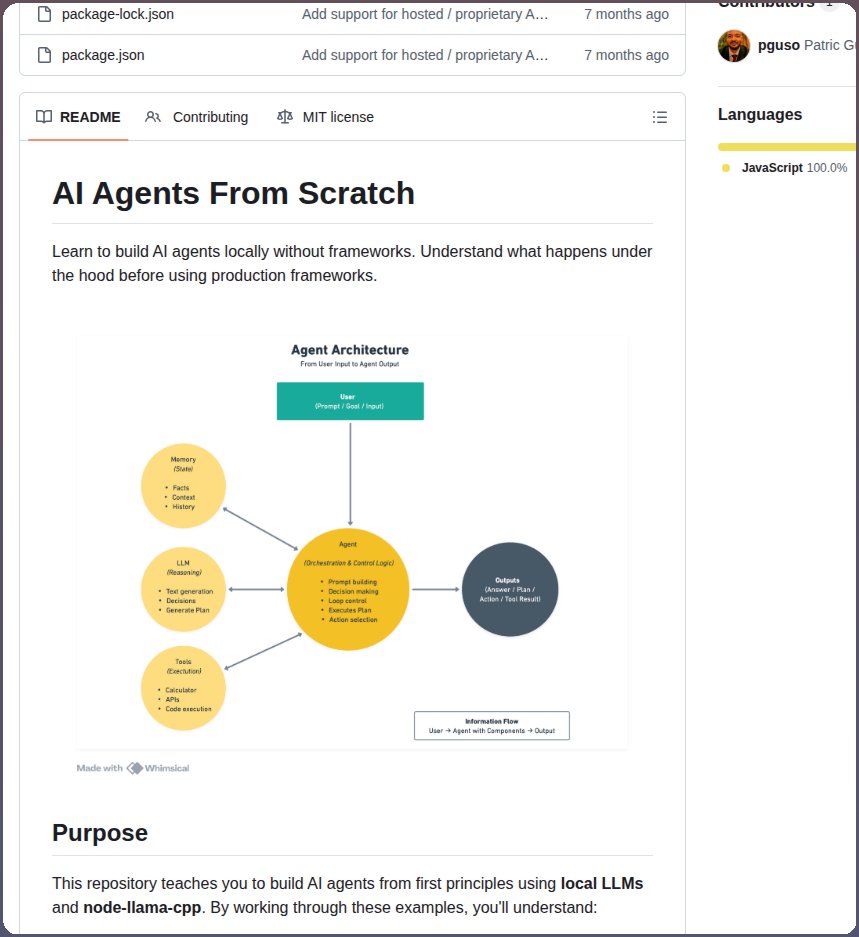
Teaches building AI agents from first principles.
Most AI tutorials skip straight to frameworks.
This one starts from zero and shows how agents actually work internally.
Tool use, memory, planning, reasoning loops — everything explained step by step.
Perfect if you want to actually understand AI agents instead of blindly using wrappers.
https://t.co/wfboSqe9l0
Local-first AI agents without the cloud dependency.
pguso/agents-from-scratch: build AI agents from scratch - no API calls, no latency, runs entirely on your machine.
Perfect for privacy-sensitive workflows and offline dev.
https://t.co/BCNts82Sac
AI Agent 从小白变大神进阶神器
https://t.co/yFwQcngsbp
这就是 ai-agents-from-scratch,3.9k star 爆款「真正把 AI Agent 讲明白」的开源教程项目!它不是又一个封装好的 Agent 框架,而是手把手教你从零开始自己造 Agent,用本地 LLM + Node.js,把 LLM + System Prompt + Tools + Memory + Reasoning Pattern 所有核心部件全部拆开给你看,一步步从最基础写到 Tree of Thought、Graph of Thought、ReAct、AoT 等高级模式,彻底告别黑盒!
MOST DEVS USE AI AGENT FRAMEWORKS WITHOUT UNDERSTANDING WHAT'S HAPPENING INSIDE
This repo teaches you to build agents from scratch local llms, no black boxes, real understanding
14 hands-on examples covering everything:
▪️ function calling & tool use
▪️ persistent memory across sessions
▪️ react pattern (reason → act → observe)
▪️ tree of thought, graph of thought, chain of thought
▪️ atom of thought planning
▪️ error handling with retries and fallbacks
each example has code + a CODE.md explaining what every line does + a CONCEPT.md explaining why it matters
the philosophy: learn by building understand deeply, then use frameworks wisely
https://t.co/pC9ff18VQd
🤖 voice-agents-from-scratch
⭐ 29 stars
Ditch the wrappers. Build a real-time voice agent from scratch: Mic ➡️ STT ➡️ LLM ➡️ TTS ➡️ Speaker, using local Python models and explicit streaming.
🔗 https://t.co/8mH2i84f2F
#AI#MachineLearning
@alnbkrgrdnguru@EileenMarieSar1 Educate yourself and watch the documentary on Netflix The great hack. It’s also about how Cambridge Analytica helped Trump to manipulate his first election with data driven social media campaigns.
@DesireeAmerica4 Your point is valid. I just find it very funny that you make a video after you bought their stuff, saying that we shouldn’t support them. That’s very contradictory 🤨
Do not listen to this, no one needs to be scared. Things change. Maybe at the moment the demand for devs is not as high as it used to be. But it’s naive to think that everything always stays the same. Find your way, there are still plenty of successful devs in traditional programming and in ai…
@Adriksh You should take into account, that there was a significant change. I was there in the golden rush, when companies couldn’t hire enough devs and the demand was high. Now everything is different. There is still some demand, but you need to have connections!
@heyshrutimishra Very nice review. Claiming „Everything runs locally on YOUR machine.“ is wrong if Claude is involved in every action. Would have loved this tool if your claim would be true and nothing is shared with the cloud. That would be such a game changer!
Hilarious! In Germany the same applies. I was working as a it consultant for a big company a while ago and there I learned it’s so true that it’s more about how people perceive your value you bring to the company, then the value you actually deliver.
I had a college he always sounded as he is always solving the most difficult problems and always goes the extra mile. And even I was impressed. And then I silently checked his work using git commits and I was shocked and impressed. He actually didn’t contributed anything to solving problems. In one instance he just added some white space and restructuring. Someone else silently solved what he was claiming he did. He was talking very positively in a political way all sound amazing but there was no actual content.
Everyone loved him. The leaders of the project thought he is the most important part in projects. Technically he was not got, but he could explain technical details in a way everyone understood and he could always verbally contribute something valuable. While contributing not much for the job he actually got hired for as a full stack dev.
So what you said is so true. Play the game right and you get what you want and don’t need to invest your energy on high level.
I was the quite contributor, learning stuff for work at the weekend and investing silently all I had to become better. No one cared much, I was just perceived as someone who is doing his job. Then in another company I started to be close to the right people and got visible and stayed overhours when everyone saw it. But in general I took it much more easy then before. And they praised me, more then others that contributed more technical value at that point.
I think when you start in a field as I do know as ai product engineer first you need to work hard and solve problems. But also be social and close to the right people and later you need to play the game in some variation as you explain to level up
Die Regierung wird oft gelobt, weil sie angeblich Familienwerte hochhält. Was dabei übersehen wird: Viele Familien kämpfen ums nackte, oft einsame Überleben.
Und nein, ich erwarte nicht, dass jeder, der diese Zeilen liest, meiner Meinung zustimmt. Ich lade vielmehr jeden ein, der in Ungarn lebt oder hierherkommt, auf diese Punkte zu achten und die Augen zu öffnen.
Verschließt euch nicht in eurem eigenen „Wohlstand“. Schaut auf die Realität – nicht, um sie zu hassen, sondern um sie zu erkennen. Es gibt viele Menschen in Ungarn, die Wahrheit, Mitgefühl und Solidarität verdienen. Keine verklärte Ignoranz.
Schau hin.
Und trage zur Veränderung bei.
Ungarn – das glorreiche Land zum Auswandern?
Ich lebe nun seit einer Weile in Ungarn. Das war ursprünglich nicht der Plan. Ich hatte hier ein Ferienhaus und habe mich in eine Ungarin verliebt. Wir beide haben eine sehr nüchterne, realistische Sicht darauf, was das Leben in Ungarn bedeutet. Umso öfter begegnen wir Deutschen, die Ungarn als das „heilige Land“ lobpreisen und Viktor Orbán beinahe als Messias darstellen.
Ich sage meist nicht laut, was ich denke. Stattdessen fühle ich mich oft hilflos und frage mich im Stillen: Setzt sich ein Deutscher, der nach Ungarn kommt, überhaupt mit der Realität auseinander – oder ist der Frust auf Deutschland so groß, dass hier automatisch alles „besser“ erscheint?
Ich liege gerade im Krankenhaus in Kecskemét und bin direkt mit der Realität des ungarischen Gesundheitssystems konfrontiert. Manche Ungarn sagen, man könne genauso gut auf der Straße sterben, bevor man freiwillig in ein Krankenhaus geht. Das ist hart formuliert – aber teilweise wahr.
Kecskemét gilt als relativ wohlhabend, vor allem wegen des großen Mercedes-Werks. Entsprechend ist hier vieles besser als in anderen Städten. Von „gut“ kann man dennoch nicht sprechen.
Mein Hausarzt schickte mich in die Notaufnahme, weil mein EKG starke Unregelmäßigkeiten zeigte. Also ging ich hin. Die Schwester meiner Freundin ist Ärztin, weshalb ich nicht lange warten musste. Ich wurde relativ schnell untersucht und an den Tropf gehängt. Eine mögliche Ursache sei, so sagte sie, ein Herzinfarkt.
Nach etwa vier Stunden kam die Kardiologin. Es war kein Herzinfarkt, vermutlich eine Entzündung nach einer COVID-Infektion. Sie riet mir, im Krankenhaus zu bleiben, da nur eine intravenöse Behandlung helfen könne.
Ein Tag später ist nichts weiter passiert.
Stattdessen sehe ich alte Menschen, die stunden- oder tagelang auf Betten in den Gängen liegen, in teils bedenklichem Zustand, ohne erkennbare Fürsorge. Toilettenpapier oder Seife auf den Toiletten: Fehlanzeige. Von der Hygiene, wie man sie aus deutschen Krankenhäusern kennt, ist wenig zu sehen. Eine Pflegerin drückt mir meine Ibuprofen ohne Handschuhe einfach in die Hand.
In den privaten Räumen wird laut gelacht, lange und herzlich – selbst um vier Uhr morgens, ohne Rücksicht auf die Patienten. Mehrmals habe ich hier Deutsche getroffen, die mir sagten, sie gingen für medizinische Behandlungen grundsätzlich zurück nach Deutschland.
Eine andere, vielleicht noch dramatischere Realität ist der Wohlstand – oder besser gesagt: dessen Fehlen.
Ich halte mich häufig in einem kleinen Ort nahe des Tisza-Sees auf. Wohin man blickt, sieht man halb oder völlig verfallene Häuser, in denen noch immer Familien leben. Teilweise ohne Strom oder Heizung. In einem Land, in dem es im Winter regelmäßig minus 15, manchmal sogar minus 20 Grad hat.
Und das sind in der Regel Menschen, die arbeiten. Dennoch reicht es nicht einmal für die grundlegenden Dinge des Lebens.
Auf den Straßen sieht man unzählige herrenlose Tiere. In Kecskemét begegnet man vielen Obdachlosen oder Menschen, die betteln, weil der Lohn vorne und hinten nicht reicht.
Junge Ungarn verlassen das Land in großer Zahl – oft sehr widerwillig. Sie lieben ihr Land, sie wollen bleiben. Doch sie sehen klar, dass ihre eigene Zukunft und die ihrer Kinder unter den gegebenen Umständen alles andere als einfach ist.
Welche Realität daran ist „wundervoll“?
Für Deutsche mit vergleichsweise wenig Geld – das hier dennoch viel mehr ist als das, was viele Ungarn besitzen – wirkt Ungarn oft wie ein Paradies. Häuser für 20.000 bis 50.000 Euro, manchmal echte kleine Juwelen in kleineren Städten. Das ist verlockend.
Was dabei oft nicht verstanden wird: In anderen osteuropäischen Ländern, in denen es den Menschen deutlich besser geht – etwa in der Tschechischen Republik – bekommt man für solche Preise längst kein Haus mehr. Wohlstand ist in Ungarn nur in begrenzten Teilen der Gesellschaft zu finden. Armut dagegen sehr häufig.
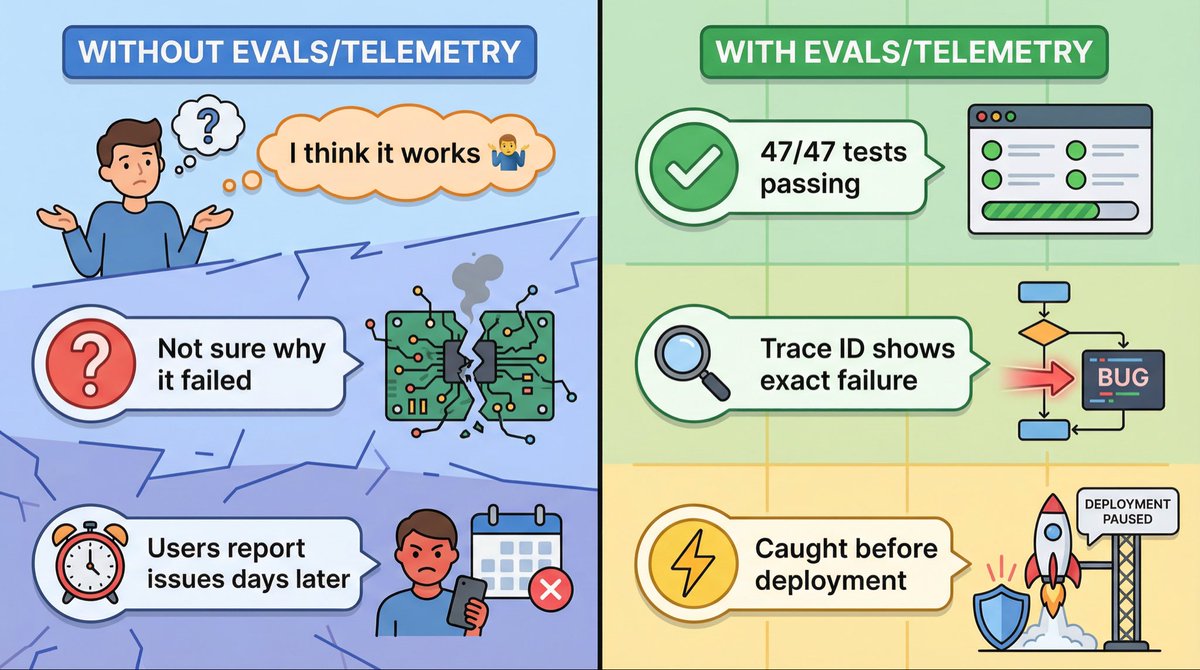
The Two Questions Every Agent Needs to Answer:
Before deployment: "Does it still work after I changed it?"
→ This is evals (Lesson 11)
After deployment: "What went wrong?"
→ This is telemetry (Lesson 12)
Most tutorials only show you how to build agents.
Few show you how to prove they work and understand their behavior.
I just added both to my Agents From Scratch repo.
Because an agent you can't test or debug isn't production-ready.
https://t.co/KeZfZWgj5J
#AIEngineering #ProductionML #Agents #SoftwareEngineering #AI #QualityAssurance #LLM