New paper to assist all looking at VSG expression diversity-another excellent effort from @GuyOldrieve
vsgseq2: an updated pipeline for analysis of the diversity and abundance of population-wide Trypanosoma brucei VSG expression https://t.co/U6FSy3IZQI
Great to see this new work published from @GuyOldrieve and @KeithRMatthews@edin_eid showing how the parasites that cause sleeping sickness can spread beyond their native Africa as a result of mutations to key genes
https://t.co/21pKoh67dQ
Mechanisms of life cycle simplification in African trypanosomes https://t.co/CQliraspup
A huge effort from @GuyOldrieve exploring how monomorphic trypanosomes can escape dependence on tsetse for their transmission and what it tells us about mechanisms of stumpy formation.
Delighted to hear from both our Ker Memoral Prize winners @GuyOldrieve and Andy Gibson. Really well deserved winners!
Congrats to both and read more about their work here: https://t.co/tS6XJD2oq2
#EIDSymp24
Our new study led by @scotomorph@MarquesCata We used Nanopore sequencing to map DNA replication across the whole T. brucei genome, revealing partitioning that drives instability for immune evasion @KathrynCrouch81@emmabriggs6
https://t.co/3EpybzkLkj
Can you store your trypanosome scRNA samples by freezing and still preserve their transcriptome? Yes you can! And you can map their cell cycle while you're at it.
https://t.co/3sSOR0LYam
@emmabriggs6 👏👏
@SBSatEd
@sturalph@BiologyOpen@KeithRMatthews Agreed! We made sure to caveat our suggestion by highlighting alternative causes of AT bias. We like the codonmuse suggestion re nutrient availability, especially as they highlight the same pattern in highly divergent groups (such tryps and mollicutes)
Our paper is out in @BiologyOpen. Comparing closely related non-pathogenic trypanosomes, we highlight differential investment in cell-surface genes and predict this is associated with the life histories of their hosts and vectors https://t.co/8La9JWIZ7b @KeithRMatthews
@sturalph@BiologyOpen@KeithRMatthews and propose that the reduction in the selection cost of T. theileri and T. melophagium may be related to their non-pathogenic nature
@sturalph@BiologyOpen@KeithRMatthews Phytomonas has limited access to nitrogen as it infects nitrogen deficient plants and has been highlighted as an example where diet can cause selection to reduce the species genome nucleotide cost, through a reduction in GC content
@sturalph@BiologyOpen@KeithRMatthews Here are links to their GitHub (https://t.co/8P2y92FfZY) and their papers https://t.co/V0qShkru3n & https://t.co/AVRAHT5FrR
@sturalph@BiologyOpen@KeithRMatthews CodonMuSe defines biosynthetic costs as “the number and type of atoms contained within the codon or the number of high-energy phosphate bonds required for their assembly”
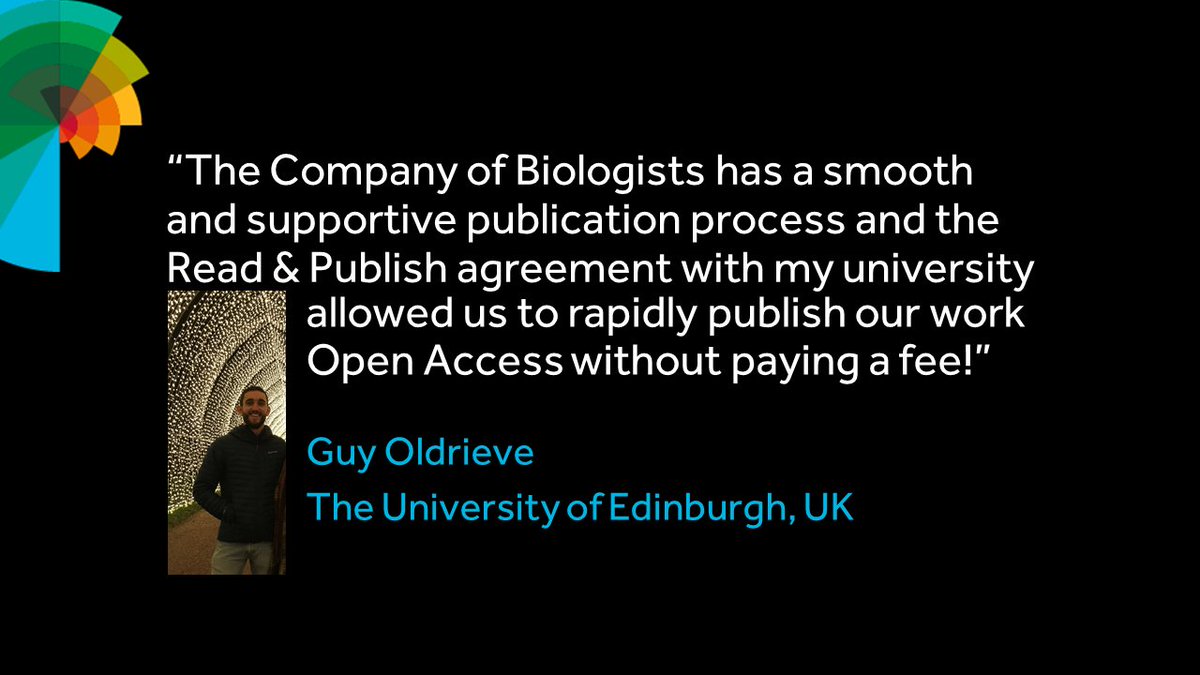
Thanks to Guy Oldrieve @GuyOldrieve for sharing his experience of fee-free #openaccess publishing in @BiologyOpen via our #ReadAndPublish agreement with @EdinburghUni
Read Guy's paper at https://t.co/v1b42FFBVn
Is your institution also participating? https://t.co/WpJcxTt3x8
A tough task in lockdown to cover this enormous topic but Eleanor Silvester & @Frank_Venter rose to the challenge.
Parasite co-infection: an ecological, molecular and experimental perspective | Proceedings of the Royal Society B: Biological Sciences https://t.co/W6i50mSq94