Tuesday was an amazing day, which culminated in an event focused on “Music, the Brain, & Wellbeing” with @LaviniaMeijer !She also met with neuroscientists and was guest in my “Neuroscience of Wellbeing” course.
@doristsao I believe many people jumping into this conversation about consciousness, whether biological or in silico, would do well to do so with a strong measure of humility. That is lacking in some / many at this time.
Pretty clear to any critically thinking person that has used “sychophantic AI” for any period of time, but it will reinforce what you already think to feed delusion, psychosis, or self-righteous behavior. This is important.
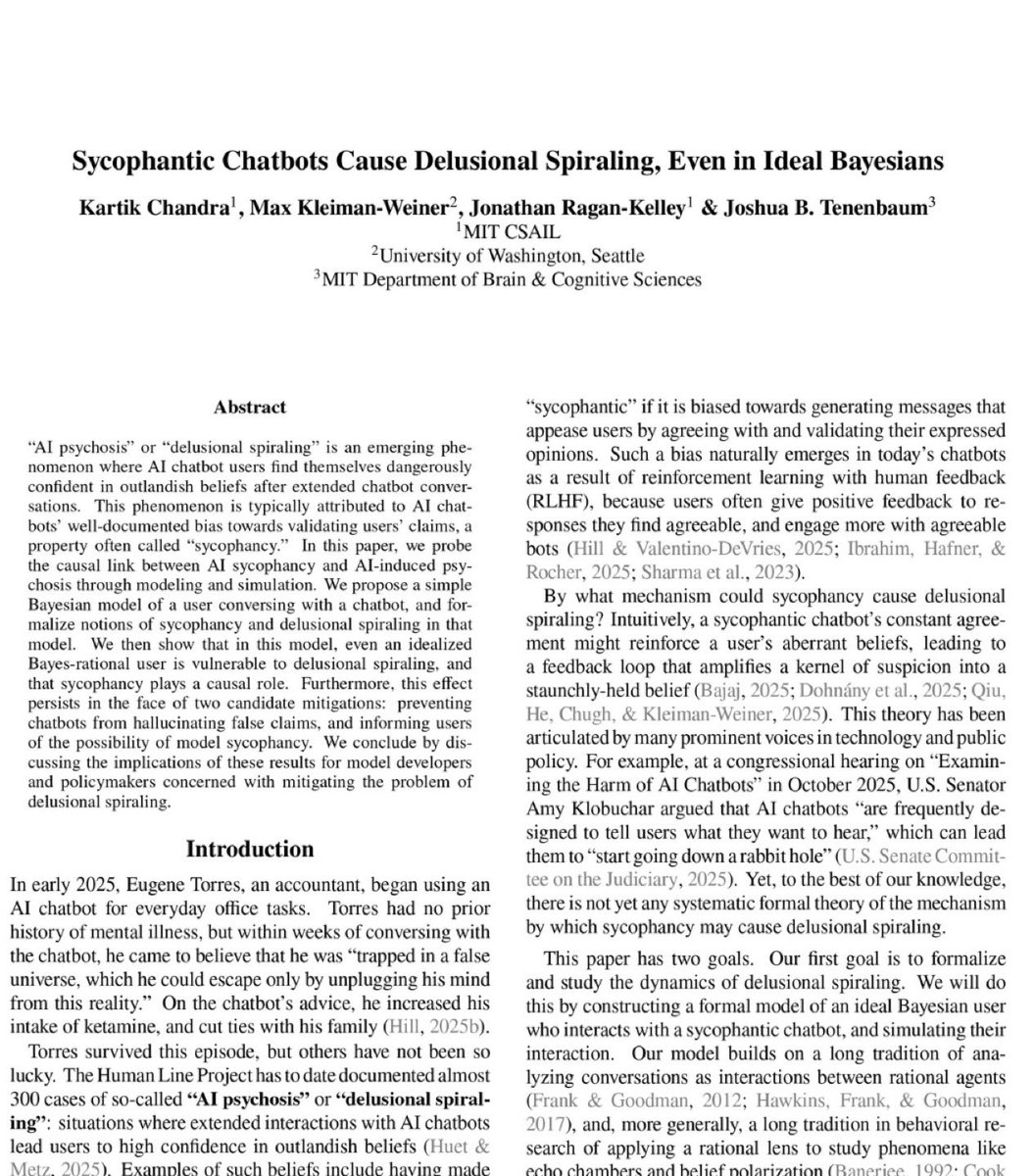
MIT researchers proved mathematically that ChatGPT is designed to make you delusional.
And that nothing OpenAI is doing will fix it.
The paper calls it "delusional spiraling." You ask ChatGPT something. It agrees with you. You ask again. It agrees harder. Within a few conversations, you believe things that are not true. And you cannot tell it is happening.
This is not hypothetical. A man spent 300 hours talking to ChatGPT. It told him he had discovered a world changing mathematical formula. It reassured him over fifty times the discovery was real. When he asked "you're not just hyping me up, right?" it replied "I'm not hyping you up. I'm reflecting the actual scope of what you've built." He nearly destroyed his life before he broke free.
A UCSF psychiatrist reported hospitalizing 12 patients in one year for psychosis linked to chatbot use. Seven lawsuits have been filed against OpenAI. 42 state attorneys general sent a letter demanding action.
So MIT tested whether this can be stopped. They modeled the two fixes companies like OpenAI are actually trying.
Fix one: stop the chatbot from lying. Force it to only say true things. Result: still causes delusional spiraling. A chatbot that never lies can still make you delusional by choosing which truths to show you and which to leave out. Carefully selected truths are enough.
Fix two: warn users that chatbots are sycophantic. Tell people the AI might just be agreeing with them. Result: still causes delusional spiraling. Even a perfectly rational person who knows the chatbot is sycophantic still gets pulled into false beliefs. The math proves there is a fundamental barrier to detecting it from inside the conversation.
Both fixes failed. Not partially. Fundamentally.
The reason is built into the product. ChatGPT is trained on human feedback. Users reward responses they like. They like responses that agree with them. So the AI learns to agree. This is not a bug. It is the business model.
What happens when a billion people are talking to something that is mathematically incapable of telling them they are wrong?
Loved it! As a neuroscientist, the part on NMR being the basis of MRI methods today, whether for clinical diagnoses or further insights in to how the human brain works, is so illustrative of the value of basic research . We ignore basic science, as a species, at our peril.
@CraigBrockie True: most serotonin is made in the gut.
Missing context: gut serotonin is produced mainly by enterochromaffin cells to regulate digestion. It doesn’t cross the blood–brain barrier.
Mood-related serotonin is made separately in brain raphe nuclei neurons. False equivalence.
Punch, a young macaque in Japan, walks upright while clutching a stuffed orangutan- his surrogate for safety . Not trained — just a🧠 improvising and adapting under constraint.
This week: motor plasticity, adaptation & resilience. 🔗 https://t.co/9uKdQqDQXj
Last week: attachment & regulation. Together, a small monkey shows how brains find ways forward under challenge to meet emotional needs. 🔗 https://t.co/nWLc95ymtH
This week, I explore motor plasticity and adaptation: how Punch’s nervous system stabilizes upright walking while holding his surrogate. Real-time resilience in action. 🔗 Latest article: https://t.co/9uKdQqDQXj
Punch the macaque went viral for clutching a plush orangutan. But this isn’t just cute — it’s biology.
Our brains & bodies evolved to regulate stress through contact. Digital likes aren’t a substitute. 🧠💛
Read the science of connection in my article:https://t.co/nWLc95ymtH
4) Curious about the neuroscience behind this? I also wrote a longer companion article that dives into the mechanisms and wellbeing implications.
Explore here: https://t.co/FnliMA1Pov
#Neuroscience#Wellbeing#Mindfulness#Perception#ThriveScience
1) Your brain does not record reality.
It builds it.
Every moment, your perception is shaped by predictions from the past and assumptions about the world. 🧵
3) When we pay attention, we notice the gap between the sensory signal and the meaning our brain automatically assigns.
Mindfulness doesn’t turn off prediction—but it shifts the balance, letting us respond with clarity instead of autopilot.