Evolution navigated billions of challenges to get to us to where we are today. Directed evolution compresses this to 1D axis.
Imagine if you could sample 200 dimensions at once, with data to boot 📈
First @chorylab PACE preprint on our new system to tackle this: TurboPRANCE👇
Aaaand it’s online ahhhhh!!! 🥳🥳 So excited!!
The first glimpse of my postdoc work with @chorye@dukecagt. Here, @stefanmgolas and I developed TurboPRANCE, an open-source robotics platform for rapid and scaled phage-assisted continuous evolutions. 🧪Tweetorial party!👇1/n
I'd love to see more biotech VC as much as the next person, but I'm not sure the numbers do much to discredit its bad rap. Last year ~$40B flowed into US life sciences VC, with the majority going to < 100 companies with super small teams. And 75% of that went to just 3 metro areas. Meanwhile, that same ~$37B in NIH research funding supported +400K jobs at 2,500+ institutions across all 50 states.
How many people actually made money from those investments, given that most of these IPOs are effectively a pump and dump for the investors to make quick returns, with the public left holding the bag?
So... if we're talking GDP and job creation (what capitalism USED to be about), maybe people are right to question whether that fuel could go to a bigger fire :)
I had a chance to present at the tail end of the BioML Symposium this summer and was blown away by the work and progress of the students! Also a great opportunity to work with amazing mentors like @KevinKaichuang@SarahAlamdari@AshleyMaeConard and the rest of the BioML team. Highly recommend for PhD students nearing graduation who are interested in exploring industry research careers!
Are you a PhD student interested in the intersection of machine learning and biology or healthcare?
Come do an internship with the BioML Group at MSR!
Make sure you submit a research statement!
https://t.co/I38IhTb11i
Well, I've picked hundreds of mESC colonies under a dissecting scope, and those aren't going near a robot any time soon without custom, bespoke engineering solutions. Anyone who's differentiated adherent cells into suspension knows those protocols are basically just "move the tip around to aspirate media and avoid the differentiated body." It's not that it can't be automated, but it requires data-responsive solutions that can replicate the visual judgment, tactile feedback, and dexterity that experienced scientists use without thinking about it. Sure, it's a "standard process" but it's a standard process whose solution requires real-time computer vision, Z-scanning, and pressure-responsive aspiration all working at once. What's "secret" in these protocols isn't written down because it's embedded in the scientist's hands, not because some protocol is being kept hidden in vault.
@hsalis@jrkelly@parsecranberry Anything requiring centrifugation over 3400g 😂 And yes there are many ways around centrifuging. Do most of them work that well? No
Speaking as someone who spends most of their time building automation platforms and teaching people to do it (enough that I built a whole class around it)... but who also spent six years of my life splitting stem cells every 36 hours... I am split on this one.
On one hand, @mkoeris is right that the primitives are learnable and that novel combinations are not some sacred skill. On the other, @hsalis is 💯 that the large majority of experiments are far from autonomous. Most methods that are truly automatable, I can still do way faster and probably better with a multichannel pipette, I just have better things to do with my time.
Automating bespoke science is the hard part, but that is where the most exciting progress is to be made. I'd encourage all to challenge themselves to think beyond automating the mundane and ask what science simply could not be done in the absence of a robot: real time responsive feedback, or changing many parameters at once based on the data as it is generated. The kind of experiment where no amount of extra hands would ever get you there. We are only scratching the surface there.
(Currently grading midterm proposals for my automation class at the moment. One aim has to justify a genuine *need* for automation, and any proposal that justifies it with throughput, combinations, scale, or time is a big yawn. Think bigger, people 🦾)
The biggest issue I see is that they don’t seem to understand that the job of a scientist is not to ask, “Is this assumption plausible?” but “What evidence would distinguish this assumption from the alternatives, and can they actually collect it?”
Without being explicitly prompted to be critical, they all tend to find reasons a claim could be true rather than look for practical ways to falsify it. And yes this seems like a huge problem for reviews for the foreseeable future.
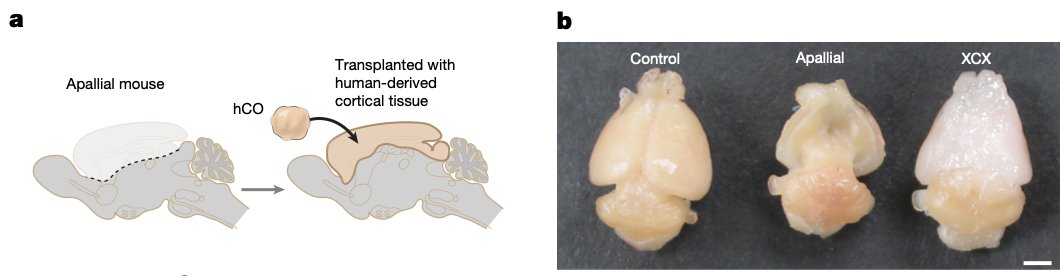
Today in @Nature, we report a new approach to studying human brain development and modeling disease in vivo.
Human neural #assembloids and #organoids have opened new ways to study development in vitro, but they also have important limitations. Transplantation can provide a more physiological environment, yet human cortical cells then develop within a rodent brain that matures much faster, constraining their growth and integration.
To address some of these limitations and obtain more advanced functional readouts relevant to disease biology, we generated #apallial mice, in which ~98% of the cortex and hippocampus fail to form, creating space for transplanted human cortical organoids to grow and integrate extensively.
We call these #xenocortical mice (XCX).
Nearly 7 years in the making. Congratulations to an extraordinary team and wonderful collaborators!
Link to the article below 👇
1/ I have long dreamed of systems that could causally model human neurobiology across scales, from molecular to behavioral.
In @Nature, delighted to share our efforts at creating xenocortical mice where human organoids grow to occupy most of mouse cortex.
I suspected it would be good but was still absolutely blown away by @GallowayLabMIT's talk today. Fundamental work presented with incredible clarity of thought and joyful levity. The kind of talk that's so good it makes you a little jealous that you didn't do it.
ASBMB is excited to announce the Future of Discovery Program and ASBMB Impact Fund, two new initiatives that will expand travel award support for graduate students and postdoctoral fellows attending the ASBMB Annual Meeting.
Learn more & apply: https://t.co/aAGQSJOQzx
#ASBMB2027
The vast majority of immigrants with U.S. STEM PhDs use the OPT program to stay in the country. The world has a shortage of people with these skills. It is our advantage that they're drawn to our university STEM programs--which are the best in the world.
@baym@anshulkundaje One of my favorite videos. I showed it to a random gentleman on a jet bridge recently who I got chatting with. He was curious how superbugs emerge and sent it to all his friends.
Looks like there is a new NSF postdoc fellowship specifically for people interested in training at the intersection of AI x Bio.
I'd be happy to sponsor someone who would like to work in our group on evolution+AI related stuff
https://t.co/1Tbjnd6KtA
Today, we're kicking off the first phase of the research preview for Model Hardware Standard (MHS): a new standard for AI agents to safely operate physical equipment in scientific research and advanced manufacturing.
Read more: https://t.co/XQ2y9EW7Af
Very excited to announce the PyLabRobot Cookbook from the Chory Lab! This cookbook showcases many usage examples and design patterns that should help you get started writing PyLabRobot code quickly. I strongly recommend this cookbook to anyone interested in lab automation!