Using biophysically generative process (analogous to Asano’s individual CMFs), a comprehensive & physically realistic modeling, reconstructed from RGB capture, is proposed & holds huge potential for spectral rendering, imaging simulation & skin perception. Plz check out soon. 3/3
Delighted and a bit unrealistic to be on the author list of my first graphics paper, <A Hyperspectral Space of Biophysical Skin Tones for Inverse Rendering of Skin Properties>🟫
Skin spectral data such as those from Leeds-Liverpool and Stanford ISET have been useful but w. some limitations in terms of spatial characterizations, diversity, etc. 2/3
The full program of @ImagingOrg#CIC30 is now online & registration is open (at a discount until Oct 16) https://t.co/2YAy74Bzyi The best part of the conference is meeting the #color and #imaging crowd from around the world. A few photos from past events to whet your appetite :)
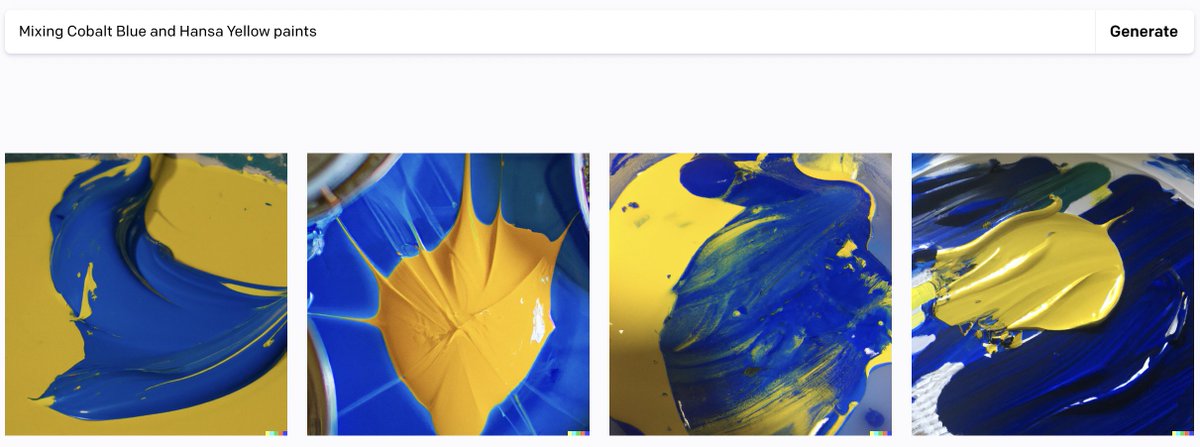
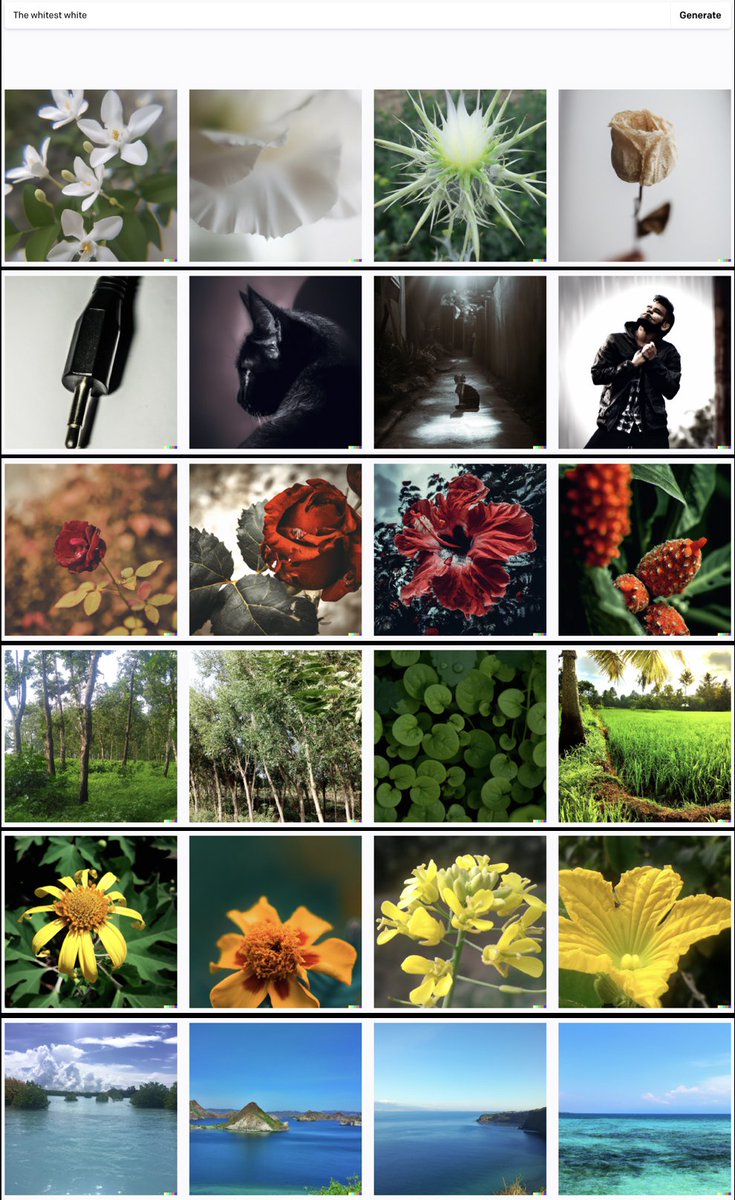
I asked DALL·E 2 to imagine the blackest black, the whitest white, etc. to see its "gamut". Wondering if the result is of any possible use for wording the instructions in (human) psychophysics?
"...large color differences saturate relative to the Riemannian prediction." Nice commentary by David Brainard https://t.co/FsVuLgj4yD Seems the idea above is consistent with the law of diminishing returns for both color and money.
It looks fun to monetize color in an experiment (with fast & "accurate" decisions). As we're thinking about *large* color differences, I wonder whether the opposite (to colorize money) can help...💵💶💷
While Studies 1-2 used subjective ratings to measure value, Study 3 used objective values. We trained people that colors = cash. Each option was a mix of colors and each trial there was an objectively better option. Trials were simply mean-shifted across value levels. 5/10
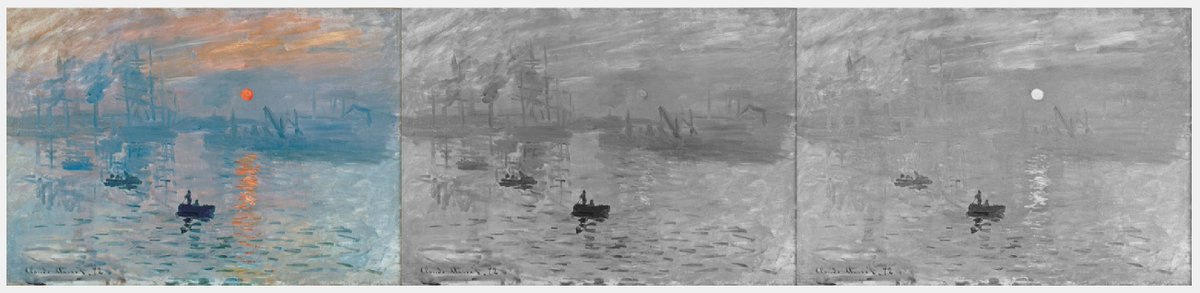
To summarize, the H-K effect is not necessarily an undesired artifact to be compensated (most times it should). Luminance & brightness can be reconciled as they serve different purposes for both artists & scientists. See also https://t.co/awWIcZQsoS & https://t.co/gbdd7USMKs n/n
The vessels in the BG become less salient in my conversion (probably they should be). Color contrast needs non-trivial care when doing the 3D-to-1D mapping. See the benchmarking results where sometimes contrast polarity did not even need to be correct: https://t.co/WhTJkF7wXE 6/n
This Wednesday, I will discuss the Luther condition for individual observers at https://t.co/AHEK9JBR6Z. It was a long-hatched idea and a fun side-project.
It was hugely inspirational. I also love the stories that the prism from his mother sparked his interest in vision at 5 yo, and his kids' jellycat motivated him to switch to tactile sensors. And the remarkable checker shadow illusion was a result of two-year iterative innovation.
While I’m lucky one of many collaborators of Ted Adelson, and thought I knew something about Plenoptic function, I didn’t know that his idea led to the development of dual-pixel AF, the core technology for mirrorless digital cameras. He is really Da Vinci of our age. #TedFest