Another project is kicking off from the development team. It was started as an internal tool among ourselves.
We're opening up Cloud Canvas for early access 🚀
The waitlist is live at https://t.co/hFPWSqkabi
For a few months we've been building something for ourselves. Today we're letting other people in. It started as a complaint. We wanted to see what each team actually spent last month, and what was sitting idle and still billing. So we did the obvious thing and asked Claude Code to build us the dashboard.
It did. Good code, fast. But it starts from an empty folder, the way it always does. It had no idea what our accounts were, which regions we use, or how we tag things, so we explained all of it. Then we handed over credentials, found somewhere to host what it made, and worked out who was going to own the refresh job when the numbers went stale. A week later we had one dashboard. The next one started from the empty folder again.
So we built Cloud Canvas. It starts from your AWS account rather than a blank page: already connected, already mapped, read-only. You say what you want to see, it builds it against your live data, and the second dashboard is one more sentence instead of another week.
It's going to be open source. You can read exactly what it does inside your account, or skip us entirely and run it yourself. It's early, and it looks early in places. That's rather the point of opening it to a small group first: we'd much rather hear what's wrong now than after we've spent six months building the wrong things. If you spend your days in AWS, come and have a look, and tell us where it falls over:
https://t.co/hFPWSqkabi
#AWS #DevOps #OpenSource #FinOps #Dashboard
@morganlinton Some tasks can even be done with Haiku. We are just lazy of switching during a task. Most of the time, we are killing a mosquito with a missile.
Before releasing HAZL's open-source version to GitHub, I tested it from localhost against real AWS.
The flow creates an EC2 instance, opens SSH through a security group, generates the key pair, stores it in HAZL, and returns a running VM. All steps run through your localhost machine, no ClickOps in AWS console at all.
#AWS #OpenSource #DevOps @HAZLCloud
Testing the open source core of @HAZLCloud and it's working fine. Currently it only supports AWS and Anthropic model API. Will release the official open source in the next couple days.
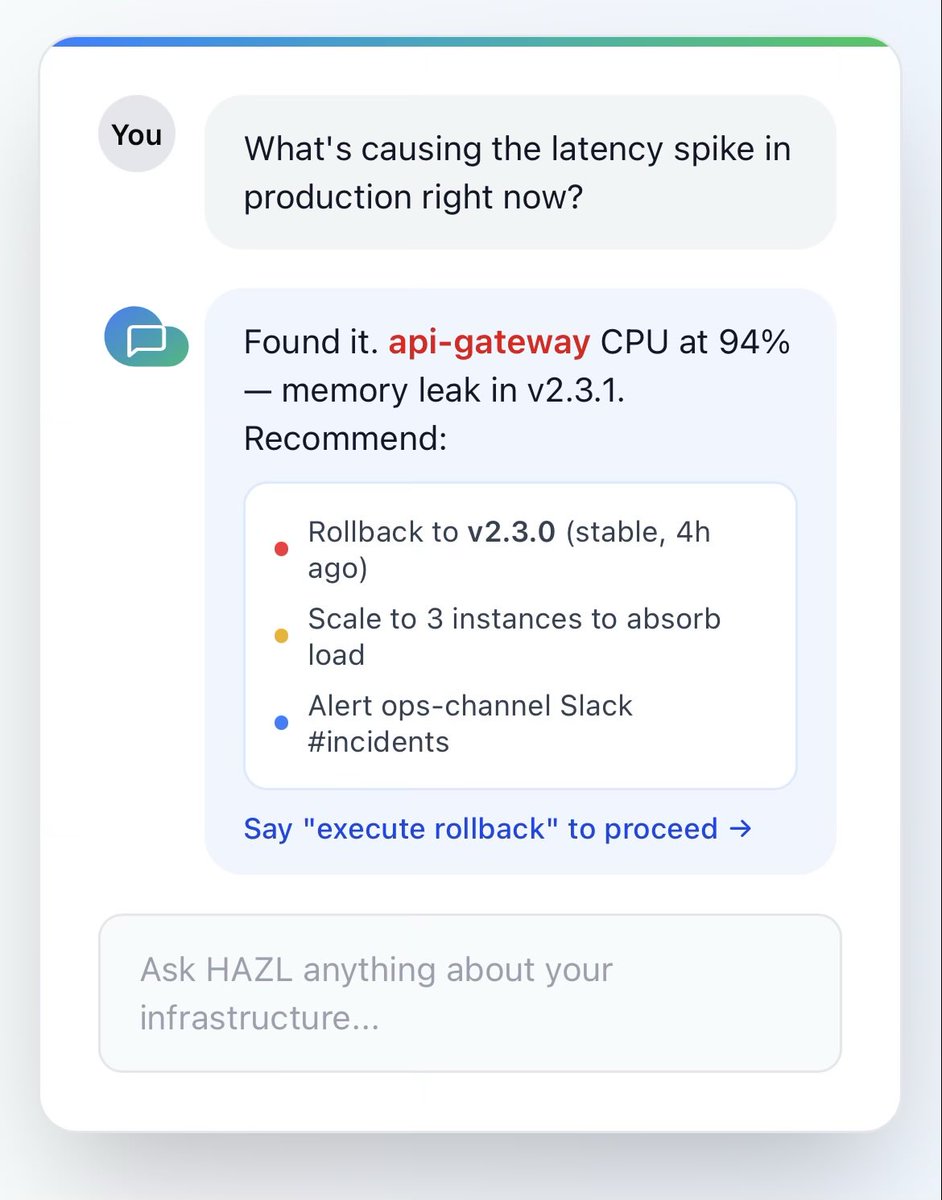
“Last night we had a production latency spike.
I was already preparing for the usual routine—opening Grafana, checking CloudWatch, digging through logs, and trying to figure out what changed.
Instead, I asked HAZL:
‘What’s causing the latency spike in production right now?’
Within seconds it came back:
• API Gateway CPU at 94%
• Correlated to the latest deployment
• Likely memory leak in v2.3.1
• Recommended rollback, temporary scaling, and notifying the incident channel
It wasn’t just monitoring.
It actually investigated the issue and gave me an action plan.
This saved us a ton of time during an incident. Instead of spending 30–60 minutes finding the problem, we were already discussing the fix.”
— Early HAZL user
Asked HAZL Cloud to create an AWS EC2 instance.
The AI agent gathered details, launched the VM, caught an SSH/security group issue, offered a clean fix, relaunched, and connected through a managed SSH session.
AI for real CloudOps, not just chat.
#AWS#DevOps#CloudOps#EC2 #VM #SecurityGroup
@Jasoliyaharsh1 We are building an agentic CloudOps platform for teams who are constantly shipping but don't have a full size DevOps teams to manage their cloud infra
https://t.co/7xxV6X2CWr