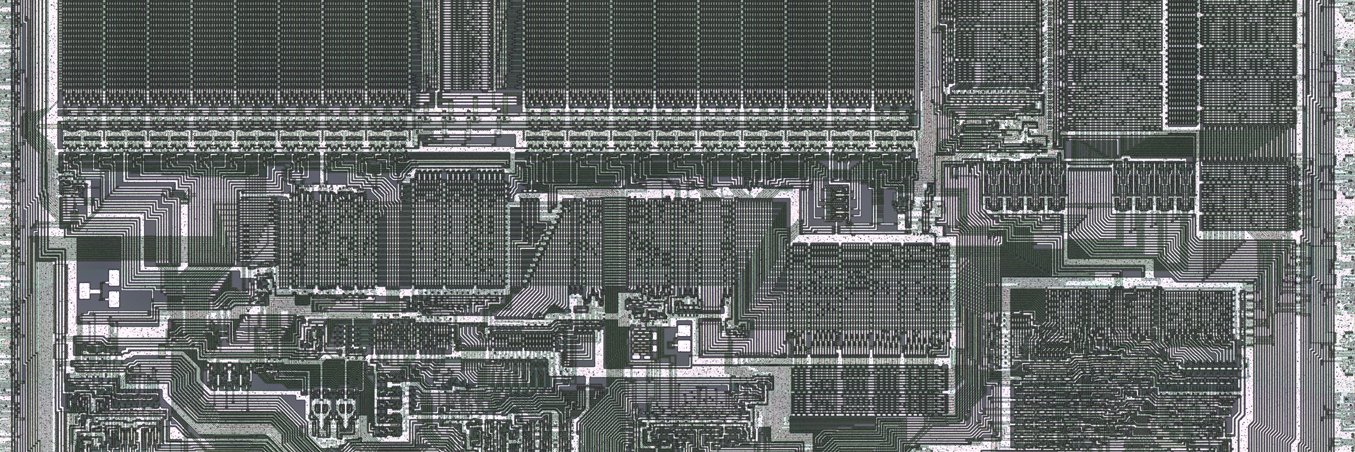
Hardware glitching masters have taken on Intel's microarchitecture - very, very cool! I'm so glad our work is contributing to research that was previously unimaginable. Research into hardware attacks on Intel processors has enormous potential...
https://t.co/4PQF1APL6E
The Spectre exploit chef @SanWieb just gave an impeccable talk at @USENIXSecurity about our work on Spectre gadgets analysis and native BHI exploitation. Very happy - and proud of the Distinguished Paper award too :)
Just a few days left to apply to our PhD and PostDoc positions available at @vu5ec. If you love low-level systems hacking and would you like to work at a top systems security research group in Amsterdam, consider applying: https://t.co/XLxFJzmrG5
😎 We’re going to REcon 2024! 😎
This will be the first talk in which we introduce the decompiler since the open source release.
It will be very much an hands on talk. Don’t miss it.
See you in June in Montreal! ⚜️🌹☘️
https://t.co/AKmgU6ehGL
If you ever happen to look for Spectre gadgets manually and feel pain and loneliness, you should check https://t.co/Ho9NG26tGD ... It's been a wild ride, but working with @SanWieb was the best thing ever :) Also, BHI is back baby
Disclosing #SLAM, aka how to combine Spectre and Intel LAM (& co.) to leak kernel memory on future CPUs (demo below). Thousands of exploitable "unmasked" (or pointer chasing) gadgets in the Linux kernel. Joint work by @MatheHertogh@SanWieb@c_giuffrida: https://t.co/8sgL8t8eC5
I'm thrilled to announce that our paper "Speculation@Fault" @USENIXSecurity is online! Read about how we automatically find information leakages arising from CPU exceptions by fuzzing against speculative contracts.
I am extremely happy about this paper, which is the brainchild of my PhD student @__L4w__ and my colleague @JinBlackx.
BINO addresses the irksome problem of identifying inlined functions (specifically from C++ template classes) in binaries.
https://t.co/yQA6guZ60K
Debug Location coverage for the variables in the optimized binaries compiled with the newest release of LLVM look nice. A bit longer post is at https://t.co/ZaiOQZlNSG. We started from 45%, and now we are at 71%, nice! @llvmorg
Should we lose hope already on Rowhammer attacks? Andrea Di Dio from Vrije Universiteit Amsterdam is showing us at #NDSS23 that it is feasible to devise a software-based design to mitigate ECC-aware Rowhammer attacks.
Disclosing CHOP, aka how attackers can bypass commodity return address protections such as stack cookies by hijacking the exception handling process. Paper to appear @NDSSSymposium: https://t.co/SWNm3xhIzf. Joint work by @victor_duta Fabian Freyer @pagabuc@nSinusR@c_giuffrida
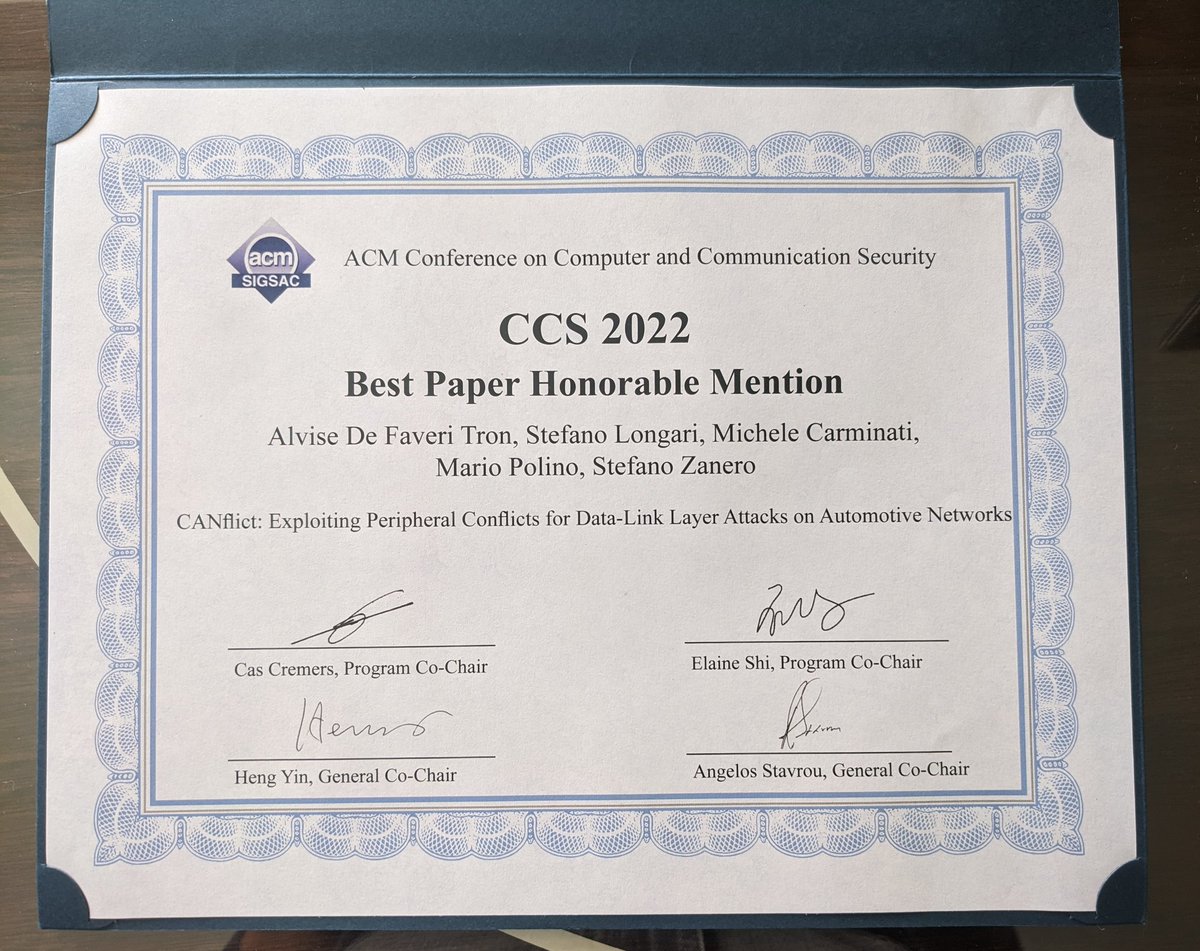
I am at @acm_ccs , where @HBitmasks is about to present "Canflict: Exploiting Peripheral Conflicts for Data-Link Layer Attacks on Automotive Networks".
Thanks to all coauthors: @HBitmasks, @aScarecrowHat, @mcarminati1988, @raistolo
Full paper: https://t.co/5XvgBvapi1
[update] We are presenting this work at @acm_ccs in a couple of weeks🥳 Come and say hi if you want to see some car hacking shenanigans :)
Paper: https://t.co/MQIMcKQOWr