Teaching @EEG_UMinho & Iscte-IUL. I study how parties adapt and fracture under grassroots and youth wing pressure, & how it affects party cohesion and change.
Very pleased to see my name in @EJPRjournal for the first time—especially alongside scholars whose work I have been reading for years.
https://t.co/yeb96r4UpP
1/ Happy to share that "Factorial Difference-in-Differences" (FDID), with Anqi Zhao and @pengding00, is out in JASA - ACS. https://t.co/XY39zo8sTw
It has been a truly thrilling experience working with Anqi and Peng.
In this article in Technology in Society, we argue that beliefs about the personal or societal benefits of AI are not enough to explain its generic public acceptance. Beliefs about its 𝘱𝘳𝘰𝘤𝘦𝘥𝘶𝘳𝘢𝘭 𝘧𝘢𝘪𝘳𝘯𝘦𝘴𝘴 should also be crucial (1). https://t.co/UJZRUNR9bk
📊 Based on my journal-submission log since Dec. 2013, I made this figure showing how often manuscripts are rejected—and how long it takes—before (conditional) acceptance. I hope it helps PhD students and junior scholars see the real world of publishing in political science. 💪📚
A polarização afetiva está relacionada com a crescente distância - e até hostilidade - entre pessoas com ideias, opiniões ou crenças diferentes.
Mas estará essa distância a aumentar?
Segundo o politólogo Pedro Magalhães, em Portugal este tipo de polarização é cada vez mais visível entre pessoas que se identificam com algum partido.
No novo episódio do [IN]Pertinente, o especialista responde às perguntas da humorista Luana do Bem e analisa o fenómeno da «polarização»: das várias formas que pode assumir aos fatores que a explicam e aos efeitos que tem na nossa vida.
O episódio está disponível nas plataformas habituais de podcast e no YouTube da Fundação.
🎧 Ouça aqui: https://t.co/GJT18R8eBI
🎥 Veja aqui: https://t.co/psSw5KXScf
Foram construídos mais kilómetros de ferrovia em Portugal continental durante o reinado de D. Luís I do que durante os reinados e mandatos de todos os outros Reis e Presidentes da República da história de Portugal juntos.
econ job market papers then:
"I ran a regression and added a bunch of covariates woohoo"
econ job market papers now:
"I tracked Bill Gates movements across 500 public and 200 paid datasets and can definitively show the impact of the Epstein files on microsofts tax payments"
New paper with @muhammet_a_bas, out today in Political Analysis:
📄 "Democracy Manifest or Democracy Latent? A Unified Framework for Identifying Regime Types and Transitions"
The setup: democracy measurement has two related problems. 🧵
Politics is often said to need renewal. But where do young politicians get elected, and where does the door start to close?
Patrícia Silva and I look at this question in Portugal.
They are not absent. But the path becomes narrower as offices become more executive and national.
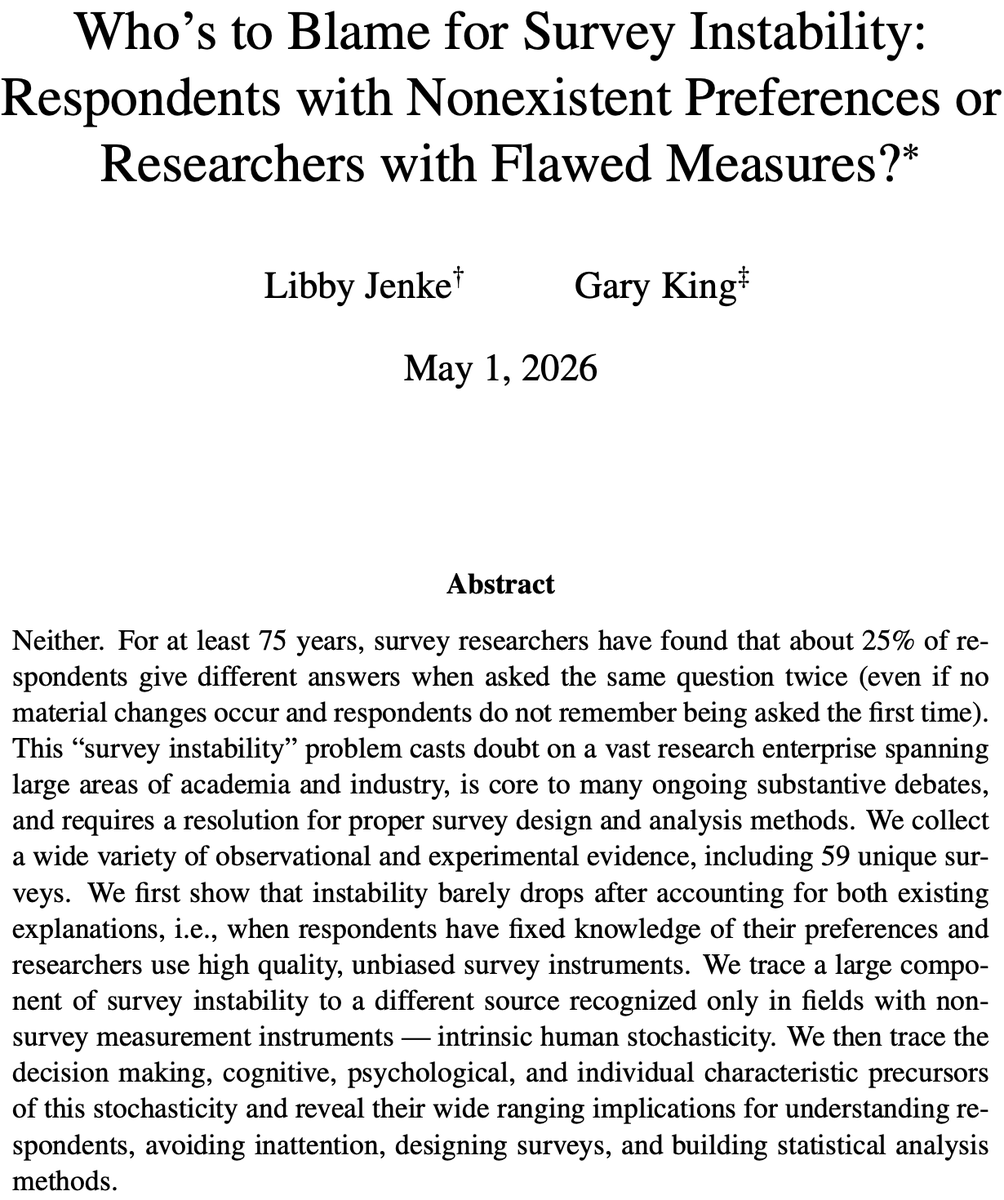
New paper: "Who's to Blame for Survey Instability: Respondents with Nonexistent Preferences or Researchers with Flawed Measures?" with @LibbyJenke. Comments welcome! https://t.co/5LhPD68qux
"We show that, depending on how the impact of omitted variables is measured, it can be substantially easier for omitted variables to flip coefficient signs than to drive them to zero."
I’m really excited about this paper! Some of my work has pointed out problems in empirical work, but this one is all about new 🔧s.
If you (or your referees) want to know about the mechanisms by which a treatment affects an outcome, you may be interested. A 🧵.
O que leva um investigador a atravessar o Atlântico para ensinar em Georgetown?
Conhece Hugo Ferrinho Lopes - professor e investigador que estuda partidos políticos, participação jovem e os desafios da democracia.
Saiba mais: https://t.co/2ciJAl8DSl
Major update: **interflex** v1.4.0 (CRAN)
- Support various DML estimators
- Support discrete outcomes
- Support group average treatment effects (discrete moderators)
- Major refactoring to improve code efficiency
- User manual rewritten
Check it out: https://t.co/8Ccckcy2lP
Many thanks to Tianzhu @Maple_Optboy
and @statsclaw for making this happen.
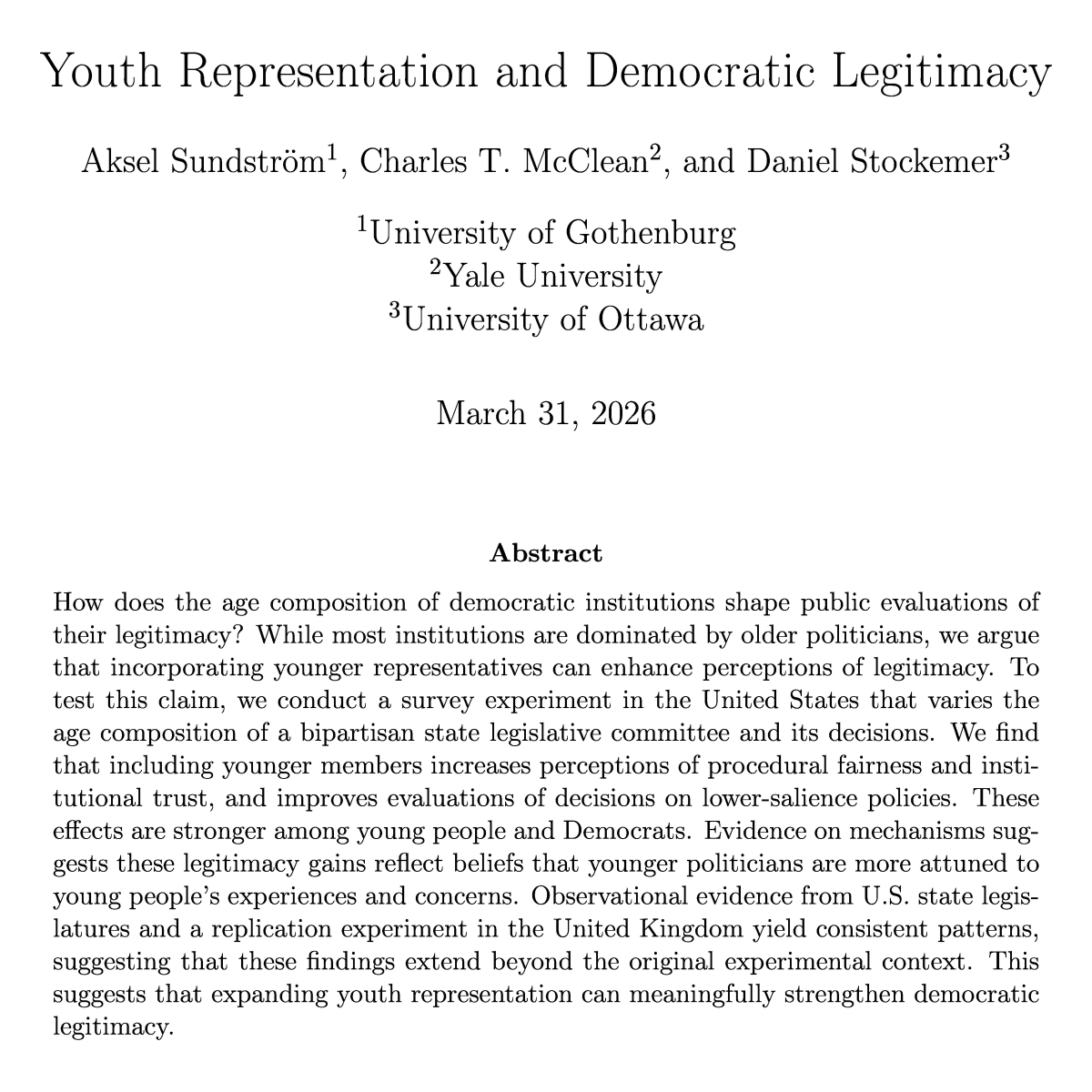
Happy to share my paper with Aksel Sundström and Daniel Stockemer has won the @SPPQJournal Best Paper Award from @APSA_SPP
We find that including younger representatives in decision-making bodies can boost perceptions of fairness and institutional trust
https://t.co/mK2sVpovwL