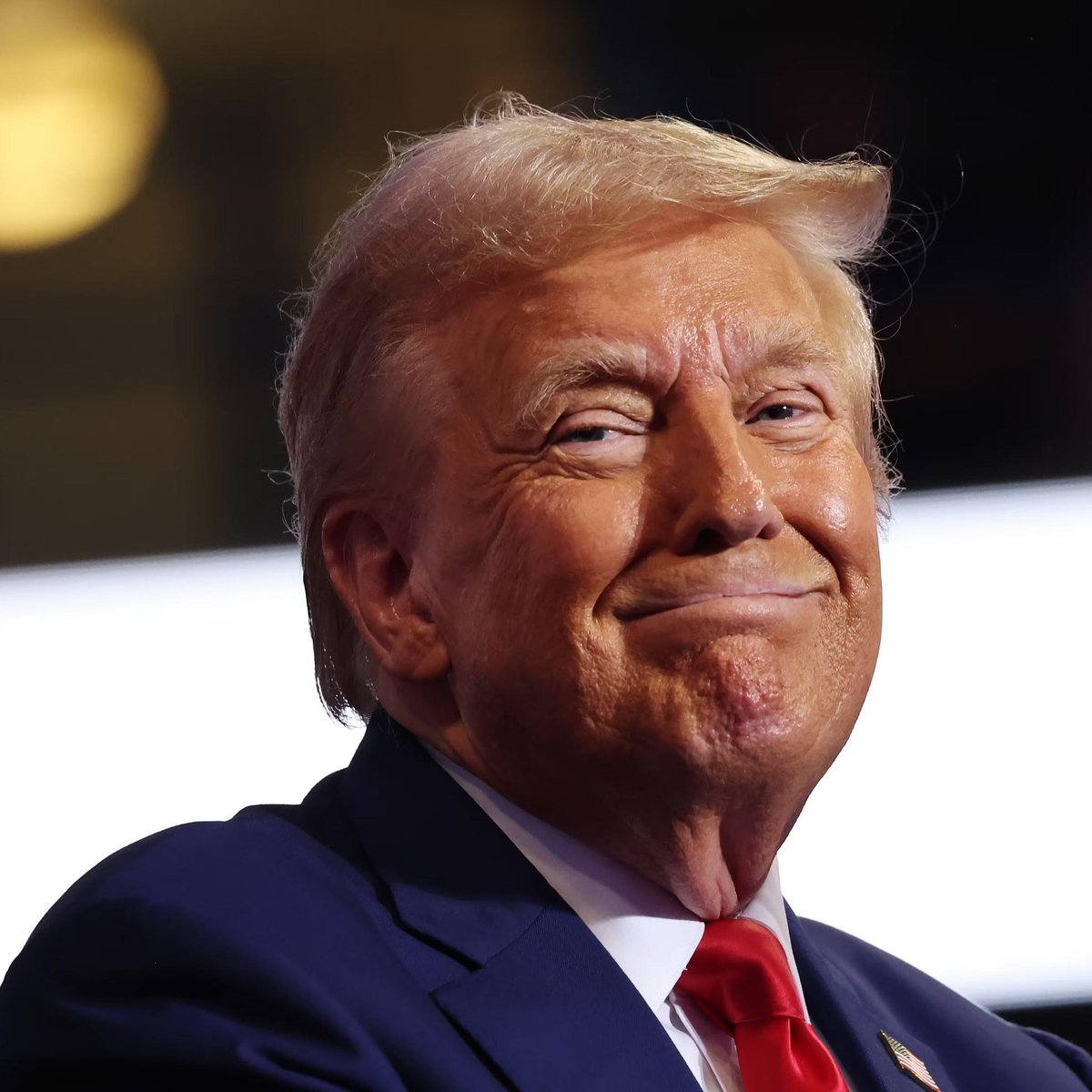
PRICE TAG FLIP: Trump's ballroom was touted as 'completely privately funded' — now Republicans are slipping $1 billion in taxpayer money into an ICE funding bill to pay for it https://t.co/kxC4vHZHSS
JD Vance is lecturing the Pope on Catholicism and Pierre Poilievre is lecturing Mark Carney on economics and RFK Jr is lecturing scientists about vaccines and Donald Trump is lecturing the world on tariffs and Pete Hegseth is quoting Pulp Fiction and thinking it’s the Bible
Reporter: "There's a pretty significant legal challenge to your arch."
Trump: "Who's doing the legal challenge?"
Reporter: "It's a group of veterans."
Trump: "A group of veterans?"
Reporter: "Because it obstructs the viewshed between Arlington National Cemetery and the Lincoln Memorial."
Trum: "You've got to be kidding."
The world stopped to watch Artemis II.
Moments like this remind us what is possible and inspire the next generation to dream bigger and take us even further.
We are just getting started on this grand adventure. It is time to start believing again.
Trump is seeking to pay for his new $1.5 trillion military budget by cutting the following:
$510 million - Grants for farmers and agricultural research
$82 million - Loans for rural small businesses (Fully eliminated)
$61 million - Support for farmers and food markets (Fully eliminated)
$240 million - School meals and food education for children abroad (Fully eliminated)
$659 million - Community building grants
$47 million - Support for minority-owned businesses (Fully eliminated)
$449 million - Economic development grants for communities
$1.6 billion - Weather forecasting, fisheries, and coastal protection (NOAA)
$993 million - Scientific research and technology standards
$150 million - Support for American exports and trade
$2.2 billion - Broadband and internet access programs
$8.5 billion - Funding for public schools
$1.5 billion - Vocational training and adult education (Fully eliminated)
$2.7 billion - College access and higher education support
$15.2 billion - Roads, bridges, and infrastructure projects
$1.1 billion - Home energy efficiency and clean energy programs (Fully eliminated)
$1.1 billion - Scientific research funding
$386 million - Environmental cleanup programs
$150 million - Cutting-edge clean energy research
$4 billion - Help paying home heating and cooling bills for low-income families (Fully eliminated)
$768 million - Refugee resettlement assistance
$819 million - Care and shelter for migrant children
$775 million - Local anti-poverty programs (Fully eliminated)
$5 billion - Public health programs, mental health services, and disease prevention
$5 billion - Medical research (NIH)
$129 million - Healthcare quality and safety research
$356 million - Emergency preparedness and disaster response
$1.3 billion - FEMA community disaster preparedness grants
$707 million - Cybersecurity protection for critical infrastructure
$52 million - Airport and transportation security
$40 million - Protection against chemical and biological weapons threats
$53 million - Funding for homeland security operations
$3.3 billion - Community development block grants for local neighborhoods (Fully eliminated)
$1.3 billion - Affordable housing construction grants (Fully eliminated)
$393 million - Programs to reduce homelessness
$529 million - Housing assistance for people living with HIV/AIDS (Fully eliminated)
$489 million - Housing and services for Native American communities
$50 million - Grants to help communities build more housing (Fully eliminated)
$60 million - Enforcement of fair housing and anti-discrimination laws
$58 million - Homebuyer and renter counseling services (Fully eliminated)
$45 million - Renewable energy development programs (Fully eliminated)
$1.7 billion - Grants for local law enforcement and public safety
$20 million - Civil rights mediation and legal access programs (Fully eliminated)
$1.6 billion - Job training for at-risk youth (Fully eliminated)
$395 million - Jobs program for low-income seniors (Fully eliminated)
$234 million - Worker safety and labor protection programs
$101 million - Enforcement of equal pay and workplace anti-discrimination laws
$46 million - Programs to combat child labor and forced labor abroad
$2 billion - International humanitarian aid
$1.2 billion - Food aid for hungry families abroad (Fully eliminated)
$4.3 billion - Global health and disease prevention programs
$2.7 billion - Funding for the United Nations and international partnerships
$642 million - International economic and treasury programs
$315 million - Democracy and anti-corruption programs abroad
$486 million - Grants for public transit projects
$4.2 billion - Electric vehicle charging infrastructure
$372 million - Airline service for rural and small communities
$145 million - Grants for sustainable and equitable infrastructure
$204 million - Loans and investment for underserved communities
$1.4 billion - IRS taxpayer services and enforcement
$100 million - Air pollution monitoring and reduction programs (Fully eliminated)
$1 billion - EPA grants to states for environmental protection
$2.5 billion - Clean drinking water and wastewater infrastructure funds
$90 million - Grants to reduce diesel pollution (Fully eliminated)
$3.4 billion - NASA space and earth science research
$297 million - NASA technology innovation programs
$1.1 billion - International Space Station operations
$143 million - STEM education programs
$309 million - Small business development and entrepreneurship programs
$170 million - Small Business Administration operations
$158 million - Loans for small businesses
The cross is part of the mission. The imperialist occupation of the world is disrupted from within; the violence that until now has been the law is unmasked. The poor, imprisoned, and rejected Messiah descends into the darkness of death, yet in so doing He brings a new creation to light. #HolyThursday
Absolute insanity. Tucker Carlson exposes how the Trump Administration is using corrupt religious leaders to justify the mass slaughter of Iranian civilians. They are literally praying for genocide in the White House while ignoring the teachings of Christ.
President Trump said he told White House budget director Russell Vought, "'Don't send any money for day care,' because the United States can't take care of day care."
"We’re fighting wars. We can’t take care of day care," Trump said Wednesday while speaking at a White House Easter lunch. He went on to say that the states should "take care of day care, and they should pay for it, too," by raising their taxes.
"We have to take care of one thing, military protection," Trump added. "We have to guard the country."
Drivers react to rising gas prices:
"I am shocked but not surprised. We have someone in the White House that does not care about the American people. He had promised us no wars, lower grocery prices, lower gas prices... It's really hurting."
I embedded with anti-drone crews across Ukraine - rooftops, trenches, the Black Sea coast. They rewrote modern warfare in real time. The Pentagon had a front-row seat, but learned nothing. Now, drones are killing Americans overseas.
Drone Hunters of Kherson premieres TODAY.
https://t.co/55RhQIBs7Z
Three weeks into the war with Iran, a number of observations as someone who spent years war-gaming this scenario.
1. The U.S. and Israel may have produced regime transition in the worst possible way.
Ali Khamenei was 86 and had survived multiple bouts of prostate cancer. His death in the coming years would likely have triggered a real internal reckoning in Iran, potentially opening the door to somewhat more pragmatic leadership, especially after the protests and crackdown last month. Instead, the regime made its most consequential decision under existential external threat giving the hardliners a clear upperhand. Now we appear to have a successor who is 30 years younger, deeply tied to the IRGC, and radicalized by the war itself – including the killing of family members. Disastrous.
2. About seven years ago at CNAS, I helped convene a group of security, energy, and economic experts to walk through scenarios for a U.S.--Iran war and the implications for global oil prices. What we’re seeing now was considered one of the least likely but worst outcomes. The modeling assumed the Strait of Hormuz could close for 4–10 weeks, with 1–3 years required to restore oil production once you factored in infrastructure damage. Prices could spike from around $65 to $175–$200 per barrel, before eventually settling in the $80–$100 range a year later in a new normal.
3. One surprising development: Iran is still moving oil through the Strait of Hormuz while disrupting everyone else. In most war games I participated in, we assumed Iran couldn’t close the Strait and still use it themselves. That would have made the move extremely self-defeating. But Iran appears capable of harassing global shipping while still pushing some of its own exports through. That changes the calculus.
4. The U.S. now finds itself in the naval and air equivalent of the dynamic we faced in Iraq and Afghanistan. It’s a recipe for a quagmire where we win every battle and lose the war. We have overwhelming military dominance and are exacting a tremendous cost. But Iran doesn’t need to win battles. They just need occasional successes. A small boat hitting a tanker. A drone slipping through defenses in the Gulf. A strike on a hotel or oil facility. Each incident creates insecurity and drives costs up while remind everyone that the regime is surviving and fighting.
5. The deeper problem is that U.S. objectives were set far too high. Once “regime change” becomes the implicit or explicit goal, the bar for American success becomes enormous. Iran’s bar is simple: survive and keep causing disruption.
6. The options for ending this war now are all bad. You can try to secure the entire Gulf and Middle East indefinitely – extremely expensive and maybe impossible. You can invade Iran and replace the regime, but nobody is seriously going to do that. Costs are astronomical. You can try to destabilize the regime by supporting separatist groups. It probably won’t work and if it does you’ll most likely spark a civil war producing years of bloody chaos the U.S. will get blamed for. None of these are good outcomes.
7. The other escalatory options being discussed are taking the nuclear material out of Esfahan or taking Kargh Island. Esfahan is not really workable. Huge risk. You’d have been on the ground for a LONG time to safely dig in and get the nuclear material out in the middle of the country giving Iran time to reinforce from all over and over run the American position.
8. Kharg Island can be appealing to Trump. He’d love to take Iran’s ability to export oil off the map and try to coerce them to end the war. It’s much easier because it’s not in the middle of IRan. But it’s still a potentially costly ground operation. And again. Again, the Iranian government only has to survive to win and they can probably do that even without Kargh.
9. The least bad option is the classic diplomatic off-ramp. The U.S. declares that Iran’s military capabilities have been significantly degraded, which is how the Pentagon always saw the purpose of the war. Iran declares victory for surviving and demonstrating it can still threaten regional actors. It would feel unsatisfying. But this is the inevitable outcome anyway. Better to stop now than after five or ten more years of escalating costs. Remember in Afghanistan we turned down a deal very early in the war with the Taliban that looked amazing 20 years later. Don’t need to repeat that kind of mistake.
10. The U.S. and Israel are not perfectly aligned here. Trump just needs a limited win and would see long-term instability as a negative whereas for Netanyahu a weak unstable Iran that bogs the U.S. down in the MIddle East is a fine outcome. If President Trump decided he wanted Israel to stop, he likely has the leverage to push it in that direction just as he pressured Netanyahu to take a deal last fall on Gaza.
11. When this is over, the Gulf states will have to rethink their entire security strategy. They are stuck in the absolute worst place. They didn’t start this war and didn’t want it and now they are taking with some of the worst consequences. Neither doubling down with the U.S. and Israel nor placating the Iranians seems overwhelmingly appealing.
12. One clear geopolitical winner so far: Russia. Oil prices are rising. Sanctions are coming off. Western attention and military resources are shifting away from Ukraine. From Moscow’s perspective, this war is a win win win.
13. At some point China may have a role to play here. It is the world’s largest oil importer, and much of that supply comes from the Middle East. Yes they are still getting oil from Iran. But they also buy from the rest of the Middle East, and a prolonged disruption in the Gulf hits Beijing hard. That gives China a real incentive to help push toward an end to the conflict.
The gop and dems both want big government…the only difference is gop wants a big govt that uses military force to make you comply.
Dems want big govt that provides healthcare, sick leave, childcare, access to education.