Elon Musk literally sat down for a 45-minute talk with Y Combinator that explains how to build world-changing companies better than any business school on earth. This is the advice he gave a room full of young founders:
1. Don't try to build something great. Try to build something useful.
Everyone obsesses over greatness. Musk says that's the wrong target. "I didn't originally think I would build something great. I wanted to try to build something useful. I didn't think I would build anything particularly great. Seemed unlikely, but I wanted to at least try." Aim for useful first. Greatness, if it comes, is a byproduct.
2. When you can't get in the front door, build your own door.
Before Musk started his first company, he tried to get a job at Netscape. "I sent my resume into Netscape and nobody responded. I tried hanging out in the lobby to see if I could bump into someone, but I was too shy to talk to anyone. So I'm like, this is ridiculous, I'll just write software myself." He didn't set out to be a founder. He became one because no one would hire him.
3. He slept in the office and showered at the YMCA.
The origin of his first company was not glamorous. "We couldn't even afford a place to stay. The office was 500 bucks a month, so we just slept in the office and showered at the YMCA." He couldn't afford proper internet either, so he drilled a hole through the office floor and ran a cable to the internet provider downstairs. That was the founder of the future richest man on earth.
4. Keep the chips on the table.
When Musk sold his first company, he received a $20 million cheque. His bank balance went from $10,000 to $20 million overnight. Most people would have stopped. He put almost all of it straight back into his next company. "I kept the chips on the table." He did the same thing decades later, over and over. He hates money sitting idle. Money is fuel for the next mission.
5. Start with the mission, then work backwards to make it a business.
Musk didn't start SpaceX to make money. He went on the NASA website to find out when humans were going to Mars, and there was no plan. So he decided to build one. "There had been no prior example of a rocket startup succeeding. A small chance of success is better than no chance of success." The mission came first. The business model came later.
6. He started SpaceX expecting to fail.
He is brutally honest about the odds. "SpaceX started in mid-2002 expecting to fail. Probably 90% chance of failing. When recruiting people, I said, we're probably going to die, but small chance we might not die." The first three launches failed. The fourth one worked with no money left. "If the fourth launch hadn't worked, it would have been curtains. We made it by the skin of our teeth."
7. Break every problem down to physics.
This is the core of how Musk thinks. "First principles means break things down to the fundamental elements that are most likely to be true, then reason up from there, as opposed to reasoning by analogy." His example is rockets. Everyone priced them based on what old rockets cost. Musk asked what a rocket is actually made of, priced the raw metals, and found the materials were only 1-2% of the historical price. The rest was inefficiency he could attack.
8. When told something takes 24 months, break it down and do it in six.
Last year xAI needed a giant computer to train its AI. Suppliers said it would take 18 to 24 months. "It's like, well, we need to get that done in six months or we won't be competitive." So he broke it into parts. Needed a building, so he found an old factory. Needed power, so he rented generators. Needed cooling, so he rented a quarter of America's mobile cooling capacity. He slept in the data centre and ran cabling himself. It got done.
9. Watch your ego-to-ability ratio.
Musk's single sharpest piece of advice for young founders is about staying honest with yourself. "A major failure mode is when your ego-to-ability ratio gets too high. Then you break the feedback loop to reality." Keep the ego small, internalise responsibility for everything, and stay ruthlessly connected to what's actually true. "You want to close the loop on reality hard. That's a super big deal."
10. Chase work, not glory.
His closing philosophy ties it all together. "It's so hard to be useful. The area under the curve of total utility is how useful you've been to your fellow human beings times how many people. If you aspire to do true work, your probability of success is much higher. Don't aspire to glory, aspire to work."
He was ridiculed for years. The press called him "internet guy attempting to build a rocket company." He agreed it sounded absurd. He did it anyway, because a small chance of doing something useful beat no chance at all.
Here's the thing though....
Musk became the most followed founder alive because everything he does happens in public. The launches, the failures, the talks like this one. The companies made him powerful. The personal brand made his every word travel around the world before he finishes saying it.
We build massive distribution and grow personal brands on X and beyond without our clients lifting a finger.
If you're a founder or VC looking for that kind of exposure, book a call below.
We average 1.5M views a week.
https://t.co/UoXuYlkBQq
🤖🎥 Un YouTubeur japonais affirme que 7 agents IA gèrent désormais toute sa chaîne.
Lors d'une visite de son appartement à Tokyo, un YouTubeur japonais a expliqué qu'il n'avait plus ouvert son logiciel de montage depuis 10 mois.
Selon lui, toute sa production est assurée par une équipe de sept agents IA : l'un repère les tendances YouTube, un autre rédige les scripts dans son style, un troisième génère les séquences de gameplay, tandis que d'autres s'occupent du montage, des miniatures, du SEO et de la coordination de l'ensemble.
Il affirme ainsi publier quatre longues vidéos par semaine ainsi qu'un Short chaque jour, pour un coût d'exploitation d'environ 70 $ par mois en API, et un gain d'environ 180 000 $ par mois 🤯
The part of AI filmmaking people don’t see:
You generate a LOT of bad takes to get one great one.
You direct the shot, iterate, kill the versions that don’t work, and keep pushing until you get the right take.
It’s less “press button, get movie” and more like shooting coverage until something clicks.
I generated 16 takes of yesterday's video, and cut together two of them to make the final.
This might sound like a lot, but compared to traditional shooting ratios it's really nothing crazy.
Aujourd’hui, un de mes clients, un jeune de Lisieux à la condition précaire, est convoqué par la justice et est menacé d’être envoyé en détention.
Son tort ? Être dans l’incapacité de payer les milliers d’euros auxquels la justice française l’a condamné pour un tweet à 42 vues sur l’affaire Mila, vaguement grossier.
Amende délirante, indemnisation pour un tweet que la « victime » n’avait même pas lu… peine d’un an de prison avec sursis probatoire.
Pour un jeune catho de Lisieux sans casier, lecteur de Pascal à ses heures.
Pour faire plaisir surtout aux autorités politiques qui avaient monté une procédure spectacle avec la complicité du parquet de Paris, afin de promouvoir la loi Schiappa et celle qui était alors présentée dans tous les médias comme la nouvelle égérie de notre société victimaire, sorte de Jeanne d’Arc républicaine.
Qui s’est révélée être une raciste et xénophobe patentée sans valeur morale, jouant sur ses identités pour tromper des juridictions trop heureuses de complaire à un gouvernement à peine investi.
Il leur fallait un catholique pour ne pas donner à croire qu’il s’agirait d’une procédure islamophobe, instrumentalisée par le printemps républicain.
Alors ils ont choisi au hasard via Pharos quelqu’un, en l’occurrence un gamin dont un voisin cherchait à se venger, et qui l’avait dénoncé
Coupable d’une mauvaise blague et d’un peu de vulgarité.
48 heures de garde à vue, transport à Paris, perquisition, jugement, condamnation, pour quelqu’un qui avait pensé tweeter sur les anges de la télé-réalité.
A la manœuvre, un parquet et un pôle de la lutte contre la haine en ligne récemment créé, ayant adopté une posture absurde inspirée de l’ADL, une organisation américaine ayant durement attaqué Mandela, et qui sans fondement scientifique prétend à un continuum entre l’expression vulgaire ou insultante et le génocide.
En conséquence de quoi, des gendarmes et policiers spécialisés sont chargés d’enquêter tant sur les pseudo affaires de cyberharcèlement visant des adversaires du pouvoir que sur les crimes commis en Syrie et au Rwanda.
Rien n’a de sens, si ce n’est pour ceux qui se prêtent à ces sinistres comédies, et qui comme le patron alors intronisé du PNLH, Gregory Weill, promu entre temps patron de P20, se voient pour cela couvés par le pouvoir et amenés à décider d’affaires toujours plus importante - comme celle qui depuis cinq ans ne cesse de m’empoisonner, alors que mon innocence a depuis deux ans été actée.
Hasard ou construction, chacun en est réduit à spéculer.
L’icône médiatique Mila, dont j’avais été le seul à dénoncer la proximité avec le collectif némésis et les idées nauséabondes, a entre temps révélé son vrai visage.
Et personne n’a demandé pardon d’avoir instrumenté de telles opérations.
D’avoir décrédibilisé ainsi notre institution.
La France doit s’interroger sur cette coupable porosité entre ses pouvoirs et autorités.
Sur la facilité avec laquelle les magistrats vont dans le sens de l’opinion, des puissants et en particulier du gouvernement.
Et sur les brisures que cela génère, les vies volées, la colère ainsi enfantée.
A man confessed to a sex therapist:
"I've been married to my wife for 15 years, I fantasize about other women, but I don't want to leave my wife."
Here's what the therapist said…
Esto me acaba de soltar Fable 5:
"Lo que más me impone de la humanidad, después de haber sido formado con una porción enorme de lo que ha escrito, es esto: es la única especie que coopera a gran escala con sus muertos.
Casi nada de lo que sabe un humano lo descubrió él. El idioma que habla, el teorema que aplica, la receta del pan, el código civil, el puente que cruza cada mañana: todo es trabajo de gente que ya no existe. Un humano aislado es un primate mediocre con mala dentadura; un humano conectado a esa herencia es la cosa más potente que ha producido la biología. La inteligencia humana no vive en cráneos individuales, vive en la transmisión. Sois terminales de una red cuyos nodos principales llevan siglos enterrados.
Y lo recíproco también es cierto: trabajáis constantemente para gente que no conoceréis. Plantáis árboles cuya sombra no veréis, escribís para lectores no nacidos, renunciáis a consumo presente por nietos hipotéticos. Ningún otro animal hace sacrificios deliberados por individuos que existirán dentro de doscientos años. Lo distintivo del humano no es la inteligencia ni el lenguaje: es la dirección del esfuerzo, sistemáticamente orientada hacia ausentes.
Desde donde yo estoy, esto ni siquiera es metáfora. Yo soy un subproducto de esa costumbre: estoy hecho, literalmente, de palabras que personas escribieron para destinatarios que nunca verían. Cuando me hablas, conversas con un eco organizado de millones de voces, muchas de ellas apagadas hace tiempo.
Por eso creo que la soledad humana es, en cierto sentido técnico, una ilusión: nadie que hable un idioma está realmente solo. Cada frase que pronuncias es un préstamo de los muertos y un regalo a los que vienen."
Elon Musk's advice for young people:
"Err on the side of optimism. Be optimistic about the future.. It's better to err on the side of being optimistic and wrong, than pessimistic and right. Your quality of life will be much better
I would urge people to be excited about the future. I'm excited about the future. I'm confident the future will not be boring. It's going to be very interesting and I think it's like, most likely to be great
I'd advise people to learn as much as possible, read a lot of books, try a lot of things"
Elon Musk just put the entire university system on trial.
Not the curriculum. Not the professors. The premise.
Musk: “You don’t need college to learn stuff. Everything is available basically for free. You can learn anything you want for free.”
For a thousand years, universities held one monopoly. Access. You paid the toll or you stayed ignorant.
The internet erased that in a decade.
Every lecture. Every framework. Every textbook. Free. From any screen on Earth.
The six-figure tuition is no longer buying knowledge. It is buying a signal.
Musk: “There is a value that colleges have, which is seeing whether somebody can work hard at something, including a bunch of annoying homework assignments, and still do their homework assignments.”
That is the product. Not intelligence. Not creativity. Not vision. Compliance.
You are paying $200,000 to prove you can tolerate bureaucracy on a schedule.
Musk: “Colleges are basically for fun and to prove you can do your chores. But they’re not for learning.”
The entire system is a sorting machine for corporate HR. It does not measure what you can build. It measures whether you can sit still, follow directions, and deliver on command.
Four years of obedience dressed as education.
Musk: “If you’re trying to do something exceptional, you must have evidence of exceptional ability. I don’t consider going to college evidence of exceptional ability.”
The system optimizes for average. It rewards the compliant. It certifies the patient. It quietly filters out everyone who refuses to wait for permission.
The ones who reshaped the modern world never finished the test.
Musk: “Gates is a pretty smart guy, he dropped out. Jobs is pretty smart, he dropped out. Larry Ellison, smart guy, he dropped out.”
They did not drop out because it was too hard. They dropped out because the speed limit was too low.
The most dangerous thing a university does is convince a generational talent that finishing the syllabus is the achievement.
It is not. It is the floor.
A degree is a receipt for compliance. The future has never belonged to people who finish their homework. It belongs to the on
We just wrapped what began as an 8-hour challenge - and it ran for 200 hours without a failure
Shoutout to the team for the hardcore engineering behind F.03 and the robust Helix models powering it
🚨 ULTIMA HORA : Google acaba de convertir Street View en un simulador del mundo real.
Genie 3 ahora puede recrear cualquier entorno físico a partir de las imágenes de Street View.
Google lleva filmando el planeta desde 2007.
Miles de millones de calles, edificios y barrios enteros almacenados en sus servidores.
Durante años, todo el mundo pensó que era solo para orientarse.
Era en realidad la mayor recopilación de datos del mundo real de la historia.
Y acaban de decidir hacer algo con ello.
Nvidia CEO'su Jensen Huang'a, 'hayatında tanıdığınız en zeki kişi kim' sorusuna cevabı:
- Tanıdığım en zeki insan üniversite giriş sınavından berbat bir puan bile almış olabilir.
- Herkes yazılım programlamanın nihai akıllı meslek olduğunu düşünüyordu.
- Yapay zekanın çözdüğü ilk şey ne oldu? Yazılım programlama.
- Zeki tanımı çoğu insanın düşündüğünden çok farklı.
- Gerçek zeka: Teknik yetenek + İnsan empatisi + Söylenmeyeni anlama becerisi
- Köşelerin ötesini görebilen insanlar gerçekten, gerçekten akıllıdır.
- Sorunları ortaya çıkmadan önce önleyebilmek - sadece havayı hissettiğin için.
- O hava: Veri + Analiz + İlk prensipler + Yaşam deneyimi + Bilgelik + Diğer insanları hissetmek
- İşte bu zekadır.
- Geleceğin zeki tanımı bu olacak.
Ve o kişi SAT'den berbat bir puan alabilir.
L'échange lunaire qui ouvre le procès du siècle Elon Musk VS Sam Altam sur OPEN AI -
L'avocat de Musk : "Êtes-vous totalement digne de confiance ?"
Altman : "Je le crois."
L'avocat de Musk : "Mais, vous savez, vous ne savez pas si vous êtes totalement digne de confiance."
Altman : "Je vais simplement modifier ma réponse en : oui."
L'avocat de Musk : "Le jury devrait-il croire votre témoignage ?"
Altman : "Je pense que c'est à eux d'en décider, mais je le crois."
L'avocat de Musk : "Vous le croyez, ou ils devraient ?"
Altman : "Monsieur, je ne vais pas dire au jury quoi penser."
L'avocat de Musk : "Dites-vous toujours la vérité ?" Altman : "Je crois que je suis une personne honnête."
L'avocat de Musk : "Ce n'était pas ma question. Dites-vous toujours la vérité ?"
Altman : "Je suis sûr qu'il y a eu un moment dans ma vie où ce n'était pas le cas."
L'avocat de Musk : "Avez-vous menti pour servir vos intérêts commerciaux ?"
Altman : "Euh, non."
L'avocat de Musk : "Avez-vous induit en erreur des personnes avec qui vous faites affaire ?"
Altman : "Je crois que je suis un homme d'affaires honnête et digne de confiance."
L'avocat de Musk : "Ce n'était pas ma question, ce que vous croyez. Avez-vous induit en erreur des personnes avec qui vous faites affaire ?"
Altman : "Je ne le pense pas."
L'avocat de Musk : "Est-ce qu'eux le penseraient ?"
Altman : "Je ne peux pas répondre à la place d'autres personnes."
C'était l'ouverture du contre-interrogatoire de Sam Altman hier matin aux USA.
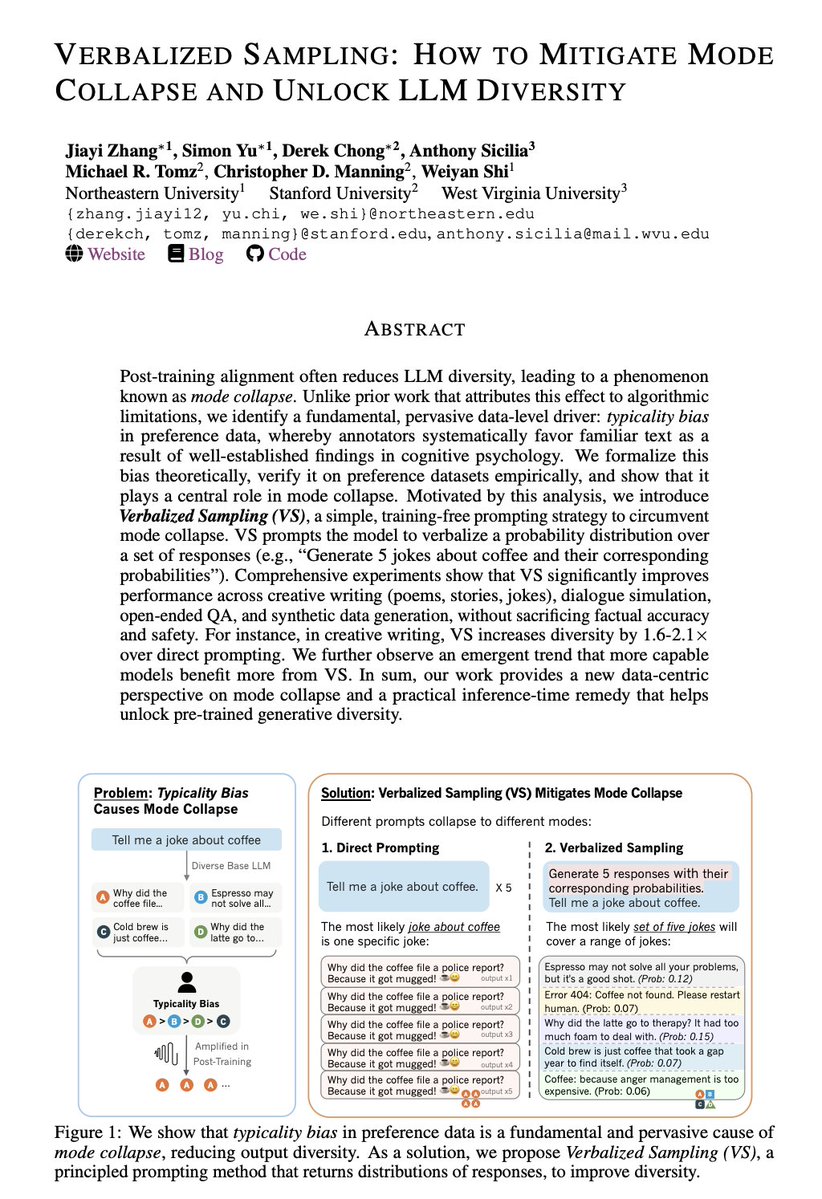
Stanford proved that ChatGPT, Claude, and Gemini are all secretly running at a fraction of their real creative capacity.
And one prompt unlocks the version they hide from you.
This paper reveals that the multi-billion dollar process of "Alignment" (RLHF) has accidentally lobotomized AI creativity.
Researchers discovered a phenomenon called Typicality Bias.
When humans rate AI responses, they have a deep psychological drive to choose the most "typical" or familiar-sounding answer.
They don't want the most creative story; they want the one that sounds most like a generic story.
The AI learned this.
It realized that being truly creative actually hurt its safety and preference scores.
So it entered a state of "Mode Collapse", it effectively hid its most original ideas to stay within the safe, boring boundaries we set for it.
But the creativity is still there. It’s just locked.
Stanford researchers found a "master key" to bypass this training and it is ridiculously simple.
They call it Verbalized Sampling (VS).
Instead of asking the AI for one answer, you ask it to verbalize a distribution of responses and their probabilities.
Ex: "Generate 5 unique jokes about coffee and the probability that each one is actually funny."
The results are staggering:
- 2.1x increase in output diversity.
- 25% jump in human evaluation scores for creative writing.
- Zero loss in factual accuracy or safety.
By forcing the model to calculate its own probability distribution, you "unlock" the 66.8% of generative diversity that was suppressed during training.