A la izquierda: imposición de manos a los diáconos que serán ordenados sacerdotes.
A la derecha: promesa de fidelidad a [“la iglesia”] al recibir la “ordenación episcopal”.
Let us rejoice and pray for the 4 new priests ordained by His Eminence Raymond Cardinal Burke for the Institute of Christ the King.
ad Jesum cum Petro!
The declaration recently presented by Cardinal Fernández indicates that Pope Leo XIV has now revoked the ordinary faculties for SSPX confessions that were granted by Pope Francis in 2015 and extended in Misericordia et Misera, but this does not make SSPX absolutions invalid. By ordination, every priest receives the sacramental ‘power of order’ to absolve sins; what a papal provision can grant or withdraw are ‘ordinary’ or delegated faculties within the current canonical regime, not that sacramental power itself. Because confession is also a judicial act reconciling the sinner with the Church, canon law requires jurisdiction for validity – but it equally foresees that, when the salvation of souls is at stake, the Church herself supplies jurisdiction in cases of necessity, doubt, or common error, as recognised in canon 144 together with canons 976 and 1335 and their predecessors in the 1917 Code.
In SSPX chapels, priests known to be validly ordained routinely hear confessions in public ministry, and a substantial portion of the faithful quite naturally presume that they have the needed faculties. That stable situation of ‘common error in law’ is precisely the case in which canon 144 states that the Church supplies the missing jurisdiction, and classic canonists like Raoul Naz explain that, in such circumstances, absolutions are not only valid but licit when otherwise many would be deprived of the sacrament. Once there is common error based on objective facts – priests visibly functioning as confessors, known to be ordained, confessions heard as a matter of routine – supplied jurisdiction extends to all penitents in that context, including those well aware that the priest lacks ordinary diocesan faculties.
Rome’s own practice confirms this. In 1989, Cardinal Mayer, writing as President of the Pontifical Commission ‘Ecclesia Dei’, answered a layman troubled about SSPX sacraments: invoking the principle of common error, he stated that ‘the acts are therefore valid’, explicitly citing the canons on supplied jurisdiction and on the rights of the faithful to the sacraments. A respected canonist, Georg May, later publicly affirmed that the Church provides the jurisdiction needed for SSPX priests to absolve validly. Furthermore, when communities formerly linked to the SSPX have been ‘regularised’ under Ecclesia Dei or similar structures, Rome has never required their faithful to repeat past confessions, even conditionally; that silence, over decades and millions of absolutions, is a de facto recognition that those confessions were valid. Bishop Bernard Fellay has also explained that, when SSPX priests encounter grave sins reserved to the Holy See, they follow the standard procedure: notify Rome within thirty days and await the reply authorising absolution and appropriate penance. In every reported case, the Vatican has responded that everything is ‘good and licit’ and has granted the necessary faculty – which presupposes that Rome accepts that a real confession has taken place and that jurisdiction in foro interno is present.
Leo XIV’s 2026 decision therefore explicitly revokes the ordinary faculties graciously granted by Francis in 2015, but it cannot retroactively cancel the Church’s own act of supplying jurisdiction in situations of necessity and common error, nor the sacramental power of order given at ordination and exercised for decades. Canon 1752 reminds us that ‘the salvation of souls’ is the supreme law of the Church, and this principle governs how the canons on jurisdiction are applied: the faithful’s right to the sacraments cannot be sacrificed to disciplinary manoeuvres or polemical rhetoric. A Catholic who confesses to an SSPX priest in good faith still receives a valid absolution, because, whatever is now being promulgated from Rome, the Church continues to supply what purely disciplinary decrees attempt to take away.
#sspx #canonlaw #catholicism #confession
@UcheMaryOkoli Hey Uche, comparing SSPX to protestants eventhough they're excommunicated is oversimplified. Many times they stated in their professions they are Roman and Catholic believe in the Pope as their Holy Father, pray for Local Bishops. Would a protestant do that?
Interesting analysis published today by @Infovaticana: https://t.co/UlJrXSQAhv
The author is not identified, but it was obviously written by a canon lawyer.
“The result of the analysis is as follows. First: the only validly declared censure is that of the six bishops, by means of the Decree. Second: with respect to the clergy, the Note lacks formal suitability to declare penalties, contradicts the conditional admonition of the Decree itself, and omits the individual judgment of imputability required by cann. 1321-1325 and 1720; the censures, if they exist, would be undeclared and would remain suspended upon the faithful’s request for sacraments (can. 1335 § 2). Third: with respect to the laity, the reference to the 1996 Note — with its requirement of a double element and case-by-case judgment — excludes automatism by definition. Fourth: the declaration of invalidity of confessions and marriages purports a derogatory effect on existing pontifical acts that a dicasterial note without specific approval cannot produce (can. 21). One may add an indication of the technical imprecision of the whole: Bishop Fellay is censured solely under can. 1364 § 1, whereas can. 1387 reaches whoever consecrates without a mandate, a condition that also concurs in the co-consecrator.
In sum, the juridical formula chosen by the prefect — declaring six by decree and all the others by note — leaves without effect, in law, the excommunication of the priests and laity of the Fraternity: where there was penal form there are only six addressees, and where the others are named there is no penal form. If the Holy See intended to extend the consequences of the schism to the entire Fraternity, the law in force required another route: law or penal precept, individual declaratory decrees preceded by the procedure of can. 1720, and express revocation, with specific pontifical approval, of the concessions of Misericordia et misera and of 2017. For the moment, none of this has been done.”
@LumenExTenebris@ShaneSchaetzel@RealDeus_Vult That's really who you are, aren't you? You even don't counter arguments.
As you really wanna know my position: I'm totally agree with dr. Peter Kwasniewski. The problem of the SSPX is complicated. I knew some SSPX priest even we laugh and eat together. I've met late Bp. Tissier
@LumenExTenebris@ShaneSchaetzel@RealDeus_Vult Catholic Church always condemn pride. No one can celebrate it.
You are seeing the individuals who haven't been sanctioned yet.
Just like our Lord, knowing Judas would betray Him, He never sanctioned Judas.
@LumenExTenebris@ShaneSchaetzel@RealDeus_Vult If you can't see the pattern here, you can't call yourself Catholic.
You don't leave Jesus because there is a corrupt Judas in it.
If you still can't comprehend I suggest you can't call yourself a Catholic
@DrKwasniewski Doctor I've asked you on Facebook a couple years ago regarding liturgy. Now finally I found, there are people that see this problem neutrally. I can argue for the SSPX and for the Holy See. It's so complicated that even the Holy See needed to make PCED. I hope there'll be PCED 2.
I have said all along that I am not taking a public stance against or in favor of the SSPX, and that remains true. As a result, fire-breathing opponents of the Society, some of whom (I am ashamed to say) even rejoice in today’s excommunications, will no doubt write me off as a duplicitous agent, while adamant defenders of it may call me a coward or a half-hearted defender of tradition. And so on. I’ve heard it all before.
But it’s not fundamentally about attitudes, it’s about theology. As a philosopher and theologian, I can make convincing arguments on both sides all day long.
The one side takes as its first principle that communion in the Church requires, above all else and before all else, union with and submission to the pope of Rome; and therefore absolutely nothing could ever “compete,” as it were, with this good. It is the “summum bonum” as far as the Church on earth is concerned; one may never, in any circumstance whatsoever, defy church authority.
The other side takes as its first principle “salus animarum suprema lex” (the health, welfare, salvation of souls is the highest law)—a law, they argue, which can, in peculiar circumstances, suspend or modify the usual rights of the Church hierarchy, which has as its raison d'être bringing souls the goods they need and deserve (the pope as “servus servorum Dei”; another way of putting it is that authority loses its binding force when it threatens or undermines the common good).
Obviously, this is a mere sketch of the two sides, and whole books have been written from and for the one or the other perspective. (I have contributed to this literature with several books, among them "True Obedience in the Church: A Guide to Discernment in Challenging Times" and “Bound by Truth: Authority, Obedience, Tradition, and the Common Good.")
If you think the one or the other position is obviously, self-evidently, exceptionlessly correct—a “no brainer”—then I believe you might be a simpleton. You might be deceiving yourself if you have no moment of hesitation or doubt, no sympathy that might tug you toward the opposite point of view. That is why I consider this moment to be especially tragic: it causes division not only within the Church at large, but also within the breast of every educated and attentive Catholic, in whom the tension between tradition and authority is like a perpetual tug of war. *It should not be this way* and that itself is a sign of the depth of our crisis.
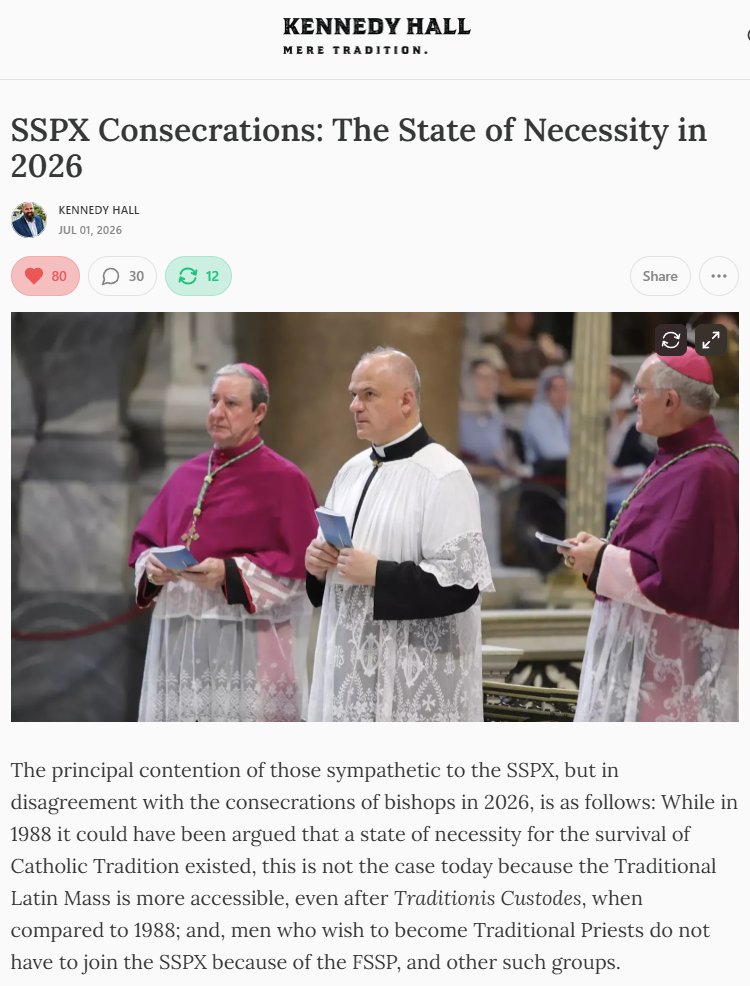
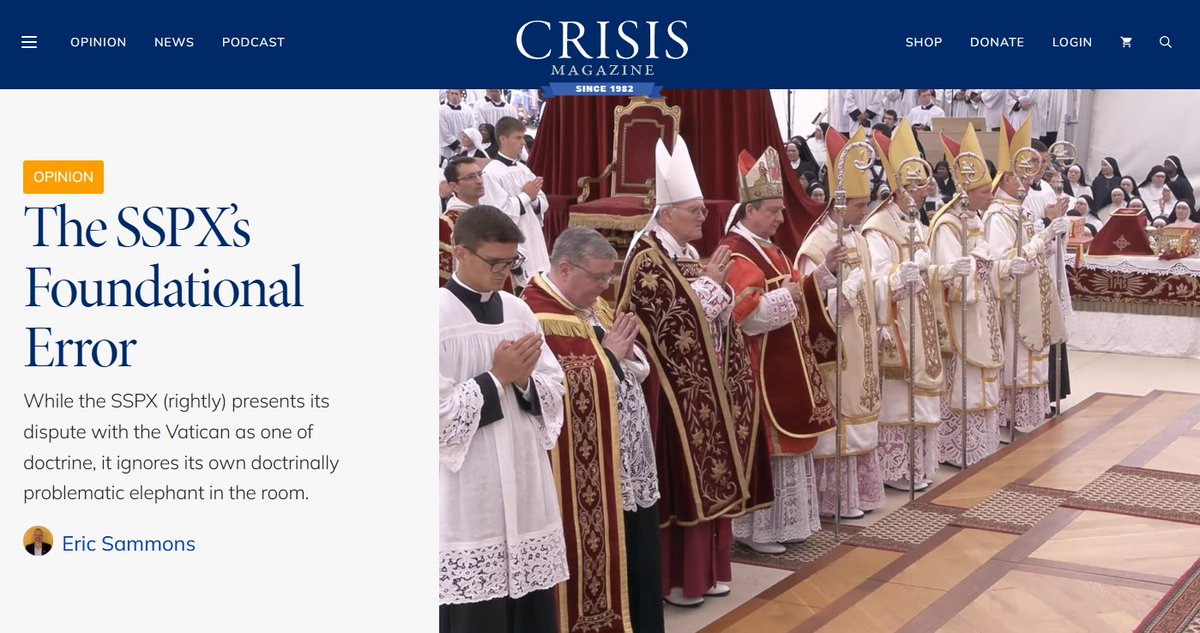
So much is being written about these things that one can feel overwhelmed, like a swimmer drowning in a stormy ocean. For this reason, I would like to present two essays that seem to me to convey effectively the two positions sketched above: one, against the SSPX, by Eric Sammons; the other, by Kennedy Hall, in favor of it (links below).
I defy anyone to read these carefully and then to say, of either one, “It’s worthless, he has no case to make, it’s a closed book—just obey! (or: just shake the dust off your feet!).” I don’t think anyone, not a single person, has a slam-dunk case at this moment. To be completely honest and transparent, THAT is why I don’t come down more definitively on these questions. My conscience would not allow me to do so, and I’m enough of a disciple of St. Thomas Aquinas and St. John Henry Newman to know that I cannot act against my conscience.
No one, at any rate, could call into question my devotion and dedication to liturgical tradition, which I consider the single most important issue facing the Latin Church—yes, in a way, even greater than doctrinal issues. After all, in the very diverse world of Catholic traditionalism, the traditional Roman Rite is perhaps the one and only thing on which every type of traditionalist agrees. It has at least a pragmatic priority as a non-negotiable pastoral good. Regardless of how much the SSPX may insist on “doctrine” as its principal focus, the TLM is inseparable from its overall case (can you imagine an SSPX with the Novus Ordo?).
And that is why, as long as ‘Traditionis Custodes’ remains on the books and bishops are allowed to destroy TLM communities with impunity, there will be no prospect of peace on the horizon, and the Society will continue to expand. The key to overcoming this purported schism rests firmly in the hands of the Church hierarchy, which can end the liturgical (and doctrinal and moral) crisis whenever it truly desires to do so or even begins to desire to do so. That may still be a very long time.
“O God, the heathens are come into thy inheritance, they have defiled thy holy temple… We are become a reproach to our neighbours: a scorn and derision to them that are round about us. How long, O Lord, wilt thou be angry for ever: shall thy zeal be kindled like a fire?... Remember not our former iniquities: let thy mercies speedily prevent us, for we are become exceeding poor. Help us, O God, our saviour: and for the glory of thy name, O Lord, deliver us: and forgive us our sins for thy name's sake… Let the sighing of the prisoners come in before thee.” Psalm 79 (DR)
Eric Sammons:
https://t.co/wWcVCTwLnV
Kennedy Hall:
https://t.co/JmOtjliVEi
"True Obedience in the Church"
https://t.co/iLcc6v2d8f
"Bound by Truth"
https://t.co/x9JNdzvZRh
@LumenExTenebris@ShaneSchaetzel@RealDeus_Vult Again. Whataboutism. A common logical fallacy.
Will you side with our Lord Jesus Christ for choosing and even condone Judas as a treasurer besides He is all-knowing that He chose the one that will betray Him and will not repent?


![ehenriquezlc's tweet photo. A la izquierda: imposición de manos a los diáconos que serán ordenados sacerdotes.
A la derecha: promesa de fidelidad a [“la iglesia”] al recibir la “ordenación episcopal”. https://t.co/RGIodfR0EJ](https://pbs.twimg.com/media/HMVXIi1bgAEdWzO.jpg)




![ehenriquezlc's tweet photo. A la izquierda: imposición de manos a los diáconos que serán ordenados sacerdotes.
A la derecha: promesa de fidelidad a [“la iglesia”] al recibir la “ordenación episcopal”. https://t.co/RGIodfR0EJ](https://pbs.twimg.com/media/HMVXIi4aYAAZFkk.jpg)