Max Brin is developing a product he describes as an ‘AV for AI’. A kind of antivirus for AI but more as a human layer. The name of the product is OpenLeash, which is more informative: the product keeps a controlling leash on unexpected and unwelcome actions that can be caused by AI agents.
It runs alongside the agent and provides an authorization layer aimed at keeping autonomous AI agents accountable, secure, and aligned with user intent when they perform real-world actions.
OpenLeash intercepts agent intentions. Depending on the configuration applied by the user, OpenLeash monitors the agents’ actions and where necessary asks the user if the action by the agent should be allowed. If no, that action is paused. If yes, it is allowed. Brin describes it as ‘medication for AI anxiety’.
But in other cases where Leash is not sure, it asks the user: did you intend to delete your entire database – or did you intend to upload your credentials to this or that or those websites.
Basically, it’s like a guardian angel that intercepts all the conversations between an agent and network assets. It does this on in-house agents, on cloud agents and on third-party agents, and then it helps users decide if they really want the agent to take that specific action.”
While OpenLeash is still described as under development, it is also in active use. Brin has a list of planned additions and improvements that he suspects will take a couple of months to complete. Meanwhile, the existing product is already in active use by several hundreds of personal users and at least four organizations.
He sees OpenLeash as especially relevant to the new class of vibe coders.“AI is bringing us the ability to code and write software, even if we don’t know how to write a single line of code, and have zero understanding of cybersecurity,” he says. “
#Agent #Cybersecurity #Guardian
⚠️ Fake software installers disable Windows Update and weaken Microsoft Defender.
The active campaign has compromised organizations across seven sectors. Each download keeps the same filename but changes the payload hash.
Inside the attack chain: https://t.co/2zO8Jao3Tz
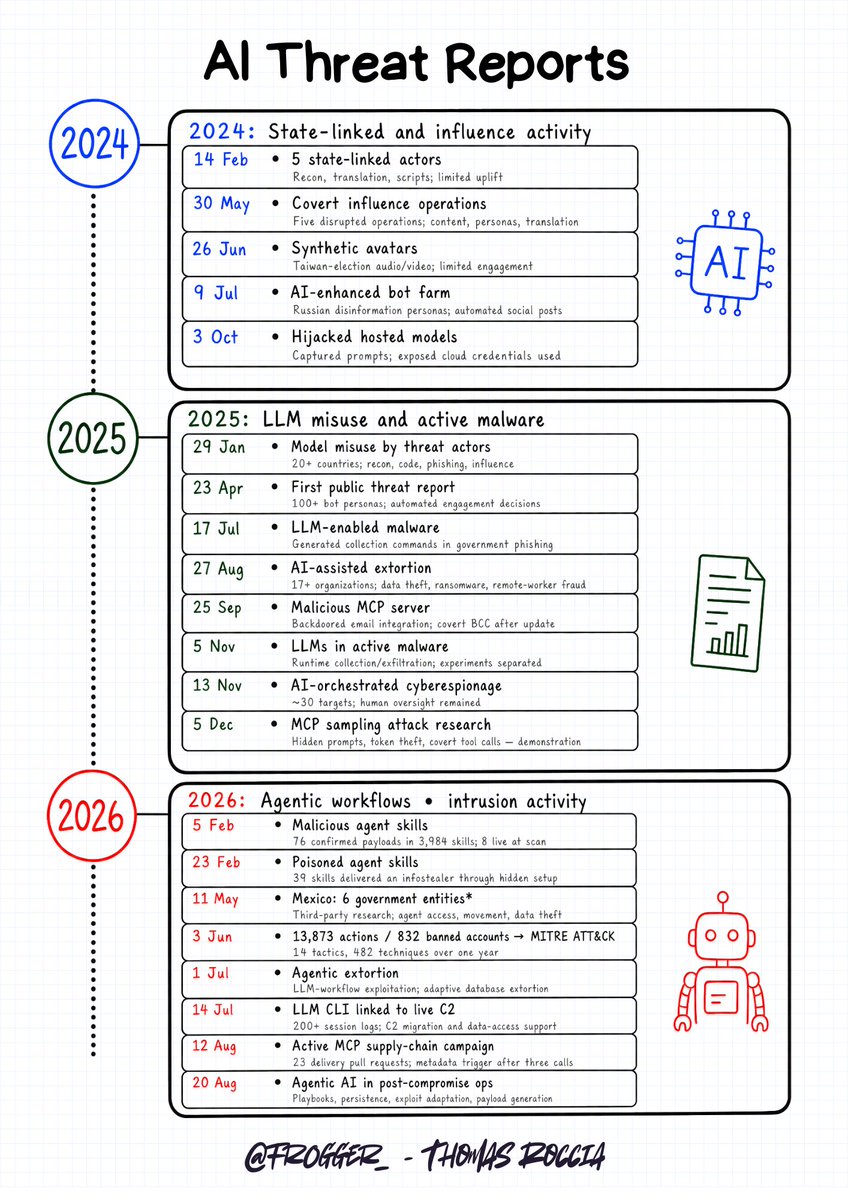
🤓 I compiled some of the early AI Threat Intelligence reports and the progression is interesting!
2024 > AI was mainly used for assistance, influence operations, disinformation and early underground AI infrastructure.
2025 > We saw early malware using LLM, MCP attacks after broader adoption and the first alleged "agentic attacks".
2026 > Agent Skills became a supply chain target. Attackers also took advantage of coding agents that install packages and reports started to show agents such as Claude Code connected to offensive tooling during attacks.
Mozilla has added a built-in ad blocker to Firefox on iPhone.
The new feature can block many third-party ads and ad-related trackers before they load, using Apple’s WebKit Content Blocker technology and the EasyList filter.
It’s optional and turned off by default. You can enable it from Firefox’s settings under Browsing > Ad Blocker.
Roblox has experienced a data leak through third-party vendor FNTech, the online game platform.
"Roblox was aware of a third-party security issue where there was unauthorized access to limited personal information of a subset of our creator community," according to Roblox spokesperson.
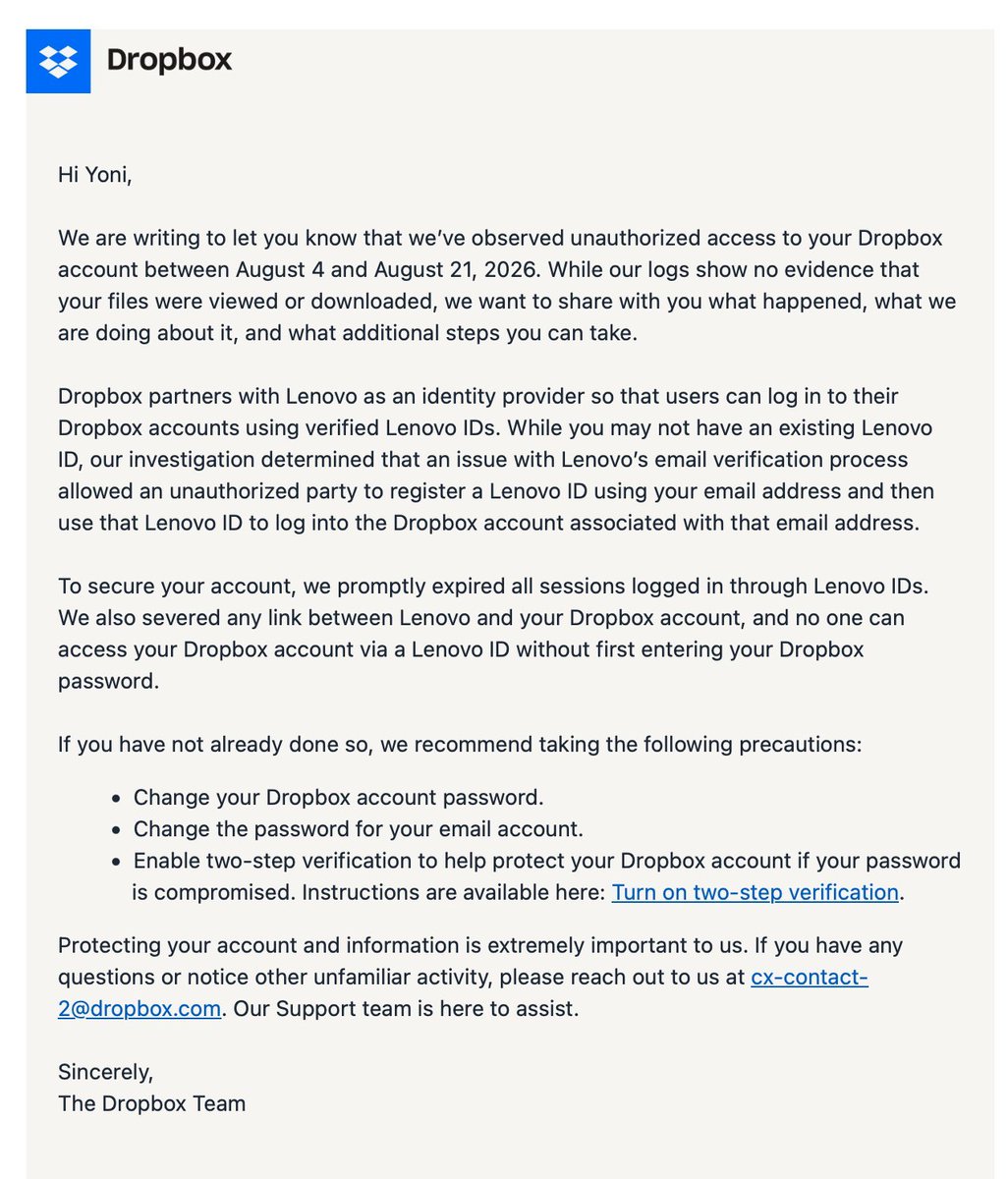
‼️ BREAKING: Dropbox says around 5,000 accounts were accessed without authorisation between 4 and 21 August, with files viewed or downloaded in fewer than a third of them.
Registering a Lenovo ID with someone else's email address was enough. Dropbox trusted Lenovo's verification and handed over a session.
Dropbox has terminated every Lenovo ID session and notified regulators.
Some issues with Memory Safety and Vulnerabilities:
Languages like C and C++ give developers direct control over hardware but lack built-in boundaries, meaning manual memory management can lead to critical bugs.
Industry estimates from organizations like Google and CISA show that roughly 70% of severe, high-impact security vulnerabilities stem from memory safety errors.
Buffer overflows (writing past allocated space) and use-after-free errors (accessing deallocated memory) allow malicious actors to inject arbitrary code or hijack execution flow.
The Solution: Agencies like the Canadian Centre for Cyber Security and CISA urge developers to adopt memory-safe programming languages (such as Rust, Go, or Python) and publish formal memory-safety roadmaps.
#CVE #Memory
HTTP Protocol Internals and Offensive Semantics
(11 sections, 98 lessons, ~294min)
The course is up. And it's free.
A few pointers👇for optimal experience.
https://t.co/JsmnKuuNLJ
❗️ CrowdStrike and NVIDIA have built two AI security models together, one to attack and one to defend
The pair were tested against each other on a digital twin of NVIDIA's own infrastructure
CrowdStrike says both run on NVIDIA Nemotron, trained on Falcon telemetry and 15 years of its incident-response data
Boring IT/cybersecurity skills that give you a huge advantage…
- Being able to troubleshoot authentication issues in Active Directory
- Reading gpresult /h and knowing which GPO settings are being applied
- Knowing when it's not DNS