Big announcement for job seekers in the Devtool marketing space 👋
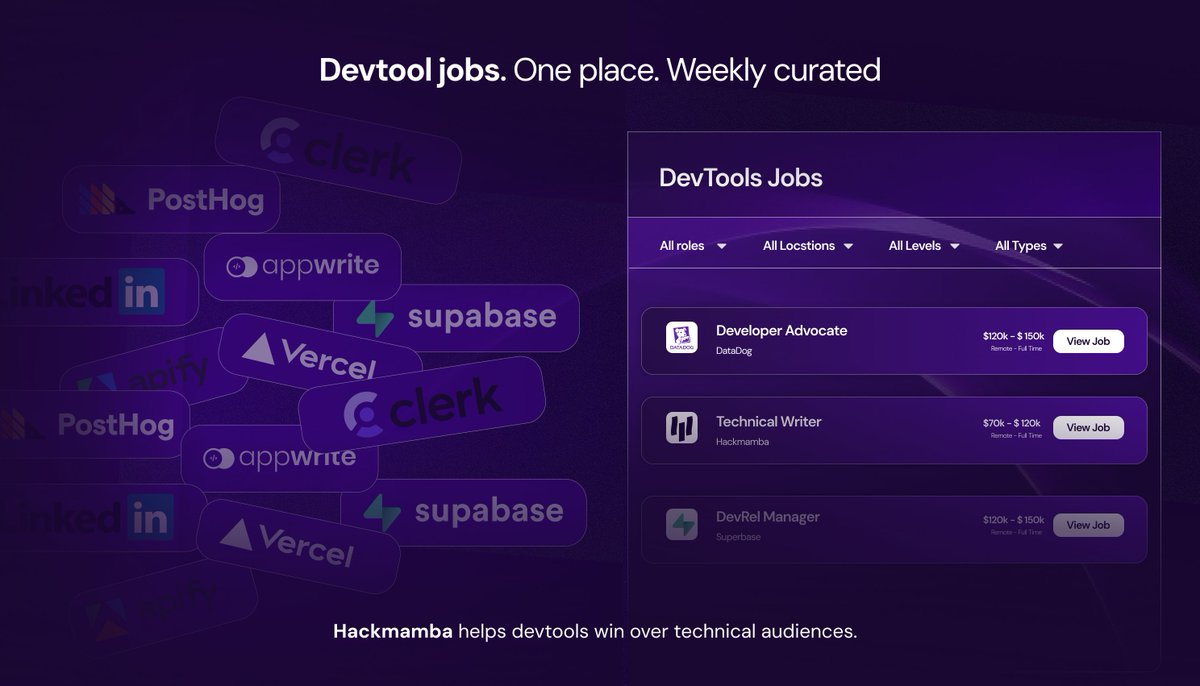
We’ve launched the Hackmamba Devtool Jobs portal!
We regularly hear from technical writers, DevRel, and growth professionals who struggle to find devtools roles without checking multiple places. Jobs are scattered across communities, LinkedIn, and company career pages, making the search slow and inconsistent.
To solve this, we built a dedicated portal that brings relevant devtool roles into one place.
Listings are curated from communities, LinkedIn Jobs, and our own network, so you can quickly see what’s open and decide what’s worth exploring.
We refresh the listings every Friday.
Bookmark it to stay updated on the latest Devtool Jobs 💜
Give yourself time every day to learn the hard parts that technical folks usually suck at.
Growth. Distribution. Community. DevRel. Positioning. Content.
The things that decide whether great technical work actually reaches people.
That’s what the EOC podcast is about.
Some of our latest podcasts:
- How to pick the right DevRel activities and Pattern (The Exact Formula for DevRel Success) with @stmcallister
- How to Win at AI Search Today (Generative Engine Optimization Masterclass) with Andrius Stockunas
- How San Francisco Engineers Hack 10x Growth (The Marketing Secret) with Anya Petrova
- Creating Content for Agent and Machine with @AccordionGuy
- AI and Developer Experience with @jimbobbennett
More coming.
Who should we bring on next?
The average data breach costs $4.45 million. Most of that damage traces back to vulnerabilities that were already sitting in the codebase waiting to be found.
Think SQL injections, hardcoded credentials, and unvalidated file uploads.
The problem at scale is that manual code reviews can't consistently catch these across large repositories with multiple developers committing daily.
AI tools close that gap by reviewing code for known attack patterns, flagging exact lines of concern, and suggesting fixes before code ships.
This article from @coderabbitai walks through three of the most common vulnerabilities, how they are introduced, and a practical workflow for using AI code review to catch them in a real Python Flask application.
Article link below.
AI Search. AI Search. AI Search.
Every marketer seems to be talking about it.
We've spent the last few months helping clients improve their visibility in AI recommendations, testing our own theories, speaking with founders building AI visibility tools, and tracking what actually gets cited by ChatGPT, Gemini, Claude, Perplexity, and Google AI Overviews.
The latest edition of The Markup Mindset is now out.
Inside, we break down:
• Why brand growth is becoming the biggest factor in AI recommendations
• GA4's new AI traffic tracking channel
• The Claude Code skill we're using to increase AI citations
• What we're learning from our own AI search experiments
If you're trying to figure out what's actually working in AI search right now, you'll enjoy this one.
Subscribe and read the latest edition below 👇
Most healthcare teams building RAG systems sign a BAA and assume compliance is handled. It is not.
The BAA protects the cloud provider's infrastructure. It does not control what your application sends through a prompt, what gets written to an external log, or whether retrieval results expose records across departments.
Those failures happen in your code.
This tutorial walks through how to build a clinical RAG system that runs entirely on hospital infrastructure with a local vector database, local models, role-based access enforced at the database level, and audit logs that never leave the network.
Article link in the comments.
(8/9)
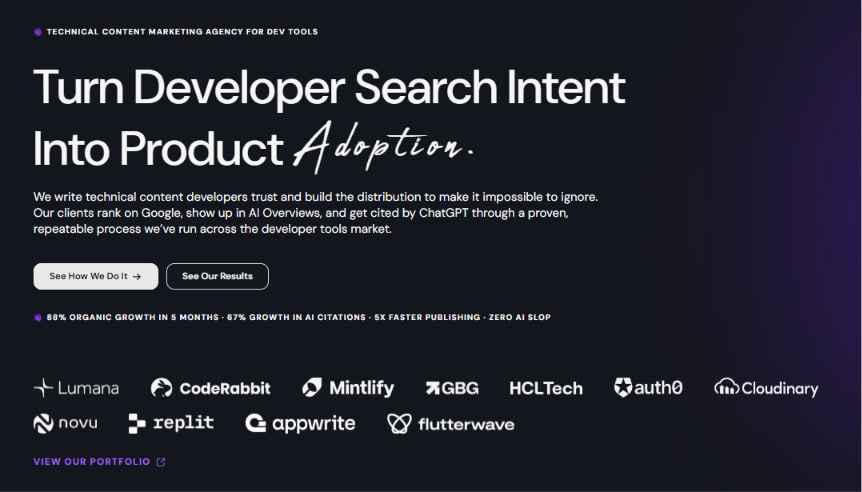
We have run this across 7+ devtools companies now.
Some of them are:
-> A developer education platform we worked with picked up 1.7K AI Overview mentions globally.
-> A video API company saw 67 percent of its content get cited across LLMs, and more.
High time we put together a page that talks about this.
https://t.co/efyH6TslSB