Big announcement for job seekers in the Devtool marketing space ๐
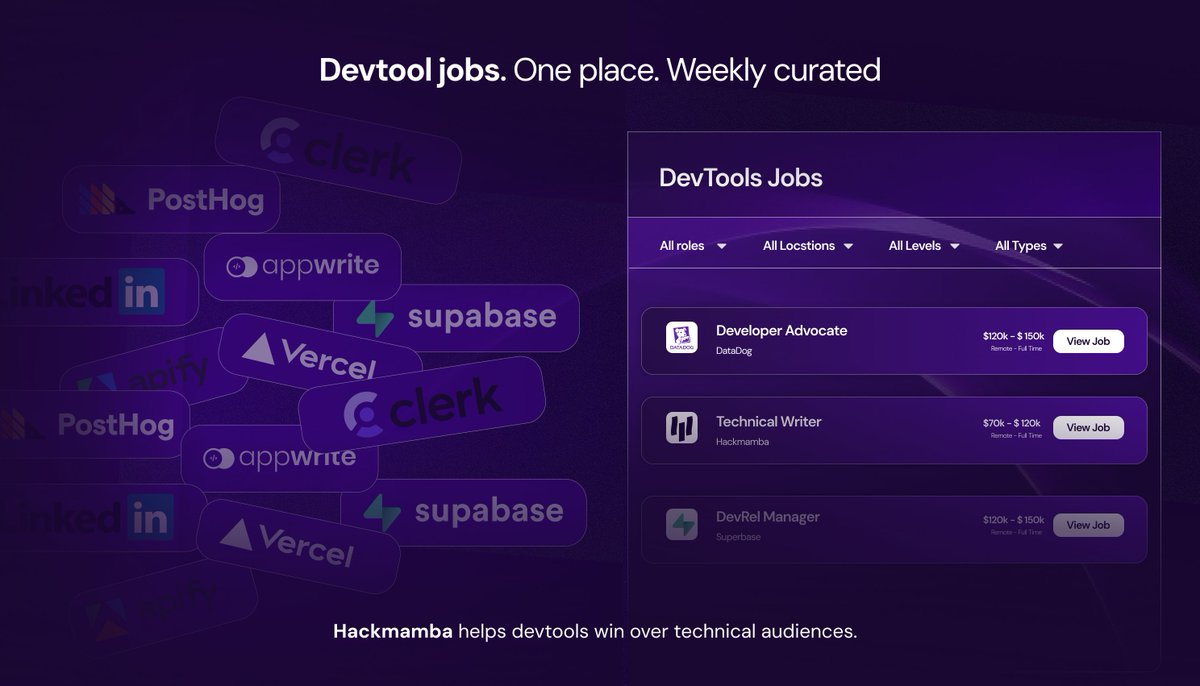
Weโve launched the Hackmamba Devtool Jobs portal!
We regularly hear from technical writers, DevRel, and growth professionals who struggle to find devtools roles without checking multiple places. Jobs are scattered across communities, LinkedIn, and company career pages, making the search slow and inconsistent.
To solve this, we built a dedicated portal that brings relevant devtool roles into one place.
Listings are curated from communities, LinkedIn Jobs, and our own network, so you can quickly see whatโs open and decide whatโs worth exploring.
We refresh the listings every Friday.
Bookmark it to stay updated on the latest Devtool Jobs ๐
Here are the channels that are working for our clients right now:
LLMs are the biggest shift. Hands down! Our clients are seeing an average of 30% of signups coming from ChatGPT, Perplexity, Claude, and Gemini. But LLMs do not work in isolation. They surface your product because your content exists across https://t.co/XfKUrx7MJp, GitHub, and the broader web. The second channel is what feeds the first.
SEO is still essential and remains a must-have for LLMs to cite you accurately. But we are seeing signups from organic search drop relative to LLM-driven signups. The two are connected but the mix is shifting.
Reddit is working for some of our clients in ways most teams are not doing. We have accounts with 100+ karma that let us seed genuine discussions around specific developer pain points and get conversations going. We also create and manage developer communities on Reddit to distribute content directly. Reddit threads also count as AEO signals, which helps your content get cited in AI search.
Search ads still work if you are in an established category and have the budget for it. In the US, expect to pay $100 to $300 per developer signup on search ads.
Retargeting on Meta and LinkedIn is one of the highest ROI plays right now. Developers who have already visited your docs or pricing page are close to deciding. We are seeing cost per signup from retargeting campaigns at $30, which makes it one of the most efficient ways to close the loop on warm audiences.
Meta ads work well for low ticket products in the $15 to $50 range. Above that the unit economics stop making sense for most devtool companies.
Over 3 years of working in developer marketing, we have identified specific LinkedIn groups and Discord channels that consistently drive distribution. We shared last week how distributing a @coderabbitai article in one of these LinkedIn groups drove thousands of impressions from a single post.
Influencer partnerships are still worth it at the right price. One of our clients got 500K impressions on X from a $5K spend on their product launch day. That is pretty cheap for the reach you get with a developer audience.
Whatโs working for you?
Soon after we shared our technical writing process at Hackmamba last week, we got a question from a few technical writing enthusiasts:
"What AI tools would you recommend for technical writing?"
Here's the stack our technical Writer and developer advocate, @khanasjad21, recommends:
โข @perplexity_ai for research and finding supporting sources.
โข @NotebookLM for understanding documentation, API references, and product materials.
โข @NotionHQ for turning research into content briefs and outlines.
โข @claudeai for working through technical concepts and identifying gaps before drafting.
โข @boki_io for reviewing content against documentation and catching technical issues.
โข @GeminiApp for editing, improving flow, and simplifying complex sections.
Each tool serves a specific purpose. The value comes from using them at the right stage of the workflow.
That said, human involvement is still critical.
Someone still needs to validate claims, test code, verify outputs, challenge assumptions, and ensure the content is accurate and useful to the reader.
AI can help you move faster, but the responsibility for quality still belongs to the writer.
What tools are part of your technical writing workflow?
Most Selenium-to-Playwright migrations stall somewhere between Phase 1 and Phase 2 and never fully recover.
The illustration shows the sequence that works. Teams start before touching any code. They confirm ownership, align QA, dev, and DevOps, and set realistic expectations.
- Phase 1 builds the foundation. Installing Playwright and rebuilding auth helpers.
- Phase 2 introduces new tests written in Playwright, starting from the highest-impact flows.
- Phase 3 migrates what remains and retires everything that doesn't need to follow.
The full guide by @currents_dev covers each phase in detail, including the infrastructure decisions, the team dynamics, and where migrations most commonly break down.
Article link in the comments.
The Technical Video Content Creator role at Hackmamba is still open.
If you're a software engineer based in Europe who's comfortable explaining technical concepts on camera, we want to talk to you.
You don't need to be a polished YouTuber. You just need to know your way around code and be comfortable on camera. We'll handle the rest.
Link in the comments.
Join our Hackmamba Creators' Discord Community! https://t.co/1e8GAO9iJo
To join, you must fill out the short form in the right side of the page. Enter your name and other details needed.
You can scroll down a bit and see why you should join our other creators + you can check our past community events! ๐
Last week's Off the Docs session with Manny Silva was exactly the kind of conversation we built the Hackmamba Creators community for.
Manny came in with ideas and lit up the discussion with all the attendees:
- Docs as testable assertions
- Documentation that self-heals
- Where to automate using AI so writers can focus more on the work where human insights and expertise are needed the most for top-notch content.
And yes, the vibes? Unmatched. Everyone was hooked, pen and paper in hand, taking notes and learning.
This is what happens when you put great practitioners in front of a community that is actively doing the work. The interaction goes deeper, and everyone walks away with something they can use.
More sessions and other community activities are coming soon. If you want to be part of these conversations, the link to join the Hackmamba Creators community is in the comments.
Kenny Eze is a technical writer, developer advocate, and Founder of DXMentorship.
He knows what good content operations look like because he has lived the broken version of it.
His take on Boki: a fresh breath for content operations and working with marketing teams.
Boki keeps that context intact from research to distribution. That is the difference @kenny_io noticed.
This is your weekly reminder to check the devtool job board.
Every Friday, we drop a fresh batch of job vacancies across these roles: DevRel, GTM, Marketing Ops, Technical Writing and more.
This week, we added 15 new opportunities from different companies.
Be an early applicant. Or share it with someone who's looking.
Apply to the link below.
When you build the most comprehensive resource on every concept, other developers naturally cite your pages as references in their own content.
Engineering teams link to your spoke pages when listing required skills in job descriptions.
Content teams use them as source material when covering the same topics. That is how 452K backlinks were earned across 24 months without a single outreach email sent.
Full case study: https://t.co/BDmJWT8BSN
Most devtool SEO strategies stop at long tail keywords. That is a solid starting point. When your domain authority is low and you do not have enough backlinks to compete, going after head terms is a waste of time regardless of how good the content is. Long tail keywords are where you earn your first rankings, build backlinks, and grow the domain authority you need to eventually push for the terms that actually move the needle. But a long tail is where you start, not where you stay.
That is exactly what happened with @roadmapsh. We mapped the full topic cluster across every technology track they cover, including frontend, backend, DevOps, system design, React, and Kubernetes. One hub page per track, spoke pages for every concept branching from it, and writers who had actually worked in the stacks they were covering. A page about system design was written by someone who had built distributed systems, not a generalist who researched it.
Over 24 months, the content earned citations across Google AI Overviews, ChatGPT, and Perplexity without a single outreach email sent. Referring domains grew from 2,475 to 6,256, entirely organic. Roadmap now ranks number one for "frontend development" at 58,000 monthly searches, a head term most SEO teams would have told them to ignore for years.
138% organic traffic growth in 24 months. The carousel below shows how we built it.
The last few weeks have been a busy one.
I've Been juggling:
upskilling (I'm currently learning API documentation through @hackmamba sprint)
building for hackathons and bounties.(I even Missed some deadlines).
and I am glad I'm making progress regardless.
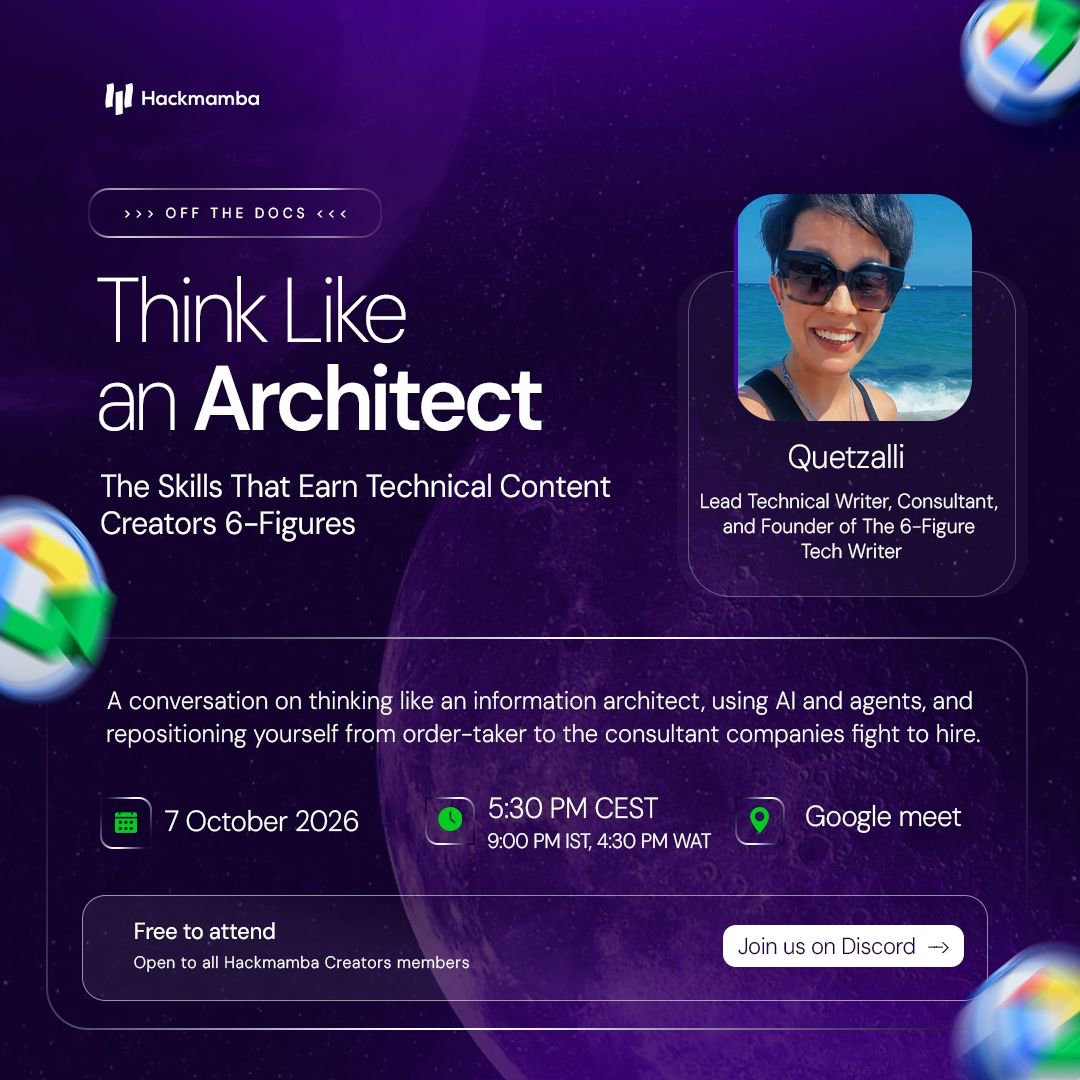
Our next Off the Docs session is scheduled for this Thursday, May 28th, and we are bringing in someone whose work sits squarely at the intersection of AI and documentation.
Manny Silva, Head of AI Docs Practice at Promptless, is joining the Hackmamba Creators community for a conversation on AI, APIs, and what it means to be a technical writer right now.
- How is AI changing the way documentation teams work?
- Where does it help and where does it create new problems?
- What does building an AI docs practice from the ground up look like in practice?
These are the questions worth having a conversation about, and Manny is surely the right person to have it with.
Date: Thursday, May 28, 2026
Time: 6:00 p.m. CEST / 5:00 p.m. WAT / 9:30 p.m. IST / 9:00 a.m. PT
Platform: Calendly
Free to attend, open to all Hackmamba Creators members.
The Calendly link and the community link are in the comments.
We are genuinely good at this. And our clients say it better than we do.
"Working with Hackmamba is like having a 10x technical writer who is in your team."
"They take complex topics and translate them into clear, engaging content that speaks directly to our audience."
"They deliver good quality results without needing much oversight."
Here is why.
Every article we write goes through three review passes before it reaches a client. This is the stage where most content teams cut corners and where we do not.
@BibiTheWriter, our content operations manager, runs the first pass using @boki_io's marketer review agent. It flags sentence-level clarity issues, structural problems, and anything that disrupts the reading experience with specific suggestions. Blessing reviews every flag and decides what changes. The tool surfaces the problems. The human makes the call.
The second pass is technical review. Most content teams either skip it entirely or send a Slack message to an overworked engineer and hope for the best. Ours uses Boki's technical review agent to audit technical terms for accuracy, validate that sources back every claim, check code behaviour, and flag anywhere the piece loses coherence as a technical argument. This pass alone has cut writer back-and-forth by 65%. Our content marketers, @xamfonos_ and @rochiberardo, then own this review for their respective teams, focusing on whether the narrative arc holds, whether the argument would survive scrutiny from an experienced developer, and whether it ties back to the client's goals. If it gets past Henry or Rocio, it is ready for the final check.
The third pass belongs to Stella, our technical editor. She catches anything that slipped through, grammatical errors, sentences that do not quite land, and transitions that break the flow. Nothing goes to the client until Stella signs off.
That is the Hackmamba standard. Every article. Every time.
Day one with AI-generated code usually feels great. Day two is when it falls apart. New features break existing components, the AI logic is tangled into the UI, and nobody knows which version of what is deployed.
This article from @bitcloud_ covers a build workflow designed specifically for what happens after day one.
You will build a chat app where every component is independently versioned, the AI layer is isolated enough to swap providers without a refactor, and the backend stays pluggable through repository interfaces.
If you have shipped AI-generated code and spent the next sprint cleaning it up, this is worth a read.
Link in the comments.