Oh Lord release your power to work in us and through us, till we are changed to be more like you.
And all the world will see your glory revealed and worship you. 🙌🏾
I appreciate the emphasis on reading Scripture and seeking the Holy Spirit’s help. Every Christian should do that. However, I think this creates a false contrast between Scripture and theology that the Bible itself does not make.
Theological books are not automatically “high-sounding knowledge books with philosophical inferences.” Many are simply believers explaining what they understand the Bible to teach. If explaining Scripture through a book is wrong, then sermons, Bible studies, commentaries, and discipleship materials would also be problematic. The real issue is whether what is being taught is faithful to Scripture.
The apostles themselves did theology. Romans explains justification, Galatians explains law and grace, Hebrews explains Christ’s priesthood, and Ephesians explains the church. They did more than quote verses. They interpreted, connected, defended, and applied biblical truth.
Yes, the Holy Spirit gives understanding. Yet the same Holy Spirit also gave teachers to the church (Ephesians 4:11-12). God has always used human instruments to help His people grow. Timothy knew the Scriptures from childhood because he was taught by others, and Paul continued to instruct him throughout his ministry.
Church history also shows that many of the church’s greatest defenses against error came through careful theological study. The doctrines of the Trinity, the deity of Christ, justification by faith, and many other foundational truths were preserved because faithful believers studied Scripture deeply and wrote extensively about it.
I agree that information overload can be a problem. We live in an age where everyone has an opinion. But the solution is discernment, not disengagement from theological study. The answer is to test everything by Scripture and hold fast to what is true.
A healthy Christian life is not Bible versus theology, Scripture versus teachers, or the Holy Spirit versus study. It is reading Scripture, praying for illumination, learning from faithful teachers, and testing every teaching by God’s Word. Those things work together, and that is the pattern we see throughout Scripture.
At my direction, following the visit of a high-level Federal Government delegation that I sent to the Esiele and Yawota communities in Oriire Local Government Area of Oyo State, I have approved the recruitment of 1,000 forest guards in collaboration with the Oyo State Government.
I appreciate the emphasis on reading Scripture and seeking the Holy Spirit’s help. Every Christian should do that. However, I think this creates a false contrast between Scripture and theology that the Bible itself does not make.
Theological books are not automatically “high-sounding knowledge books with philosophical inferences.” Many are simply believers explaining what they understand the Bible to teach. If explaining Scripture through a book is wrong, then sermons, Bible studies, commentaries, and discipleship materials would also be problematic. The real issue is whether what is being taught is faithful to Scripture.
The apostles themselves did theology. Romans explains justification, Galatians explains law and grace, Hebrews explains Christ’s priesthood, and Ephesians explains the church. They did more than quote verses. They interpreted, connected, defended, and applied biblical truth.
Yes, the Holy Spirit gives understanding. Yet the same Holy Spirit also gave teachers to the church (Ephesians 4:11-12). God has always used human instruments to help His people grow. Timothy knew the Scriptures from childhood because he was taught by others, and Paul continued to instruct him throughout his ministry.
Church history also shows that many of the church’s greatest defenses against error came through careful theological study. The doctrines of the Trinity, the deity of Christ, justification by faith, and many other foundational truths were preserved because faithful believers studied Scripture deeply and wrote extensively about it.
I agree that information overload can be a problem. We live in an age where everyone has an opinion. But the solution is discernment, not disengagement from theological study. The answer is to test everything by Scripture and hold fast to what is true.
A healthy Christian life is not Bible versus theology, Scripture versus teachers, or the Holy Spirit versus study. It is reading Scripture, praying for illumination, learning from faithful teachers, and testing every teaching by God’s Word. Those things work together, and that is the pattern we see throughout Scripture.
@pfemiolaleye Theological book are high sounding knowledge books with philosophical inferences. I would advise people to read the Bible more and pray that Holy Spirit helps with understanding. Paul prays for Christians to be filled with knowledge. And from a child thou art known the Holy Scr.
We partnered with Anthropic to release our Claude Code course free for everyone. No subscription required!
@lydiahallie teaches you the agentic loop. CLAUDE.md. Skills. Hooks. Subagents. Agent teams.
🧑💻 Learn Claude Code, free: https://t.co/8ZeXhKBb4N
One of the things you should be intentional about as a parent is Catechizing your children.
Especially if you were raised Neo-Pentecostal in Nigeria. Because chances are, you have no conception of what it really means to be catechized. (NB This is my experience too).
We are genuinely good at this. And our clients say it better than we do.
"Working with Hackmamba is like having a 10x technical writer who is in your team."
"They take complex topics and translate them into clear, engaging content that speaks directly to our audience."
"They deliver good quality results without needing much oversight."
Here is why.
Every article we write goes through three review passes before it reaches a client. This is the stage where most content teams cut corners and where we do not.
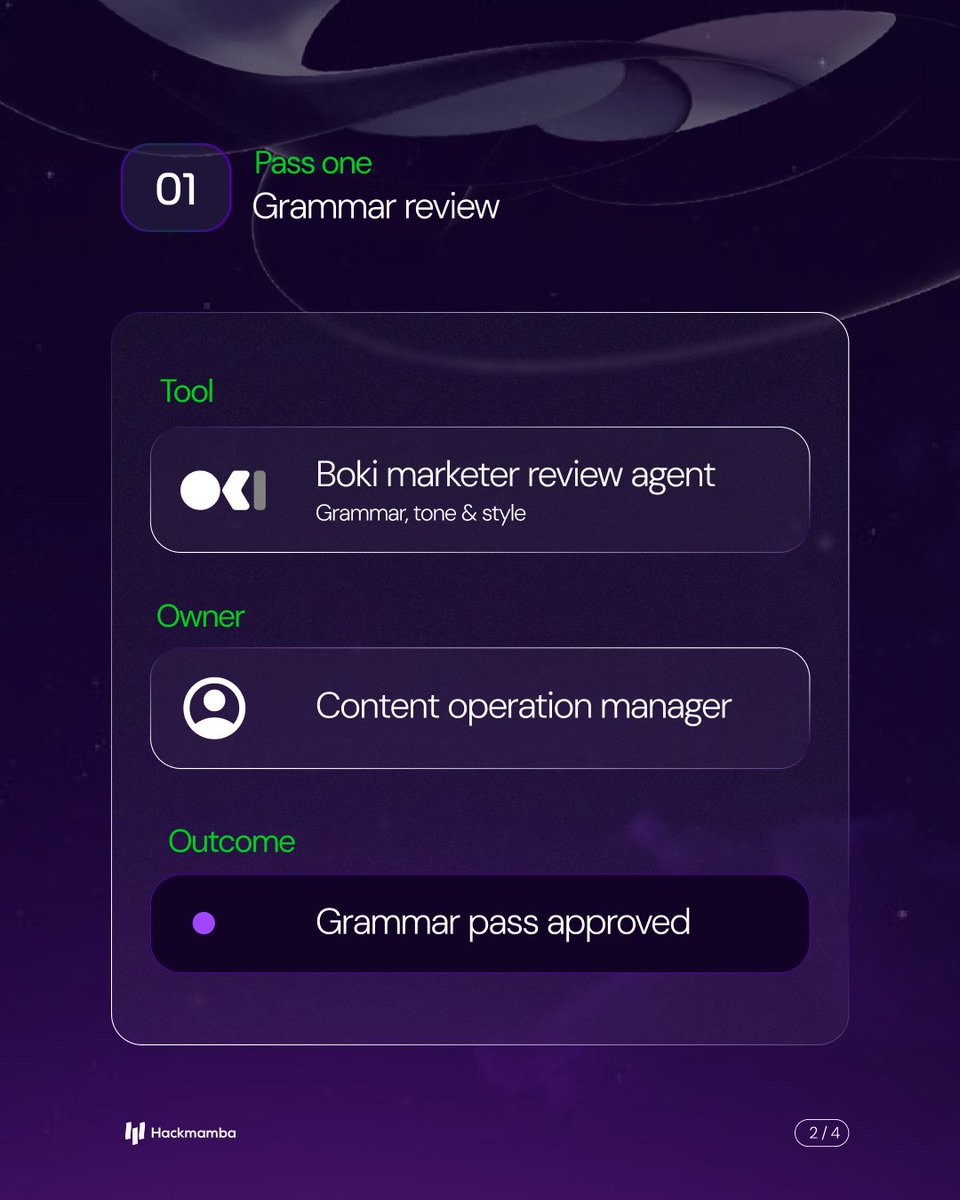
@BibiTheWriter, our content operations manager, runs the first pass using @boki_io's marketer review agent. It flags sentence-level clarity issues, structural problems, and anything that disrupts the reading experience with specific suggestions. Blessing reviews every flag and decides what changes. The tool surfaces the problems. The human makes the call.
The second pass is technical review. Most content teams either skip it entirely or send a Slack message to an overworked engineer and hope for the best. Ours uses Boki's technical review agent to audit technical terms for accuracy, validate that sources back every claim, check code behaviour, and flag anywhere the piece loses coherence as a technical argument. This pass alone has cut writer back-and-forth by 65%. Our content marketers, @xamfonos_ and @rochiberardo, then own this review for their respective teams, focusing on whether the narrative arc holds, whether the argument would survive scrutiny from an experienced developer, and whether it ties back to the client's goals. If it gets past Henry or Rocio, it is ready for the final check.
The third pass belongs to Stella, our technical editor. She catches anything that slipped through, grammatical errors, sentences that do not quite land, and transitions that break the flow. Nothing goes to the client until Stella signs off.
That is the Hackmamba standard. Every article. Every time.
I was thinking of making financial decision but after seeing @eldivine and @Babajiide related to building wealth/investment last week but Omo…
Anyways, starting my investment this month on @Risevest
Meanwhile Christianity gave us:
Universities
Hospitals
Preservation of classical knowledge
Natural law theory
Abolitionist movements
Public charity
Welfare structures
Human dignity
Things atheism has given us:
Gulags and millions of dead intellectuals who were a threat to the state.