Director @ EconOne | Editorial Board @TheSlingOrg | NYT: "one expert for the plaintiffs" | Prospect: "preeminent watchdog of The Economist's most wrong takes"
Another "benefit" of AI, y'all. Sowing distrust in the workplace and creating tension between bosses and employees. Why would a worker embrace a tool that could displace said worker? Strong basis for why adoption of AI should be negotiated collectively by workers (i.e, the need for unions).
Yglesias makes the point that one should stay silent on unpopular issues so one can win elections and then do the unpopular thing.
That’s an endorsement of systemic lying and betrayal as a governing strategy.
The Economist leader has a quote from a journalist (and author of The Strange Death of Liberal England) describing the breakdown of society before World War I that is just as apt today as it was a century ago.
Also enjoyed @TheEconomist’s jab at Musk here. It’s very important for oligarchs and their defenders to deflect blame away from a cruel economic system and towards a minority population that has NOTHING to do with the problems of falling real wages and lack of affordability.
In 1938, FDR warned the Nation that “a concentration of private power without equal in history” was growing in our midst. Today, I discovered that the concentration of private power he faced was NOTHING compared to the concentration we face today.
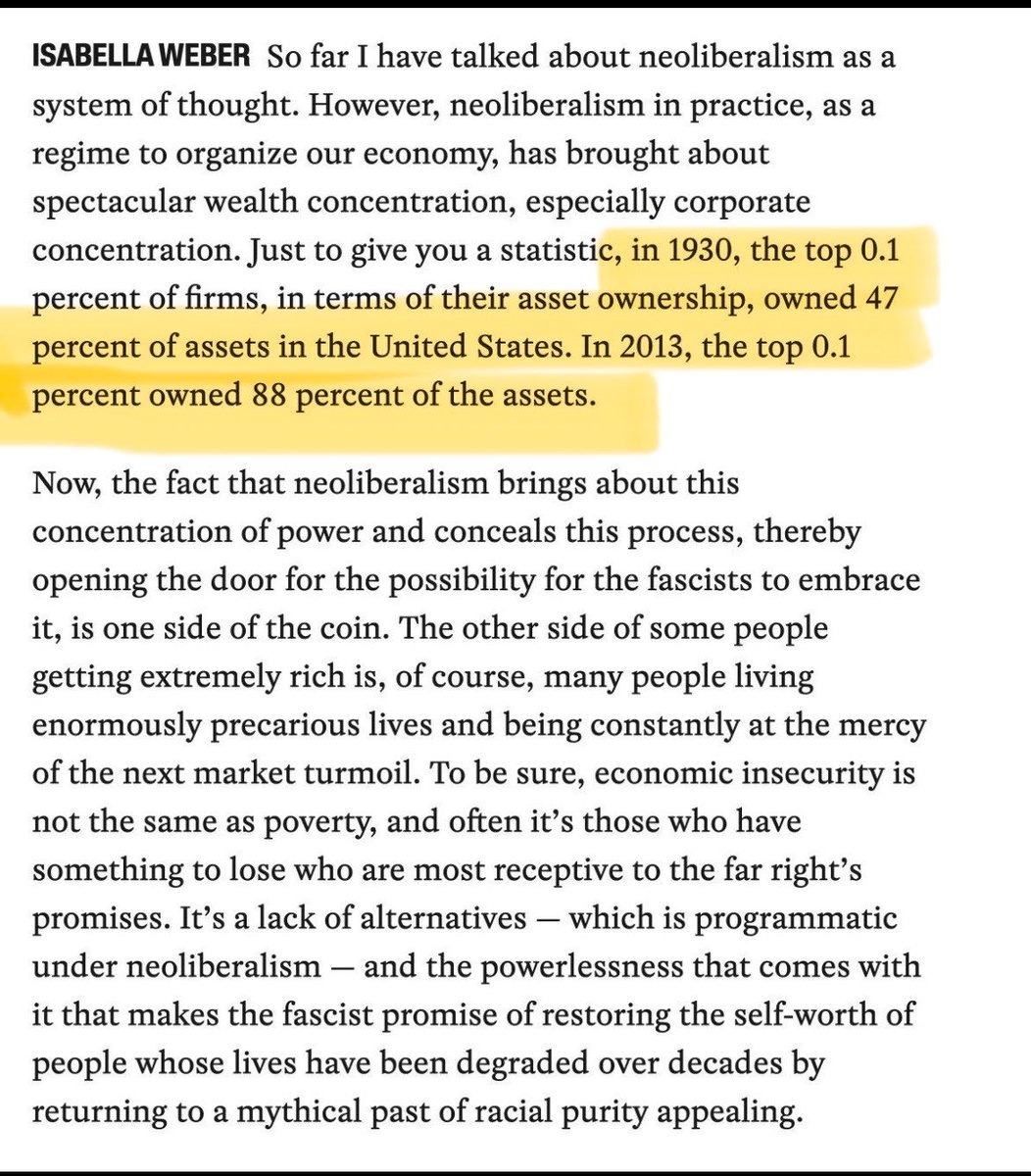
In 1930, the largest 0.1% of American business firms controlled 47% of the country’s business assets. In 2013, the largest 0.1% of firms controlled 88% of business assets. That is bonkers. There is no way we can maintain anything resembling political democracy — let alone free enterprise — with such few hands gripping essentially all of the economic power in the country.
In 1938, FDR predicted that “the liberty of a democracy will not be safe as long as the people tolerate the growth of private power to a point where it becomes stronger than their democratic government itself.” “That, in its essence,” he said, “is Fascism — ownership of government by an individual, by a group, or by any other controlling private power.” A few years later, the Federal Trade Commission (FTC) conducted its own investigation into the concentration of economic power and found that the “dead hand of corporate control” had displaced free, private enterprise in most of the Nation’s basic industries. As a result, the FTC issued a stark warning to the country: “[A] definite choice has to be made,” the FTC said. “Either this country is going down the road to collectivism” and fascism, “or it must stand and fight for competition as the protector of all that is embodied in free enterprise.” That generation of Americans — the Greatest Generation that rose from the ashes of the Depression to beat Hitler, end Jim Crow, and bring about the most prosperous era in the Nation’s economic history — chose to fight. And they won.
If American democracy is going to survive the critical moment we’re going through today, we need to relearn the wisdom of that New Deal generation — and act on it — fast. Like the Greatest Generation did in their time, we have to find “practical controls” over the “blind economic forces” and the “blindly selfish men” of our time. Like our forbears did on the eve of the Second World War, our task is nothing less than to rebuild “a way of living in which political democracy and free private enterprise serve and protect each other — to ensure a maximum of human liberty not for a few but for all.”
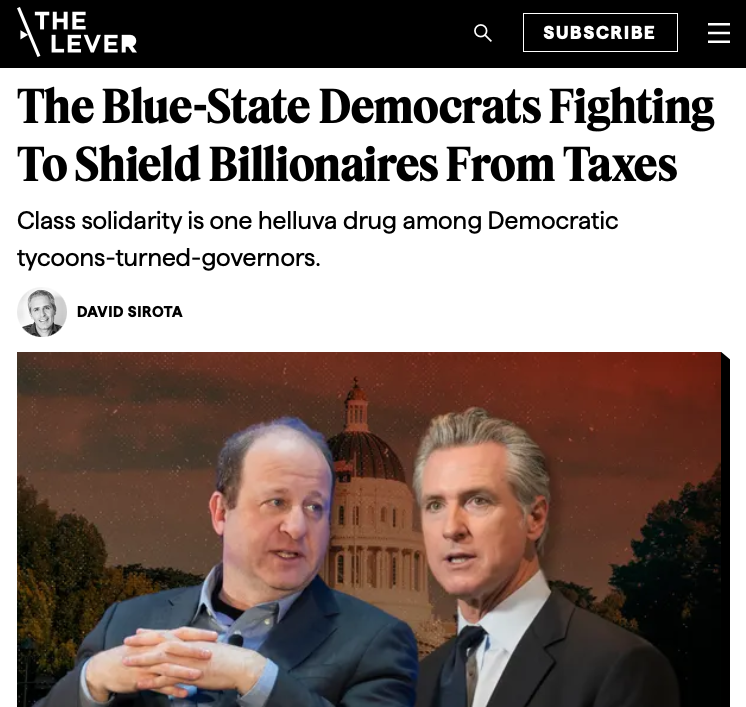
NEW: Tax-obsessed billionaires bankrolled @GavinNewsom's businesses & career.
E-card centimillionaire @JaredPolis's first move in politics was to try to block Obamacare's millionaire surtax.
Now both blue-state governors are helping the GOP try to kill Dems' billionaire taxes.
So Elon Musk just injected $1 billion into Skydance (Paramount-Warner Bros.)
I stand by this prediction, and it’s probably much worse than this. https://t.co/9eroFRoWUU
@spooleyhi I suspect it came from an editor. I’ve seen the same jab in countless NYT stories across myriad reporters. Setting that one paragraph to the side, the reporting and graphics were nice!
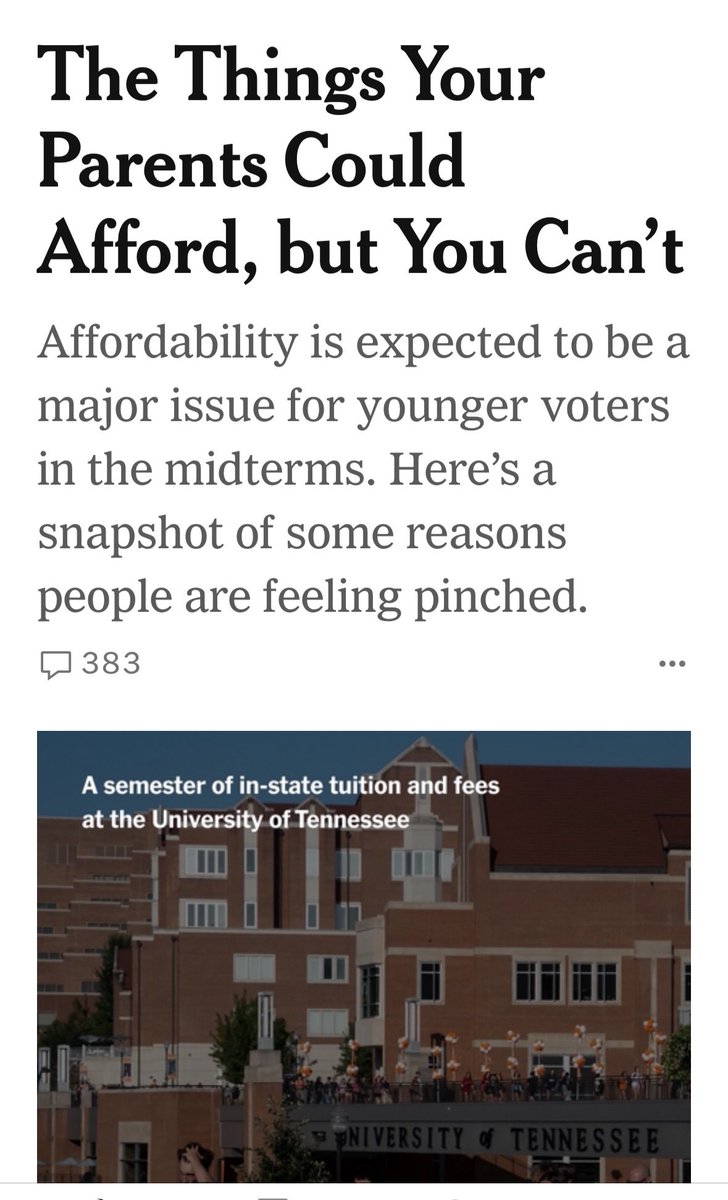
Nice story in NYT on the growing affordability crisis. My only nit was the takeaway, which failed to explore whether any of the price hikes in healthcare, concert tickets, skiing, or other industries assessed here could be attributed to monopolization or price fixing. The authors blame rising child care prices on workers (sigh), ignoring private equity roll-ups of child care centers.
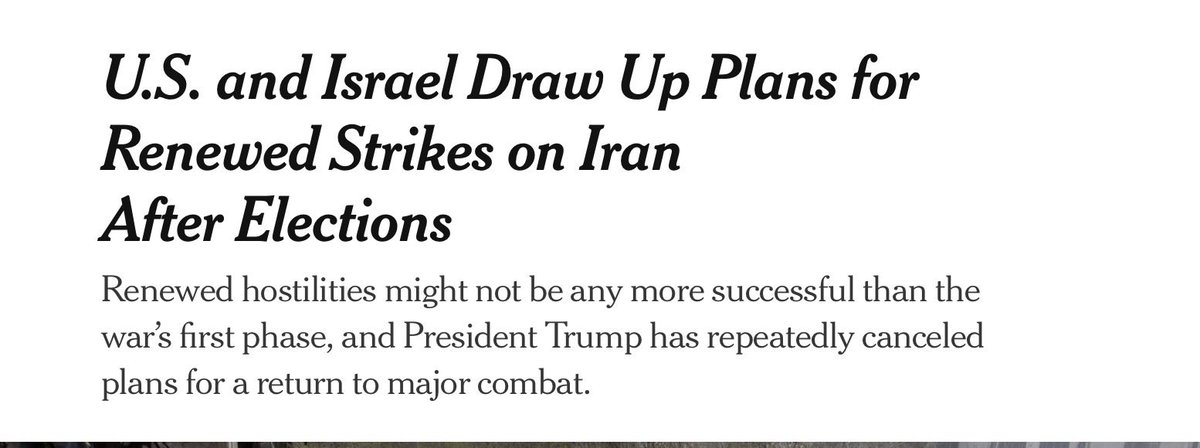
It is becoming increasingly clear that we no longer live in a democracy. The notion of extending this war, in coordination with Israel, with gas prices surging amidst a general affordability crisis is proof that this administration is not responding to the interests of the electorate, but instead is working at the behest of some other interests.
Practically a caricature of the standard anti-labor neoliberalism (is there any other kind?): Notoriously underpaid and overworked child-care workers are actually making too much and hurting families
@HollyBlomberg I’m actually worried that there’s some editor in the NYT business section who won’t allow it to be spoken!
A. B. W.
A always
B blame
W workers
Cc @IsabellaMWeber
@halsinger with child care, the price is mostly a result of near zero contribution from federal, state, and municipal governments. Child care workers are among the lowest paid workers in the US, a significant percentage of whom earn below the poverty line and typically earn $14/hour
This is huge.
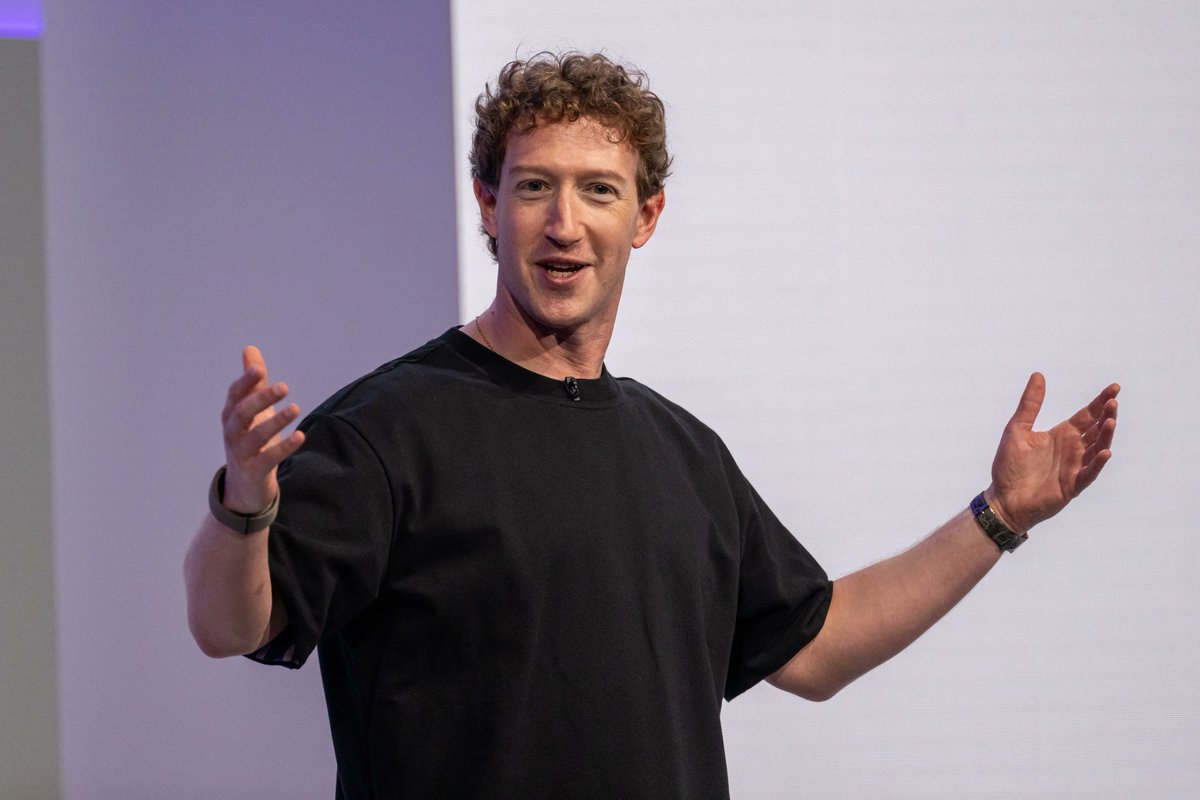
A just-released SEC filing makes an extraordinary revelation: Mark Zuckerberg is getting ready to pay California’s 5% billionaire wealth tax and has signed an agreement to remain in California for 8 years.
We are witnessing a global turning point unfold before our eyes. 🧵