Det er ikke lenger politikk. Det er elite som bevisst overstyrer folkets vilje for å beholde makt, posisjoner og tilgang til det internasjonale globalistspillet.
Folket sa nei. Eliten sa EØS.
Det er ikke bare sykt. Det er et demokratisk ran.
Folket sa nei til EU både i 72 og i 94. Likevel valgte politikerne å binde Norge til EU gjennom EØS like før den siste folkeavstemningen. De ga oss alt det folket stemte nei til, bare uten stemmerett i Brussel.
Og det verste er: det er vanvittig enkelt å komme seg ut. Ett enkelt brev, ett års oppsigelsestid, så er vi ute. Likevel nekter de å gjøre det.
Det er ikke lenger politikk. Det er elite som bevisst overstyrer folkets vilje for å beholde makt, posisjoner og tilgang til det internasjonale globalistspillet.
This is extraordinarily rare.
In fact, according to a key figure in the German business community (who is a dear friend of mine), it's unprecedented.
An op-ed, two pages, centerpiece, in Germany’s most important economic newspaper (the Handelsblatt) that begs the German establishment to stop looking at China via the prism of propaganda. And it's by their Shanghai bureau chief - not some outside contributor.
The title is "The China debate cannot continue like this!" and the article makes the case that it's suicidal, from a German and European standpoint, to keep reducing China to false caricatures rather than facts.
In effect it's rubbish in, rubbish out: if you tell people lies about China - whichever direction they go (anti or pro) - then obviously the policies that come out will be rubbish, designed for a mirage of a country that exists only in people's imagination.
Needless to say, this is absolutely music to my ears because it's literally the main point I've been making in my advocacy around China for now almost 10 years. Some are finally seeing the light...
I also believe, as I argued in my article "Are Western media turning China-friendly?" last year (https://t.co/Xg1hoSRtNy) that this type of coverage was bound to happen, and there will be more and more of it.
Why? For a very simple structural reason: China is now too powerful to coerce. The West, and Europe in particular, just don't have the leverage anymore. Which means that if you tell China to do something and they don't want to, they just won't do it. Period.
In this situation, incapable of coercing, your only remaining choice is... convincing. And what do you need if you want to convince someone? Well, you need to understand them: understand how they think, how they behave, what drives them, what they actually want.
In other words: the moment coercion stops being an option, not only does propaganda stop being useful, it begins to be actively harmful as genuine understand becomes a strategic necessity. Reality is finally becoming profitable again.
Which means, if you're a journalist reading this and you're peddling some of your usual lies, describing China as some sort of cartoonish dictatorial dystopia that's simultaneously on the verge of collapse yet a "threat" to the whole world (in short, if you write on China for The Economist or the FT), be on notice: the real threat to your country isn't China. It's you.
Ich gehöre der Denkschule des Realismus in der Theorie der Internationalen Beziehungen an (Thukydides, Thomas Hobbes, Carl Schmitt, Hans Morgenthau, Kenneth Waltz, John Mearsheimer, Stephen Walt) und weiss, dass Menschen viele schlimme Dinge tun können.
Aber mit welcher Hartnäckigkeit unsere europäischen Führer (Macron, Starmer, Merz von der Leyen und Kallas) den Krieg des Westens mit Russland via Stellvertreter Ukraine aufrechterhalten und eskalieren, macht mich doch immer wieder fassungslos.
Mit aller Macht treiben sie uns in die Katastrophe.
NRK fyller alle nyhets- og aktualitetsflater på radio og tv med kronprinsessens sykdom. Fullstendig overdekning. Lojalt publikum som min mor (79) boikotter nå sendingene.
Borte er alle kritiske spørsmål om Epstein og Marius. Dette er reindyrka tillitsmaskinell statspropaganda.
"Minst to generasjoner med krig..." Ved å insistere på at russerne er monster skaper vi de monstrene russerne må bli for å bekjempe vår projisering. Det blir en selvoppfyllende profeti av sløseri og ødeleggelse som utelukkende belønner de verste blant oss.
This shows that Germany obviously still doesn't get it: their "historical responsibility" isn't to support Israel even as they commit genocide.
When the lesson of Nazism is obviously a universal one about justice, they instead think it's a blood debt to a particular people.
Which is, when you think about it, the Nazi way of looking at it: hierarchizing peoples and assigning collective responsibility - or collective impunity - on that basis.
This isn’t a Russian official speaking.
It’s John Mearsheimer, one of America’s most respected international relations scholars, speaking more than 10 years ago.
He warned that expanding NATO towards Russia’s border and turning Ukraine into a Western outpost would end in tragedy.
For years he was dismissed as a Kremlin propagandist.
Today, Ukraine is devastated, NATO membership is nowhere in sight, and his critics are still pretending he didn’t predict exactly what happened.
There is a strange development in which academics of international politics are expected to publicly condemn adversarial countries before they are allowed to participate in public discourse. The complexity of international politics is reduced to a moral question of good versus evil, and academics must make moral declarations before even discussing facts, history, strategy, and interpretations. Academics should explain why states behave as they do; they are not moral validators.
What value does it bring to an analysis if the analyst "condemns" one side? After Russia invaded Ukraine, the former Norwegian foreign minister actually argued that "this is not the time to understand, but to condemn". This ridiculous position is pushed on academics. However, understanding is not endorsement, explanation is not advocacy, and ignorance is not strength. I argue it is in Russia's security interest to push NATO away from its borders, it is in Iran's interest to control the Strait of Hormuz, and it is in China's interest to create a new international economic architecture. This is not advocacy, nor is it a normative position about how the world should work; rather, it is a recognition of how the world actually works.
An academic should examine interests, capabilities, and strategic calculations that produce such policies—not participate in ritualised declarations of virtue that contribute absolutely nothing. Furthermore, moralism and condemnation often lead to a lack of understanding and increased conflict. When the conclusion is always that the good guys are confronting the bad guys, then the solution is always "peace through strength", "weapons are the path to peace", and defeating the latest reincarnation of Hitler. If you want war, condemn the other side as pure evil. If you want peace, the first step is to understand the other side.
It always astonishes me how there is virtually ZERO public debate - or even public awareness - in Europe about the decisions that will most shape ordinary people's lives.
These days, the EU is drafting a new anti-China legal framework where - quite literally - the more affordable and competitive Chinese products are, the more illegal they'd become.
You'd think EU citizens would want to be informed about such things - as it couldn't be more consequential for their prosperity.
Yet I bet virtually no EU citizen is even aware of it, beyond a vague sense that there is some sort of trade dispute going on.
So what's going on exactly? It all centers around a new legal instrument the EU is drafting called the "overcapacity instrument" (https://t.co/mNpCMudYyS).
First of all, the very notion of "overcapacity" is pretty ridiculous to begin with, especially the way it's being defined by the EU, as it basically means being competitive enough to export.
By this definition of "overcapacity," pretty much every European industry that's ever run a trade surplus - German cars, French wine, Italian fashion - has been guilty of "overcapacity."
I'm not even exaggerating: if you read this study by the EU Parliament on "Industrial overcapacities, with a focus on China" (https://t.co/TcwEBoL8mD), they define "overcapacity" as building more capacity than your domestic market can absorb. So the moment you build capacity to export abroad, you're in "overcapacity."
Utterly ridiculous.
And what this "overcapacity instrument" is about is creating a permanent legal mechanism for the EU to block Chinese competition across whole sectors of the economy, if they happen to be in "overcapacity."
In effect, this means that if China is competitive globally in a given sector in such a way that it exports a lot, that's proof of overcapacity, and legally it'd mean that the entire sector can be restricted from the EU market.
Which means it really, factually, is a legal framework where the more affordable and competitive your products are, the more illegal they become.
Which is a CRAZY economic concept! 🤦♂️
Please note that it's different from the anti-subsidy legal instrument, which the EU has already put in place in 2023 (the "Foreign Subsidies Regulation": https://t.co/SvPKFyN0zo).
This "overcapacity instrument" would be above and beyond this: it wouldn't even matter if a particular sector was subsidized by the Chinese government or not, the mere fact of its competitiveness in exports would be grounds for restrictions in the EU.
It doesn't take a genius to understand how badly this could impact everyday people: this is European consumers being forced to pay more for worse products by law, so that uncompetitive European firms don't have to improve.
Politicians frame it as avoiding a "China shock 2.0" but really this is choosing an even steeper self-inflicted decline than is already the case, where EU citizens would subsidize mediocre EU companies that would have even less pressure to catch up. It's a hidden tax: subsidies for uncompetitive firms paid by consumers instead of governments, which in turn makes them less incentivized to become competitive.
The first "China shock" did de-industrialize Europe somewhat, but at least it made things cheaper for European consumers. If this becomes Europe's response to a second "China shock" not only it'd make everything more expensive but it'd do nothing for EU industry: you don't become competitive by banning the competition...
Look at China itself: the way it industrialized was NOT by banning Western firms but on the contrary by welcoming them strategically and learning from them. You learn to compete by... competing, duh!
What I find most shocking in all of this isn't even the policy itself - you can make arguments for and against protectionism, and reasonable people can disagree.
What's shocking is that virtually no European media outlet is explaining any of this to the public. This is unarguably one of the single most consequential economic decisions the EU will make this decade, affecting the price of everything, and it's being drafted in near-total silence.
No newspaper is running the headline "EU plans to make Chinese goods illegal if they're too affordable" - even though that's essentially what's happening.
But that's what you call a "democracy" with "freedom of expression" these days apparently...
Janne Haaland Matlary synes Norge skal meldes inn i EU uten en folkeavstemning, fordi spørsmålet er for vanskelig for folket. Mitt mening er at demokrati er for viktig til å overlates folk som Janne Haaland Matlary.
Du går kanskje rundt og håper på at vi en gang skal få normale kraftpriser igjen i dette landet? Da skal du lese denne. Ap-mafiaen planlegger datasentre med et vanvittig kraftbehov, og det skal stort sett dekkes med ny vindkraft! Batterifiaskoen blir barnemat. https://t.co/lDymeH8bRD
China’s message on the next UN secretary-general is clear:
The UN does not need another rubber stamp for empire.
It needs someone committed to the UN Charter, capable, impartial, responsible, and willing to defend the interests of developing countries.
Because a real international order should not allow one country to kidnap foreign presidents, assassinate foreign leaders, bomb sovereign states at will, or turn “security” into a license to erase entire peoples.
A functioning global institution should not stand by while Gaza’s homes are shattered, mothers are killed, children are maimed, and genocide is dressed up as self-defense.
The UN was created to prevent the strong from deciding the fate of the weak.
If it cannot do that, then it is not order.
It is empire with a conference room.
The world does not need another secretary-general trained to bow when empire enters the room.
It needs someone with a spine.
One step away from the brink: NATO’s march towards all-out war with Russia
The risk of an all-out conflict between NATO and Russia is higher than it’s ever been — even at the height of the Cold War — given how deeply the two sides are now entangled in what is, in every operational sense, an increasingly direct military confrontation, even if the fiction of non-belligerence is still formally maintained. Unlike during the Cold War, when the superpowers maintained elaborate protocols designed to prevent direct confrontation, the lines today are blurred to the point of near-invisibility. A war that was supposed to be contained within Ukraine’s borders has steadily metastasised into something far more dangerous: a proxy conflict in which NATO’s role has become so operationally central that the distinction between proxy and principal has largely collapsed, and in which each week brings fresh evidence that the escalatory logic is running well ahead of any political capacity to control it.
[...]
The risk of war is not some distant abstraction — it is dangerously, imminently real. The mechanisms of escalation that have brought us to this point are well understood: each step up the ladder, taken with the confident assumption that the other side will back down, makes the next step more likely and the space for de-escalation narrower. Western leaders have convinced themselves, through a combination of wishful thinking and institutional inertia, that Russia will continue to absorb provocations without responding in kind. But every week that passes without a diplomatic off-ramp brings us closer to the moment when that assumption is tested to destruction.
What makes the current situation uniquely perilous is not just the military escalation but the complete collapse of the political imagination that might arrest it. There are no Cold War realists, no back-channel, no serious European leader with the standing and the will to propose a negotiated settlement. There is only the momentum of the war machine, now distributed across a dozen countries and thousands of companies, producing weapons in Finnish factories, German joint ventures and British workshops — all of them feeding a conflict that, in the absence of urgent political intervention, has no logical terminus short of catastrophe.
The responsibility lies, ultimately, with European citizens. Our governments are not acting in our name or in our interests. It falls to us — before the next incident, the next miscalculation, the next drone that crosses into the wrong airspace — to demand that they step back from the brink.
Read my latest article here: https://t.co/QEhwknVxzJ
It is not a coincidence, in our view, that the tech bubble burst within 12 months of US rates being hiked in 1999, in response to stronger commodity prices.https://t.co/NVDBvDHSe3 via @financialtimes
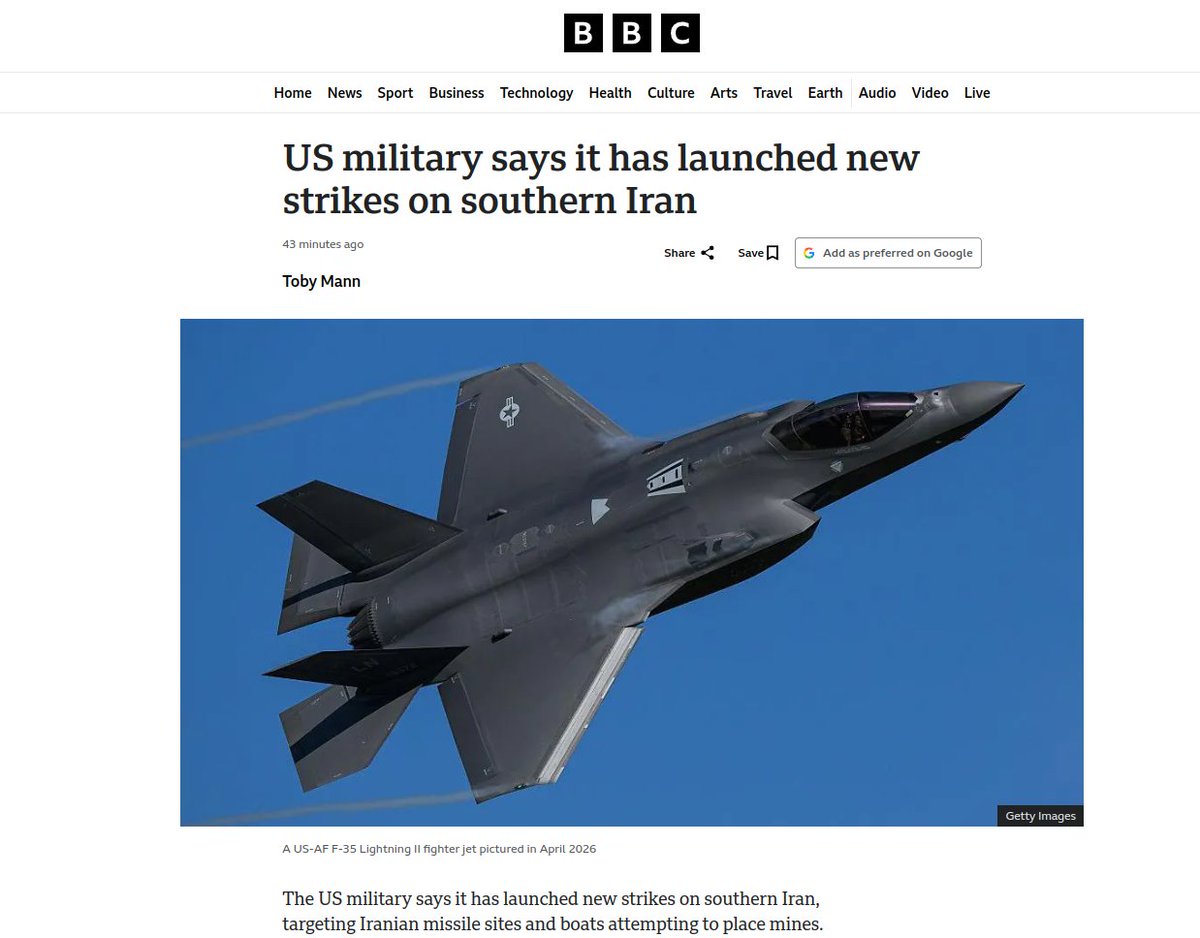
US-Iran "Negotiations"
I warned that the US objective is not necessarily toppling Iran immediately, and certainly not stopping "nuclear weapons" that don't even exist - but to cut China and the rest of Asia off from not just Iranian oil, but all energy exports from the Middle East.
To maintain the slow but sure strangulation of energy exports from the entire region, the US has triggered a war damaging energy production and export infrastructure across the whole region, then placed its own blockade on Iranian ports and any other shipping it decides to interdict, as well as carrying out sporadic attacks even while "negotiating" with Iran.
The goal is to maintain this strangle hold, increase it when necessary, perform political circus when it needs to cool markets - all while creating the economic crisis it requires to isolate China and force Asian states under a greater degree of US energy dependence.
This is exactly what the US just spent the last 12 years doing with Russia regarding Ukraine - pretending to "negotiate" while constantly escalating.
This is exactly what the US has spent the last 47 years doing with China regarding Taiwan - pretending to "negotiate" while constantly escalating.


![battleforeurope's tweet photo. One step away from the brink: NATO’s march towards all-out war with Russia
The risk of an all-out conflict between NATO and Russia is higher than it’s ever been — even at the height of the Cold War — given how deeply the two sides are now entangled in what is, in every operational sense, an increasingly direct military confrontation, even if the fiction of non-belligerence is still formally maintained. Unlike during the Cold War, when the superpowers maintained elaborate protocols designed to prevent direct confrontation, the lines today are blurred to the point of near-invisibility. A war that was supposed to be contained within Ukraine’s borders has steadily metastasised into something far more dangerous: a proxy conflict in which NATO’s role has become so operationally central that the distinction between proxy and principal has largely collapsed, and in which each week brings fresh evidence that the escalatory logic is running well ahead of any political capacity to control it.
[...]
The risk of war is not some distant abstraction — it is dangerously, imminently real. The mechanisms of escalation that have brought us to this point are well understood: each step up the ladder, taken with the confident assumption that the other side will back down, makes the next step more likely and the space for de-escalation narrower. Western leaders have convinced themselves, through a combination of wishful thinking and institutional inertia, that Russia will continue to absorb provocations without responding in kind. But every week that passes without a diplomatic off-ramp brings us closer to the moment when that assumption is tested to destruction.
What makes the current situation uniquely perilous is not just the military escalation but the complete collapse of the political imagination that might arrest it. There are no Cold War realists, no back-channel, no serious European leader with the standing and the will to propose a negotiated settlement. There is only the momentum of the war machine, now distributed across a dozen countries and thousands of companies, producing weapons in Finnish factories, German joint ventures and British workshops — all of them feeding a conflict that, in the absence of urgent political intervention, has no logical terminus short of catastrophe.
The responsibility lies, ultimately, with European citizens. Our governments are not acting in our name or in our interests. It falls to us — before the next incident, the next miscalculation, the next drone that crosses into the wrong airspace — to demand that they step back from the brink.
Read my latest article here: https://t.co/QEhwknVxzJ](https://pbs.twimg.com/media/HJaSLCgWQAEBRfj.jpg)