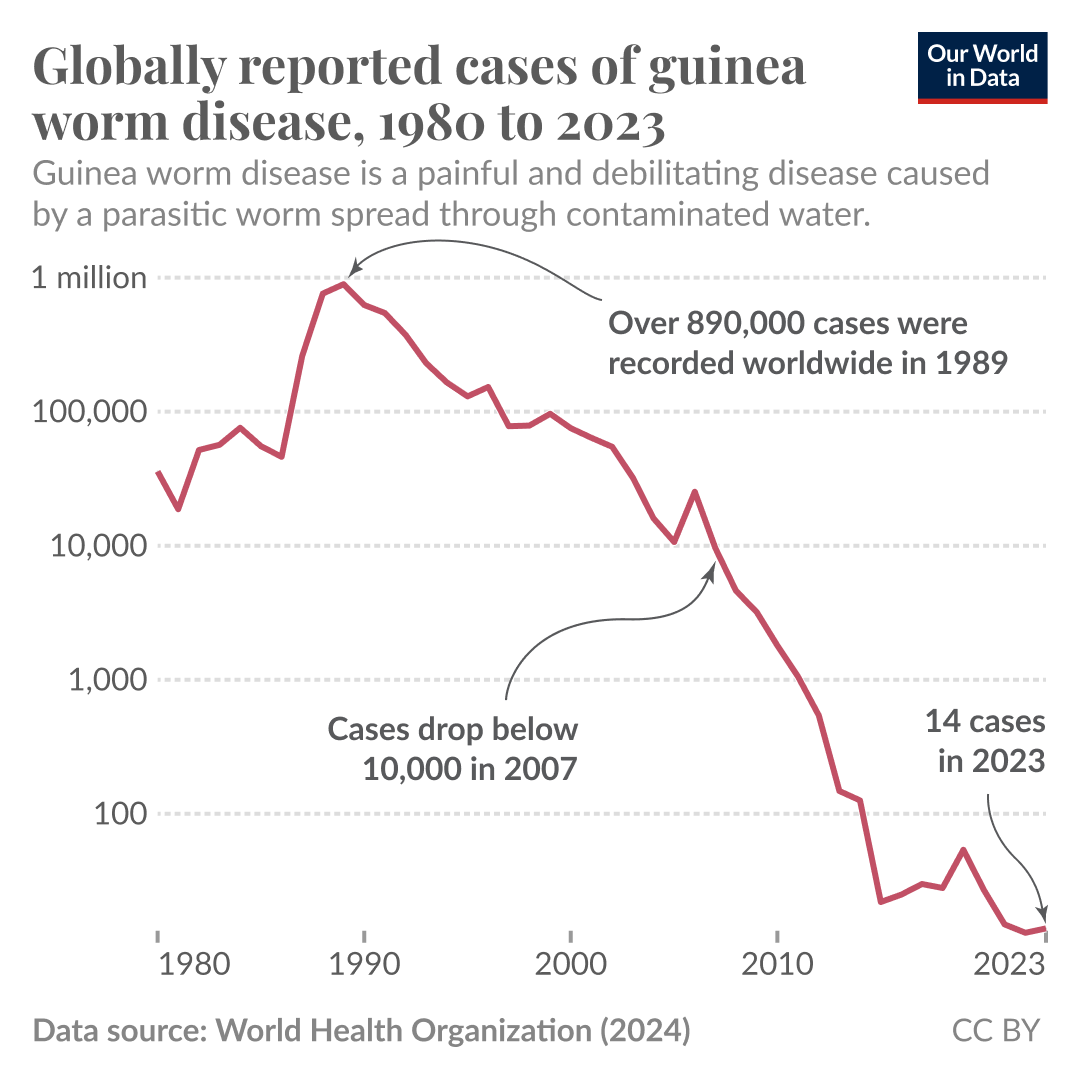
Cases of guinea worm disease have fallen dramatically in recent decades. According to the WHO, over 890,000 cases were recorded worldwide in 1989. As you can see on the chart — which we just updated with the latest data — only 14 human cases were reported in 2023.
Guinea worm disease is caused by the parasitic guinea worm, which mainly spreads through stagnant water sources like ponds. The worm’s larvae enter the human body when a person drinks contaminated water, after which they penetrate the digestive tract to mature and reproduce within the body.
Around a year after the initial infection, the adult female breaks through the skin's surface, creating a painful blister through which it gradually emerges over several weeks. When it comes into contact with water, it releases new larvae and continues its life cycle.
The disease was previously endemic in over 20 countries in South Asia and Africa. An international eradication campaign has substantially decreased the number of cases by improving access to clean drinking water and actively monitoring and containing cases in endemic regions.
(This Data Insight was written by Tuna Acisu.)
@dieworkwear I wonder if the Spanish king ever wakes up and thinks “what if I just wore off the rack today, does it really matter?” And then goes “no, I’m needed. I’m an example.”