@CanadaChina Massacre. Calling it a crackdown legitimises the brutal massacre. Also, how do you honour the victims without calling out the murderer - the CCP regime.
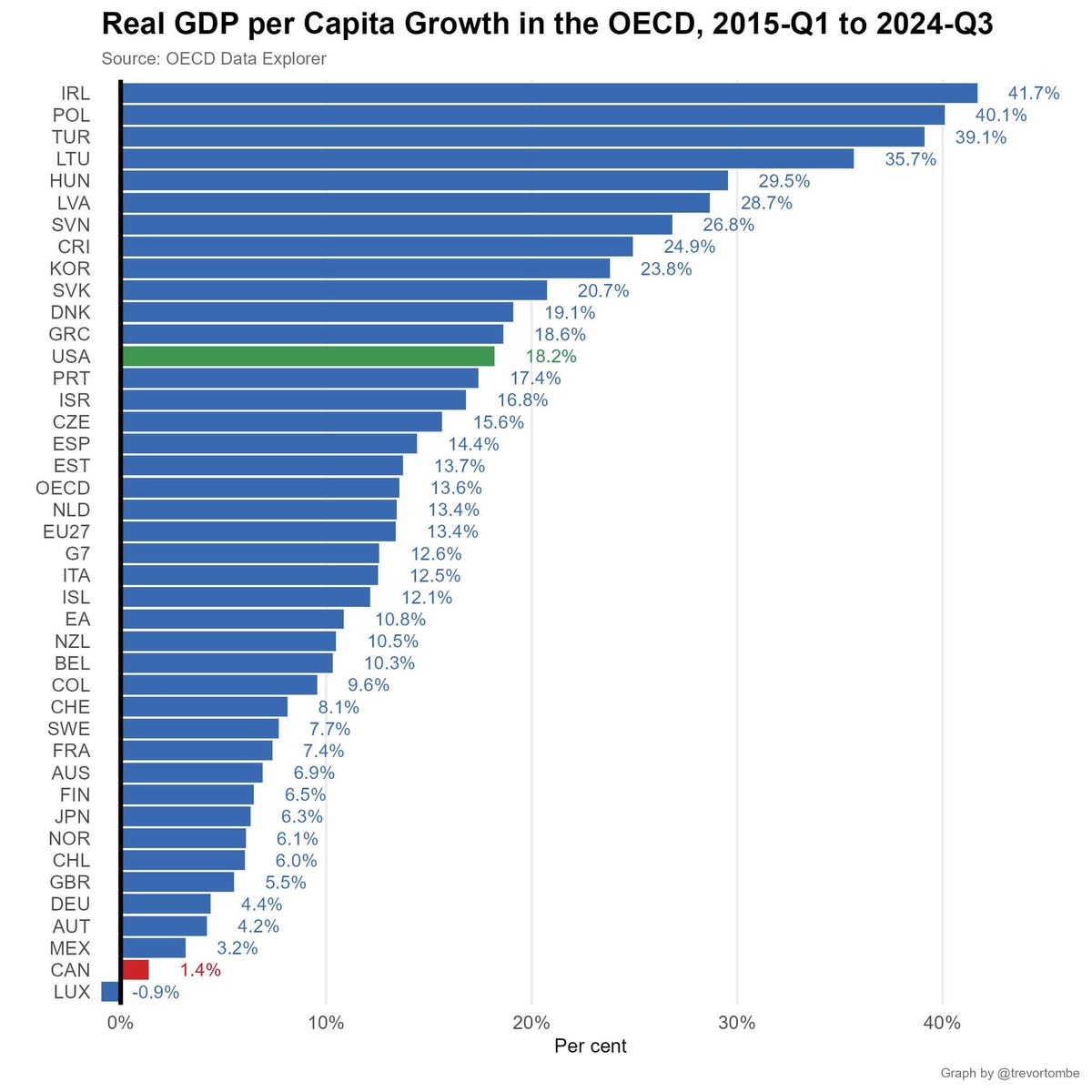
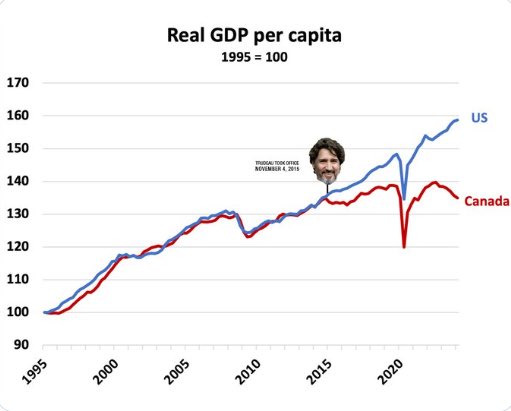
Canada's GDP per capita was 94% of America's in 1981.
Today it's 67%. The widest gap since World War II.
Ontario — Canada's economic engine — is now poorer than 43 US states. Including Louisiana and Alabama.
This isn't a blip. It's a generational collapse. Here's the data:
From 2017-2024, US productivity grew 10.1%. Canada's fell 0.6%. America is sprinting. Canada is walking backwards.
71% of Waterloo software engineering grads leave for the US. The brain drain damage threshold is 20%. Canada is at 3x the red line.
Israel spends 6.35% of GDP on R&D. The US spends 3.4%. Canada spends 1.7%. That's not a gap. That's a different species.
Canada's pension funds hold $2.6 trillion. Only 13% is invested in Canada. 47% is in the US. Even Canada's own money doesn't believe in Canada.
Net FDI position: negative $1 trillion. Capital is fleeing the country faster than Waterloo grads.
72% of Canadian entrepreneurs start businesses because "jobs are scarce." Not opportunity. Survival.
Canadian workers get 30 cents of IP investment for every $1 an American worker gets. You can't out-innovate anyone with 30-cent tools.
The average Canadian spends 48% of their income on a mortgage. The average American: 34%. Canadians work to pay for houses. Americans work to build companies.
None of this is about laziness. Canadians are talented. The system is broken.
Zero income tax. Business-friendly regulation. Speed of execution. That's Dubai. That's Singapore. That's what "Dubai of the North" means.
Canada has everything — talent, resources, geography, rule of law. What it doesn't have is a system that rewards building.
Fix the tax code. Kill the red tape. Stop subsidizing real estate. Start subsidizing R&D. The talent is there. The capital will follow.
Blaming the MAGA guy is always the most instinctive knee-jerk reaction, but it certainly isn't the solution. If anything, it masks our ability to face our own issues with reasons and make the hard decisions for the long run.
I’m Canadian. I vote in Canada. I don’t get a ballot in the U.S.
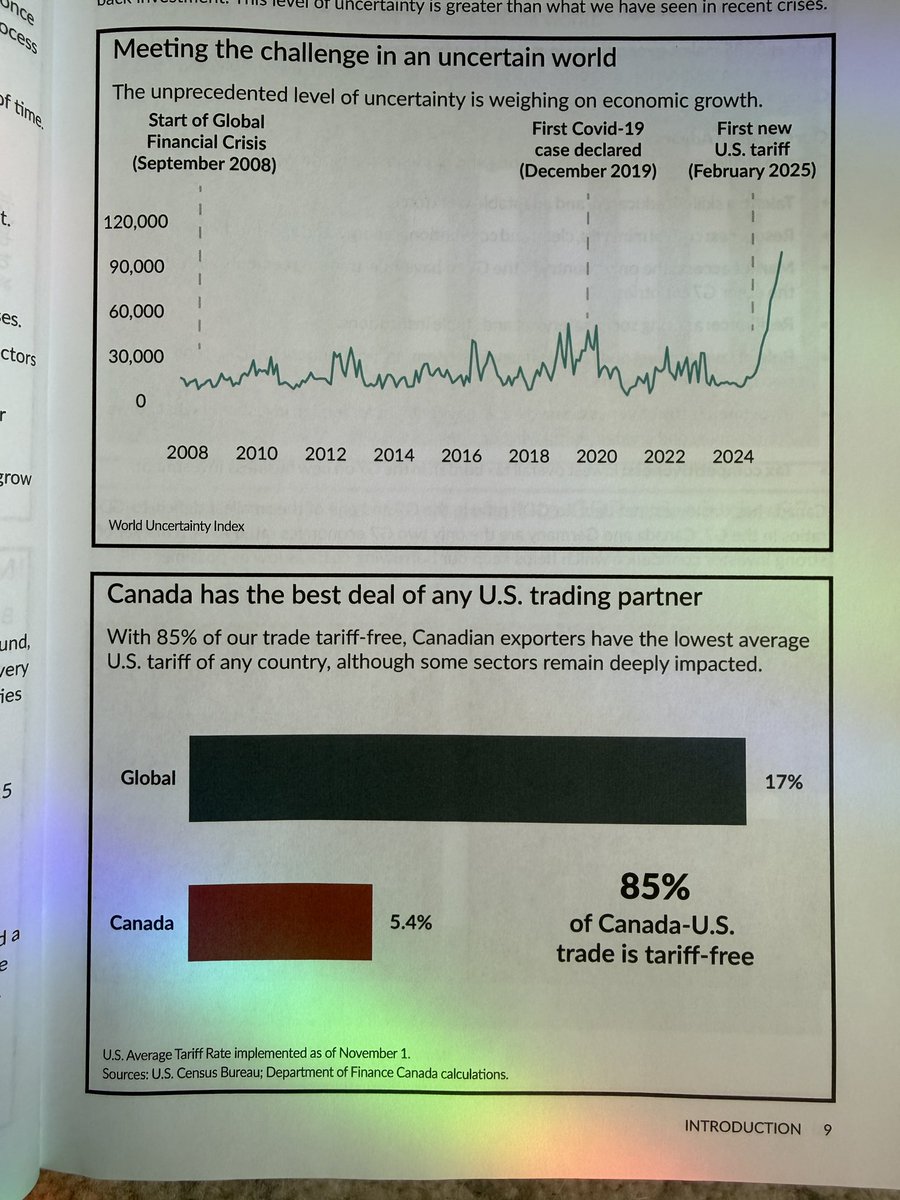
Whether you love Trump or hate him is irrelevant to this point: our economic problems existed long before tariffs. That should be the only thing dominating headlines.
Housing didn’t collapse because of Trump. Productivity didn’t stall because of Trump. Per-capita GDP didn’t weaken because of Trump. Capital wasn’t initially fleeing because of Trump. Justin Trudeau didn’t step down over tariffs—he stepped down because Canadians no longer believed he could fix what was already broken. Tariffs didn’t create our vulnerabilities… they highlighted policy failure that was previously masked.
If one trade shock rattles your economy, the structure was already fragile.
So why are we gossiping about Trump’s personality instead of dissecting our own numbers? Why are we speculating about American politics instead of talking about Canada’s declining productivity, stalled investment, rising debt, and capital flight?
75%-85% of our exports are covered under USMCA. Yet tariffs are still the convenient villain—because it’s easier to blame an American president than to reform tax policy, reduce regulatory drag, attract investment, and grow productivity.
Talking about Trump every day doesn’t fix Canada. But reading our own economic data just might. Canada doesn’t need an American scapegoat… It needs structural reform. And until we address taxation, regulation, capital formation, and productivity, we’ll keep treating symptoms with rebates and headlines while the underlying problem gets worse.
It’s been a year.
At this point, obsessing over Trump isn’t analysis… It’s continuing to avoid and hold the government accountable.
The CCP’s “big lie” on Taiwan isn’t just diplomatic spin, it’s lawfare.
UN Resolution 2758 does not determine Taiwan’s status, and it doesn’t even mention Taiwan.
It’s time the U.S. calls out this truth.
“Whoever advised @MarkJCarney to elevate Canada’s relationship with China into a ‘strategic partnership’ and part of a ‘new world order’ with Xi Jinping has done lasting damage to Canada’s national interest and our long‑term prospects.
China is anything but a true strategic partner. The last thing the world needs is a ‘new world order’ built around Xi Jinping’s China.”
How people still believe it's just economics are way too naive, or, using economics as a disguise for whatever else is going under the table. In other words, cunning, unfortunately.
Canada still tends to approach trade with China as if it were mainly about economics. In practice, it rarely is. Talk of a new “strategic partnership” risks obscuring a basic reality. China hasn’t changed how it uses trade, investment, and diplomacy as tools of state power.
Canadians who don’t like what they see in America and think China offers an alternative should remember that the absolute worst excesses of the Trump administration are tame compared to the routine violence and repression of the Chinese Communist Party.
Perspective, people.
Make no mistake: China now has a foothold in the Canadian market and will use it to their full advantage at the expense of Canadian workers.
The federal government is inviting a flood of cheap made-in-China electric vehicles without any real guarantee of equal or immediate investments in Canada’s economy, auto sector or supply chain. Worse, by lowering tariffs on Chinese electric vehicles this lopsided deal risks closing the door on Canadian automakers to the American market, our largest export destination, which would hurt our economy and lead to job losses.
To fix this mess, Prime Minister Carney and the federal government need to urgently step up and support Ontario’s auto sector. That means making the sector more competitive by ending the electric vehicle mandate, harmonizing regulations with key trading partners and scrapping federal fees that do nothing but add thousands to the cost of making vehicles and chase away investments. Instead of importing made-in-China vehicles, the federal government needs to be focused on working with Ontario to bring investment and jobs to factory floors in Brampton, Oshawa, Ingersoll and across the province, where assembly lines are at risk or have already left the country.
Whether farmers or auto workers, Canadians expect and deserve a federal government that gives them every shot at success. I’m urging Prime Minister Carney to work with Ontario to strengthen Canada’s auto industry, not weaken it. Together, let’s protect Ontario and protect Canada.