LLM System Design Interview #4 - The Gradient Highway
Why post-norm Transformers break at scale - and how one architectural swap enables stable training for 100B-parameter models.
Full breakdown on my Substack here: https://t.co/wklF8v9tBk
LLM System Design Interview #4 - The Gradient Highway
Why post-norm Transformers break at scale - and how one architectural swap enables stable training for 100B-parameter models.
Full breakdown on my Substack here: https://t.co/wklF8v9tBk
LLM System Design Interview #3 - The Scaling Law Playbook
Why elite AI engineers never guess model size - and how to use small-scale experiments to de-risk six-figure training runs.
Full breakdown on my Substack here:
https://t.co/Yku96zKchQ
LLM System Design Interview #3 - The Scaling Law Playbook
Why elite AI engineers never guess model size - and how to use small-scale experiments to de-risk six-figure training runs.
Full breakdown on my Substack here:
https://t.co/Yku96zKchQ
City2Graph turns buildings, streets, and GTFS feeds into spatial graphs.
It sits between GeoPandas, NetworkX, and PyTorch Geometric, so the same GeoDataFrame round-trips into HeteroData and back.
1.8k ⭐ stars BSD-3-Clause.
#GeospatialAI#GraphNeuralNetworks#PyTorchGeometric
City2Graph turns buildings, streets, and GTFS feeds into spatial graphs.
It sits between GeoPandas, NetworkX, and PyTorch Geometric, so the same GeoDataFrame round-trips into HeteroData and back.
1.8k ⭐ stars BSD-3-Clause.
#GeospatialAI#GraphNeuralNetworks#PyTorchGeometric
OpenViking stores agent memories, resources, and skills as one filesystem.
Agents browse context with ls, tree, and find instead of querying a vector store. Every entry is written in three tiers, abstract, overview, details, and loaded only if the task needs.
32.1k stars ⭐
OpenViking stores agent memories, resources, and skills as one filesystem.
Agents browse context with ls, tree, and find instead of querying a vector store. Every entry is written in three tiers, abstract, overview, details, and loaded only if the task needs.
32.1k stars ⭐
LLM System Design Interview #2 - The Lossless Speedup Trick
How top AI teams double inference speed without quantization, pruning, or touching model weights - by exploiting a core asymmetry in Transformers.
Full breakdown on my Substack here:
https://t.co/VElvOShekL
Stanford CS336 builds a language model from scratch across 18 recorded lectures. The course moves through data collection and cleaning, transformer construction, training, and evaluation before deployment. Nothing is imported that has not been built first.
Must watch
Stanford CS336 builds a language model from scratch across 18 recorded lectures. The course moves through data collection and cleaning, transformer construction, training, and evaluation before deployment. Nothing is imported that has not been built first.
Must watch
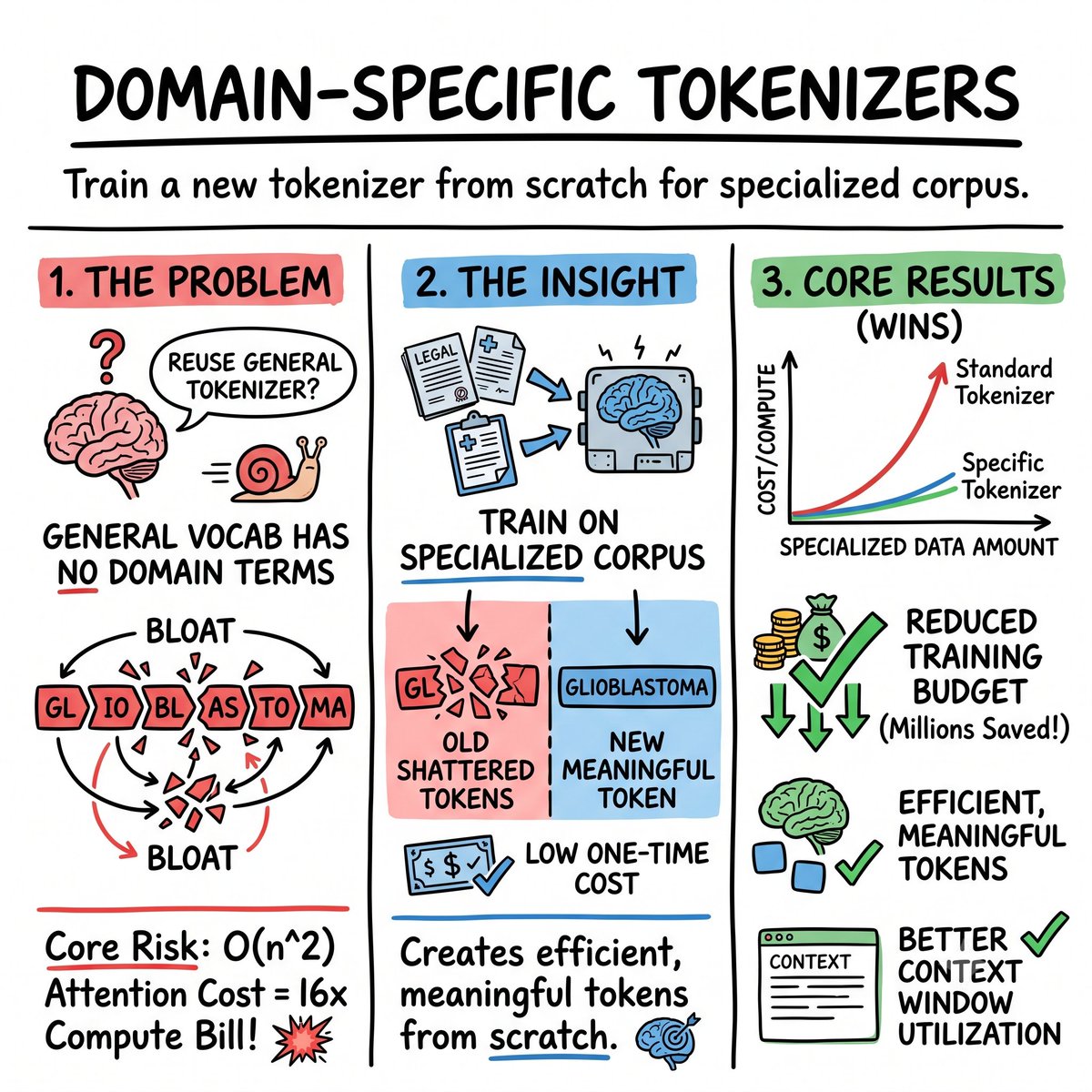
LLM System Design Interview #1 - The Tokenizer Trap
Why reusing a general tokenizer can quietly 16x your compute bill - and how to avoid it.
Full breakdown on my Substack here:
https://t.co/Zf3Bu0x9qQ
RAG Interview Questions #8 - The IVF-PQ Compression Trick
Why blindly scaling HNSW is a scaling nightmare, and how to gracefully trade imperceptible coverage loss for massive infrastructure savings.
Full breakdown on my Substack:
https://t.co/YUjy0Etn68
I just gave my AI agent persistent memory using 30x fewer tokens than full context.
F1 score went UP, not down.
SimpleMem from aiming-lab, 3.3k 🌟 GitHub stars, MIT license.
Three design choices broke my model of how memory should work:
1️⃣ Compresses at write-time, not read-time
Raw dialogue gets rewritten into atomic facts with absolute timestamps BEFORE it hits storage. "He'll meet Bob tomorrow at 2pm" becomes "Alice will meet Bob at Starbucks on 2025-11-16T14:00:00." Disambiguation is a feature, not an afterthought.
2️⃣ Three indexes per memory, picked at query-time
Semantic (vectors), lexical (BM25), symbolic (entities + timestamps). The LLM generates a retrieval plan per query. No config tuning. No hybrid weighting magic numbers.
3️⃣ EvolveMem v3.0: the retriever rewrites its own architecture
An evaluate → diagnose → propose → guard loop mutates retriever config autonomously. After 7 rounds it discovered retrieval dimensions the original authors never designed, query decomposition, entity-swap, answer verification.
The numbers on LoCoMo:
1️⃣ 43.24% F1 at ~550 tokens (vs 30x full context)
2️⃣ +25.7% over best baseline on GPT-4o
3️⃣ +36.8% over best baseline on GPT-5.1
4️⃣ +64% over Claude-Mem on cross-session memory
Most memory frameworks compete on storage. SimpleMem competes on retrieval planning, then teaches the planner to evolve itself.
If you're building agents that need to remember anything beyond a single session, this is the new floor.