@elonmusk Can you please stop the annoying Nigerian bot accounts?
I want to support your visions, but if you can't get rid of them, and the fake Elons, I worry about how much of your talk is dreamy marketing and PR vs. reality.
US government auctioned off 12.7 million hectares (31.5 million acres) of American Samoan seabed for $6 million, despite a federal court ruling that found the lease sale to be illegal for not taking into account impacts on endangered species. https://t.co/9knR9p0Cde
@SecKennedy Torturing surgical patients, cancer patients, and chronic illness patients is good?
Just because YOUR FRIENDS get all of the pain treatment you want, it's okay that legit patients are committing suicide, terminal patients are dying in agony, and you cheer!
TRUMP & YOU TORTURE.
Most folks don't think about how much information we've lost. Yes, the stone tools and pot sherds are fun finds, but the plant-based items of every day living rarely survive. Also, so many sites are now under water- damned rivers and coastal, or looted.
Most of ancient America rotted away.
Stone points survived. Pottery survived. Copper survived. Mounds survived.
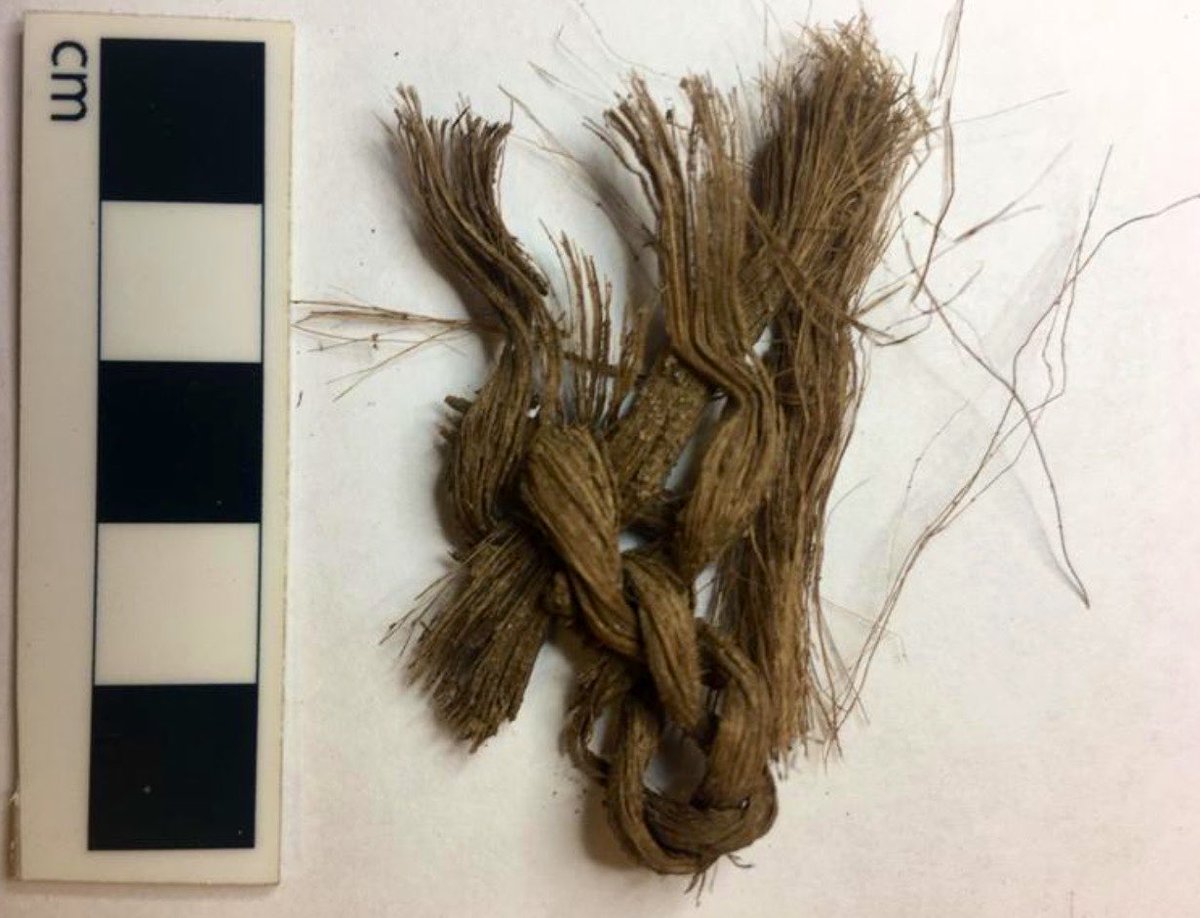
The nets, bags, cordage, baskets, mats and clothing mostly became dirt. That has probably distorted our picture of ancient America more than we realize.
Archaeologists can find the stone weights from a fishing net long after the net itself has vanished. Thousands of years later, the weights sit in a museum case while the more complicated technology that connected them is gone.
And that net was not just “string.”
Someone had to know where the right fiber plants grew and when to gather them. Stalks or bark had to be processed, fibers separated, strands twisted into cordage, then worked into something strong enough to hold under tension and water.
Try making ten feet of consistent cordage by hand and the archaeological record starts looking different. It ain’t easy.
A projectile point reaches us without its shaft or binding. A copper awl outlives whatever it pierced. Sometimes an entire house comes down to stains in the soil where its posts once stood.
At Cahokia, this missing world would have been enormous.
Thousands of people lived beside one of the richest river systems on the continent. Fishing, carrying, construction, storage and everyday household work all consumed fiber.
Nets tore. Bowstrings broke. Bags wore through. Buildings needed binding. Mats and baskets had to be replaced.
Behind that was an entire economy almost invisible to us now: gathering dogbane and other fiber plants, processing stalks, twisting cordage, knowing by touch when a strand was weak, passing techniques from one set of hands to another.
Almost none of it leaves a monument.
The rare places where textiles do survive make the loss everywhere else harder to ignore. Dry caves and rock shelters have preserved ancient sandals, bags, mats, nets and other fiber work that ordinary soil would have destroyed.
And preservation bias can hide more than technology.
A stone tool can sometimes be traced back to the geology it came from. Copper can cross hundreds of miles and still survive for us to map. A woven bag can travel just as far and disappear. So can the food, seeds, feathers, medicines or other perishable things carried inside it.
Some ancient exchange networks may be quieter in the archaeological record simply because the things moving through them were made from plants instead of stone. That changes how I look at museum cases.
A projectile point that took hours to make can survive for 5,000 years. A fishing net representing far more accumulated labor can disappear and leave us staring at a few rocks.
Durability gets mistaken for importance.
Museum cases are filled with what survived, not necessarily with what filled people’s lives.
We picture ancient America through what the ground was willing to keep.
The soft world mostly didn’t.