@djDriverless@holdyourwinners@cryptomanran The problem with content middle men, Youtube, Spotify, etc. Everybody’s getting off except the creator. This is way better direction!
We're excited to announce that Chainlink and the United States Department of Commerce (@CommerceGov) have worked together to bring U.S. government macroeconomic data onchain.
https://t.co/Bea4iLirfZ
These new Chainlink Data Feeds securely deliver critical information around key U.S. economy metrics onchain, sourced from the Bureau of Economic Analysis (@BEA_News).
Metrics include the Real Gross Domestic Product (GDP), Personal Consumption Expenditures (PCE) Price Index, and Real Final Sales to Private Domestic Purchasers.
Bringing key U.S. government data onchain unlocks innovative use cases for blockchain markets, including:
• Automated trading strategies
• Increased composability of tokenized assets
• Issuance of new types of digital assets
• Real-time prediction markets for crowdsourced intelligence
• Transparent dashboards powered by immutable data
• DeFi protocol risk management based on macroeconomic factors
These datasets are updated monthly or quarterly as applicable, and are initially being made available across ten blockchain ecosystems, starting with Arbitrum, Avalanche, Base, Botanix, Ethereum, Linea, Mantle, Optimism, Sonic, and ZKsync. Support for additional blockchain networks can be incorporated over time based on user demand.
This development builds upon Chainlink’s accelerated work with the U.S. government in 2025, including meeting with several key officials and regulators to make policy recommendations that are advancing the growth of the blockchain industry.
Very excited about this report from Visa, showcasing how Chainlink is able to solve the three biggest problems of next generation smart contracts for institutional transactions, all in one platform.
1. Providing the critical data needed to properly price the assets in the transaction and enable transfer agents.
2. Connecting multiple chains to enable the value and the data of the transaction to move across multiple chains. Powering a public chain to private chain connection in this case.
3. Enabling compliance by providing on-chain identity proofs and matching them against various policies from two different jurisdictions and regulatory frameworks.
Smart contract transactions in the institutional world are complex, they require various sources of data, multiple cross-chain connections and a reliable form of on-chain identity/compliance, all of which the Chainlink standard is able to uniquely provide in one secure and reliable platform.
This transaction between ANZ and Fidelity International, two existing institutional users of Chainlink, all happening within the HKMA regulatory framework which Chainlink has now been being built work within for many years. Complicated flows like this, being executed in a compliant way, is a clear sign of the unique value that Chainlink is now able to provide.
As more top institutions adopt the Chainlink standard for data, connectivity and compliance, I expect that they will begin to transact with each other more frequently, as the friction for the institutions on this comprehensive transactional standard is much less than the cost of a transaction on institutions that are on various seperate standards with multiple ways of proving data, connecting chains and creating compliance. As more and more top institutions join the Chainlink standard for institutional transactions to happen on-chain, the network and the standards become more valuable to the current participants and the ones considering joining the transactional standard.
Excited about seeing more of these coming up and having Chainlink power the next stage of our industry's growth through mainstream institutional adoption.
https://t.co/4RApSpL6Pi
“Welcome to the new global financial system.”
@SergeyNazarov explains how the crypto executive order establishing the President‘s Working Group on Digital Asset Markets makes cryptocurrencies, blockchains, and related technologies a focus for the United States:
I think the technical term to describe this situation is "now we're cooking with gas"
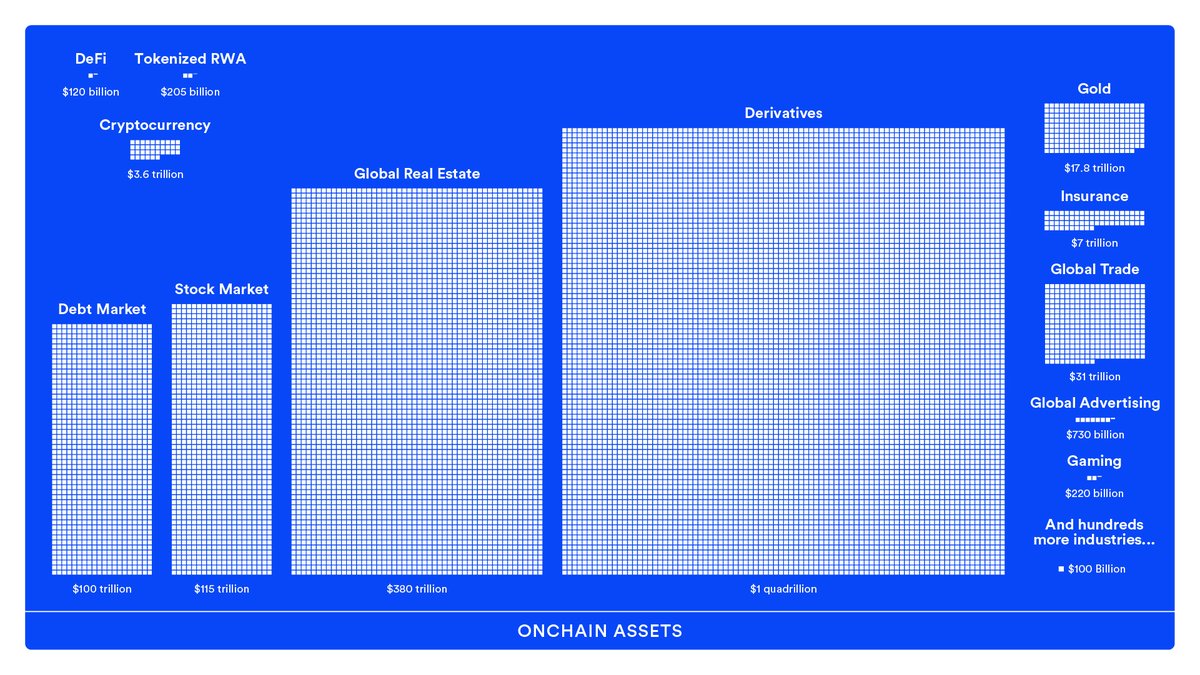
I wonder what happens when the world's largest financial institutions decide to go on-chain because being on-chain becomes a "national priority".
Seems likely they will need a secure and reliable way to utilize various kinds of data on-chain to build their financial products. I can also see them needing a reliable way to interconnect all their chains to transact in a secure, compliant and efficient manner accepted by regulators. Something like what TCP/IP does for the internet, but built to handle cross-chain transactions and able to work for institutional systems/use cases.
It might also be nice if they had a simple development environment from which to manage all this complexity, something like a runtime environment that makes it easy to rebuild all their existing financial products and transactional flows on-chain. If that development environment was already integrated with their existing standards like Swift and their existing CSDs like DTCC, that would make it a lot simpler for them. If only there was a single platform where they could get all of these key building blocks to work together in a secure way...
Exciting times ahead.
I see this long list of initial capital markets users and early adopters of multiple Chainlink services as just the beginning.
Just like Chainlink became the standard for powering DeFi, there is now very active integration work and adoption of Chainlink in the TradFi/Capital markets.
Whether you're an asset manager, custodian bank, central bank, financial market infrastructure or various other traditional financial system participant, the Chainlink standard gets you transacting across multiple chains quickly, securely and in a compliant manner. There is no other standard that currently does that.