gn tweet (long tweet, rwa edition)
very early since this is going to be my last parisienne night and even if i'm terminally online, i'm gonna go enjoy it
So, RWA and T-Bills have become something people really started looking forward to in crypto over the last year, due to the market downturn, the search for sustainable yields, and the credibility issues we experienced.
Several protocols capitalized on this demand and launched different types of services.
The common approach is to mint a stablecoin against yield-bearing “RWA” assets.
The yield is then either withheld by the company (like Circle or Tether), or redistributed to stablecoin holders or governance token holders, or both.
A few questions come to the mind:
1) is this RWA thing here to stay?
Well, very likely.
It's unlikely that yields on t-bills will fully return to pre-covid pre-ukraine level very soon, although they might have peaked already and therefore the market may contract.
A 3% 30y US-T bill is surely not as attractive as a 5%, but T-bills are not the only RWA assets.
2) What are exactly RWA (or OST) assets?
These RWA assets are usually US T-bills with short-term maturities, but in recent months we've also seen an increase in private bonds, typically characterized by higher yield and somewhat more risk.
These bonds (or alternatively just loans) can be issued or extended from/to traditional finance companies or crypto companies, with the latter typically posing an additional layer of risk due to the sector's youth and, ironically, the lack of transparency of many companies operating in this field versus public companies.
Whilst technically even a loan to Orthogonal Trading would be classified as an rwa as much as a US T bill, those are worlds apart.
Finally, what is happening in this world?
1) Did you know that @MakerDao is currently the RWA king? $2.2 billion of $DAI supply is backed by T-bills or bonds, with $500 million invested in short-term T-bills by Coinbase.
As a result, Maker is earning a significant amount of money, partially redistributed through the DSR, which also benefits $MKR holders (https://t.co/SFf9o8iWh6).
The DSR's advantage is that it's permissionless, justifying its lower yield.
2) One of the main contenders for that title is certainly @OndoFinance, with offerings that extend beyond US T-bills to include US market maker funds and high yield bonds.
Although Ondo is permissioned, yields can still be accessed in a permissionless way through @FluxDefi. By depositing your USDC on Flux, you can earn a yield similar to that of holding Ondo assets. The current yield on Flux is 4.5%.
There is also an $ONDO token, which was sold on Coinlist but hasn't been released yet.
Its initial valuation is pretty high, but so is the potential market.
3) One of the original RWA space players is @centrifuge, extending credit to several companies through USDC or DAI deposits (permissioned).
It has a $CFG token that followed the $MKR's good run in recent weeks (I totally missed it).
A money market for these assets exists at https://t.co/Jys7XViJHW (permissioned).
4) A newer player is @OpenEden_HQ, which currently offers permissioned access to US T-bills of different maturities.
As the name suggests, OpenEden prioritizes transparency and provides a full breakdown of their T-bills on the dashboard.
5-6-7) One thing that stands out about Ondo's success is the struggle other similar protocols have with liquidity.
Achieving liquid, permissionless RWA is a significant challenge due to regulatory constraints.
This issue is evident with @BackedFi and @SwarmMarket.
Both protocols offer US T-bills and tokenized stocks, both are permissioned, and both have liquidity issues. While you can always redeem these assets (with minimum caps), you may want the flexibility to exit at any time.
Swarm’s solution to this is two-fold: Balancer-like pools, but currently the deepest is the one for $AAPL with 10k liquidity, and an OTC market which is not immediately liquid.
Backed has issues several tokenized RWAs which are theoretically tradable as erc20 tokens on Uniswap (but blacklisted by the UI).
Both protocols struggle to make their assets permissionlessy tradable bc of regulations, so they won’t add liquidity on dexes until they figure it out (probably never, they’ll have to find a workaround like Ondo did, or they’ll have to rely on a third party that independently does it).
Swarm has a governance token $SMT.
As things stand, therefore, both Backed and Swarm are mostly useful as brokers for protocols and on-chain entities, allowing them to quickly access RWA/OSTs.
For example, i've learned today that this (and the next point) is how @Jarvis_Network will be doing their RWA collateralization.
8) Same goes with @KumaProtocol, a newcomer by Mimo Labs
What interested me about Kuma is not only the token structure (they’ve interest bearing tokens that can be wrapped in interest bearing nfts), or the fact that it’s not the first interesting protocol by Mimo Labs ( $PAR ), but the fact that recently they’re focusing on private bonds which is something still mostly unexplored as i’ve mentioned in the beginning.
There will be $USK (US-t backed) and $EGK (bonds backed) and $MIMO will be the governance token for Kuma aswell.
9) An intriguing one is @TProtocol_.
They're doing something similar to Open Eden, except the receipt is a freely tradable ERC-20 token, which is $TBT (a rebasing token, and its wrapped version $wTBT).
I won't delve into the legalities behind this (mainly because I'm not an expert), but it's certainly one of the most compelling implementations due to this aspect. The collateral is sTBT issued by Matrixdock (permissioned).
I participated in minting and LPing for three epochs, but I'm currently out and waiting for the airdrop.
A governance token $TPS will be introduced.
10-11) Real Estate Backed
Two main protocols come to mind (though there are several other smaller ones):
@RealTProtocol and https://t.co/21resTTbK1 (similar to the Ondo and Flux relationship) allow you to invest in US real estate (permissioned) or to benefit from mechanisms similar to Flux's on rmm by depositing DAI and earning a competitive yield.
I'm not a user, and there are some caveats on pricing those assets and the LTV at which Real Token holders are allowed to borrow DAI, but I know several people are fans and are enjoying the high yield or the US real estate exposure.
For now, I'm more of a traditional finance user when it comes to real estate, but I've heard very good things about RealT management and their acumen in real estate market.
The second one is @tangibleDAO, which directly issues a stablecoin primarily backed by Real Estate, in both a rebasing model (USDR) and a wrapped model (WUSDR).
This isn't the first time I've discussed Tangible, so you can look for my previous tweets on the subject.
TL;DR: The yield from the real estate helps to recapitalize the stablecoin's collateral over time if necessary, and there are obviously caveats around Real Estate liquidations.
12) Now we've finally come to loans, which have been somewhat under the spotlight after several debacles and borrower bankruptcies on Maple and others.
The issue here is clearly that we're in a relatively new sector that lacks transparency and regulation. Therefore, blowups and shady deals are more frequent, and oversight is not always sufficient to ensure loan repayments.
This part of RWAs don't really interest me.
13) An interesting intersection - not the first time I've mentioned this - is @arborfinance, which allows every DAO or web3 protocol to issue bonds that people can subscribe to in exchange for usually a quite high yield (at least in Shapeshift's case). It's surprising that this hasn't been adopted more widely considering how teams typically finance here - I mean, loaning against some governance token is always better than dumping, as the largest DAO in this space has well demonstrated (lmao). Why not issue bonds with a 400% collateral in governance tokens? There must be some reasons I'm not immediately aware of because this sounds like a deal both sides would happily accept.
14) Not surprisingly, as RWA and LSTs are two adjacent areas in many aspects, @RevestFinance has taken an interest in both with Resonate's yield anticipation.
Wow, something of a bombshell in this interview. I always wondered why Microsoft raised venture funding. They didn't need it. The VC involved hypothesizes it was partly because Ballmer wanted to be sure he got the equity he'd been promised.
https://t.co/QUfxHNnDGB
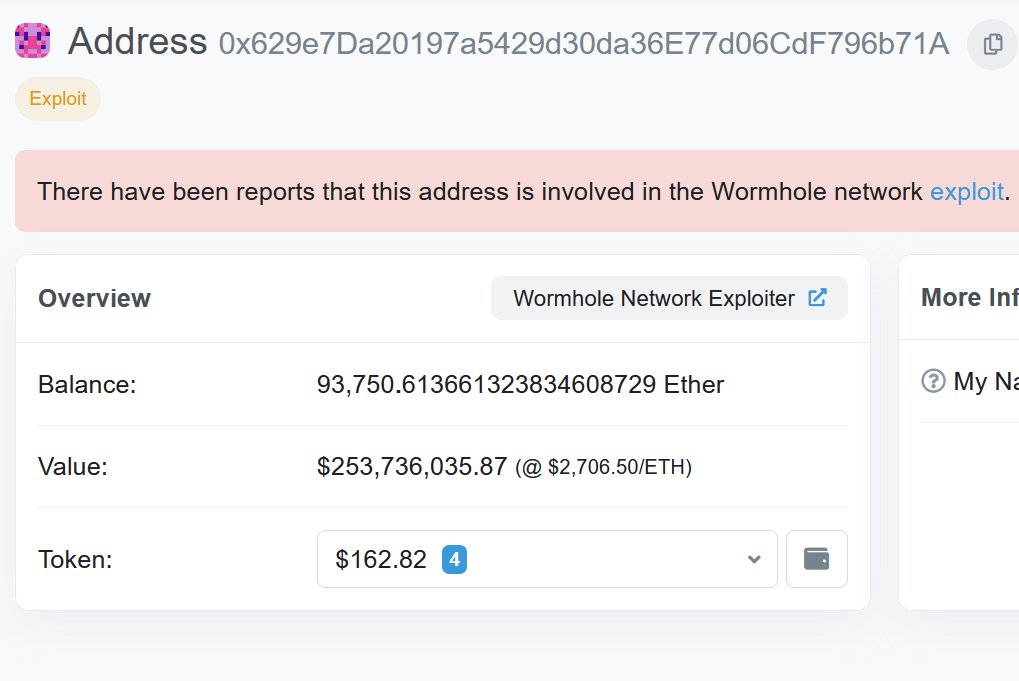
How did the @wormholecrypto exploit work? I joined forces with @gf_256 and @ret2jazzy to reverse engineer the exploit, and now that it's been patched we can finally share it with you👇
Insurance is still a niche player in DeFi and therefore severely undervalued.
But as institutional capital is coming in, it has the potential to become one of the biggest DeFi's pillars.
Read on to learn more about the current DeFi insurance market landscape.
👇
0/ Teaching an old DEX new tricks ($BNT)
4 months ago, Bancor released their flagship single sided Impermanent Loss protection solution for LPs.
70x increase in TVL and 55x increase in volume later,
I present a deep dive on a forgotten DEX that may be the dark horse of 2021
👇