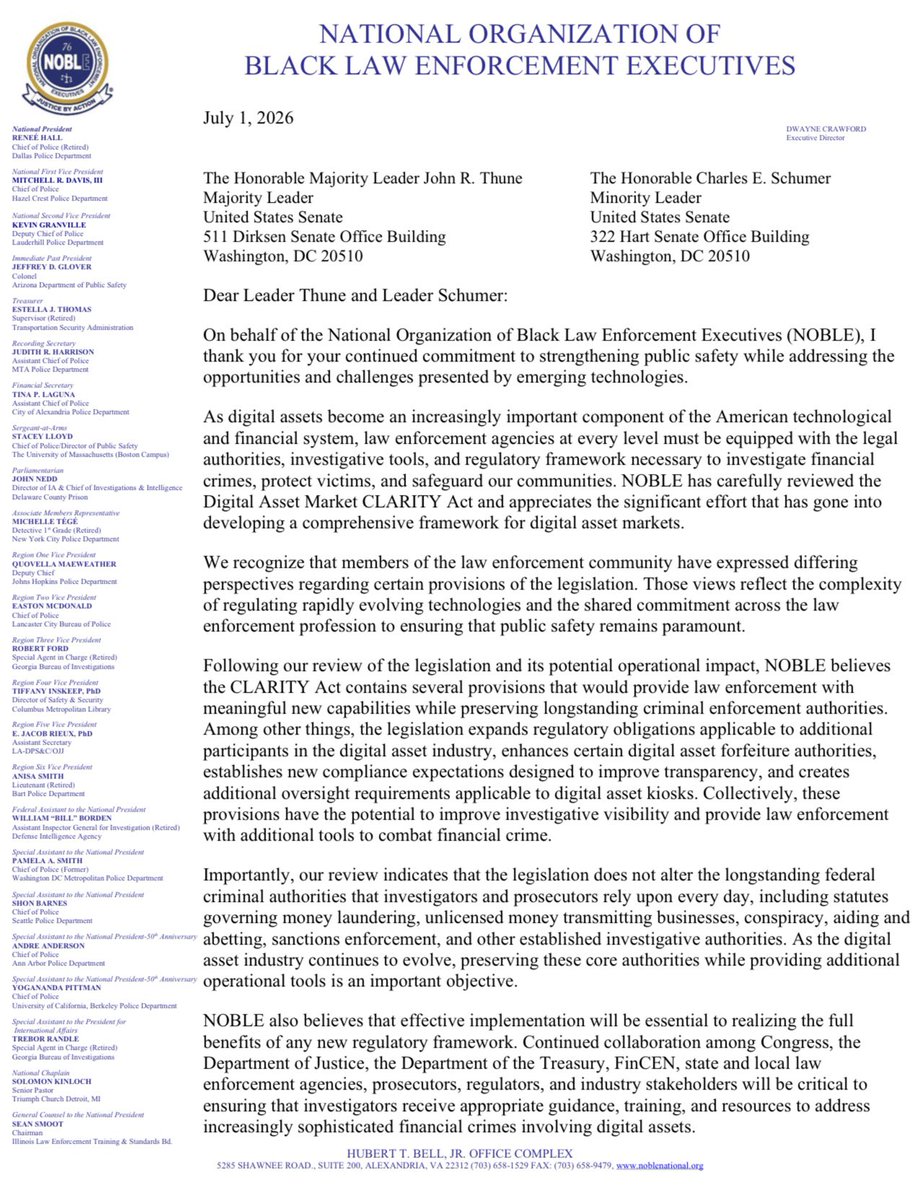
🚨NEWS: The National Organization of Black Law Enforcement Executives (NOBLE) has endorsed the Clarity Act, becoming the first major law enforcement organization to publicly support the legislation, which includes the Blockchain Regulatory Certainty Act (BRCA).
In a letter to Senate leaders, @noblenatl says the bill “contains several provisions that would provide law enforcement with meaningful new capabilities while preserving longstanding criminal enforcement authorities.”
Responding to concerns raised by other law enforcement groups, NOBLE adds that the legislation “does not alter the longstanding federal criminal authorities that investigators and prosecutors rely upon every day,” including statutes governing money laundering and unlicensed money transmitting businesses.
The future of payments will be multichain, interoperable, and built on institutional-grade blockchain infrastructure.
Our focus is simple: continue making the XRPL the leading blockchain for institutional payments – and a natural home for the next generation of key regulated stablecoins – while growing the utility and adoption of $RLUSD and $XRP around the world.
Concerns have been raised about the possibility of front running or transaction sandwich attacks on XRPL payments and offer crossing.
For the reasons I've explained, I'm not that concerned about this issue. But I have a proposal for a fairly simple scheme that would eliminate this attack. It's a transaction reservation scheme that can ensure that a transaction executes before any transaction that was formed after it was disclosed.
This is the scheme, and it eliminates concerns about front running or sandwich attacks.
Reserving Transaction Slots
A new ledger object is proposed, ReservedTxns. It contains a ledger sequence number and an array of transaction IDs. It is stored at an index that is formed from a hash of a fixed string and the ledger sequence number.
A new transaction is proposed, TxnReserve to reserve an execution slot for a transaction. It takes a ledger number and transaction ID as parameters.
It succeeds if:
1) It pays a fee of at least twice the normal transaction fee.
2) It meets all the normal transaction execution requirements.
3) The ledger sequence number specified in the transaction is greater than that current ledger sequence number and not more than 16 ledgers greater than the current ledger sequence number. The transaction TECs if this test fails.
4) The ReservedTxns object for the specified ledger sequence number either does not exist or if it exists it contains fewer than 32 transaction IDs and does not contain the specified transaction ID. The transaction TECs if any of these tests fail.
If it succeeds, it creates a ReservedTxns object for the specified ledger index if one does not exist. It then adds the specified transaction ID to the end of the array of transaction IDs in the object.
Broadcasting Reserved Transactions
If a transaction has a reserved slot in ledger X, the transaction should be broadcast as soon as it is known ledger X-1’s initial proposals are all received or the final consensus transaction set is known. The XRPL software should be modified to provide a feature to disclose when that occurs and, if desired, to hold a list of transactions to broadcast when, and only when, that happens.
The XRPL software should always broadcast a transaction with a reserved slot if that transaction has not been broadcast recently. This should apply even if the server thinks the transaction will not succeed. Its relaying has already been paid for by the doubled fee for the reservation transaction, so this is not an attack.
A transaction that is intended to execute as a reserved transaction should have its last valid ledger set to the ledger it is expected to execute in. This ensures that if it is somehow delayed, it still cannot be sandwiched or front run.
Execution Mechanics
As each ledger executes, the following steps are added prior to the execution of any transactions in the transaction set:
1) The ledger object containing the reserved transactions for this ledger sequence number is retrieved. If there is none, skip the rest of these steps and execute transactions normally.
2) For each transaction ID in the set of reserved transactions, that transaction is executed if it is in the consensus set and removed from the consensus set so it will not execute again.
3) The reserved transactions object for this ledger sequence number is removed from the ledger.
DoS Attack Resistance
There is a theoretical attack on this scheme where an attacker could fill up all reservation slots for many ledgers as a denial of service to others to prevent them from being able to use this scheme to protect their transactions. This is mitigated by the fact that they would have to pay continuously and others could simply wait the attack out. However, the cost is low enough that someone could theoretically do this indefinitely.
A simple fix is to ratchet up the fees for the reservation transaction as the object starts to get full. For example, when we hit 16 reserved slots, we could begin to raise the fee linearly up to the base reserve. By the time we hit 30, the fee could go up to three times the base reserve.
If needed, we could even raise the limit to 64 if people are willing to keep paying fees. It’s likely that this would never result in such fees being paid and simply make the attack impractical. An attacker would have to pay, every five seconds, several times the most anyone would be willing to pay to protect their transaction.
We are proud to announce our integration of the #XRP ledger for cross border payments.
Bull Street has chosen $XRP to be our primary choice for payments. We strive to settle billions of dollars in transactions on the #XRPL and are blown away by the incredible network speed, 3-5 second transaction times for fraction of a cost fees.
Ripple is on the road to clarity!
Our Clarity truck is on the move in D.C. as Congress continues work on transparent rules of the road for digital assets.
The message is simple: the Clarity Act will protect consumers, support responsible innovation, and keep the U.S. competitive.
🇯🇵 JUST IN: Ripple and SBI Group officially launch $RLUSD in Japan following JFSA approval, making the stablecoin available to both institutional and retail users.
We're proud to announce that Ripple USD ($RLUSD) is now officially available in Japan, following approval from the Japan Financial Services Agency (JFSA): https://t.co/ChkYMQ6kxW
Through our partnership with SBI Group and @sbivc_official, $RLUSD will be accessible to both institutional and retail users via the VCTRADE platform, serving as a bridge for payments, tokenization, and collateral management.
With $1.7 billion in market cap and a 10-year relationship with SBI, this is a significant milestone in advancing regulated stablecoin adoption across Asia.
🚨RIPPLE SECURES EU MiCA LICENSE FOR ITS $1.6 BILLION RLUSD STABLECOIN
Ripple received preliminary CASP approval from Luxembourg's CSSF, allowing it to offer crypto asset services across all 30 EEA countries under MiCA.
RLUSD can now be used for cross-border payments and settlements across Europe once full authorization is granted.
The bill includes a temporary ban on a central bank digital currency that would expire at the end of 2030.
It’s set for House consideration this week, with House Financial Services Committee Chairman @RepFrenchHill saying he “looks forward to the House moving quickly to advance this bill to President Trump’s desk.”
So you’re telling me Europe delisted USDT to hand the entire continent’s on-ramp to Ripple’s freshly MiCA-approved RLUSD.
Well I’ll be damned, Ripple was indeed the Trojan Horse😳🤫
$3 billion in real-world assets, now live on the Stellar network.
Since the beginning of 2026, Stellar has crossed the $1B, $2B, and now $3B RWA line ‼️
Keep moving.
today, @ripple received preliminary MiCA approval to offer regulated crypto payment services across europe.
TLDR MiCA approval allows ripple to legally offer its crypto and stablecoin payment services to banks and businesses across Europe.
here's why it might be one of the most important milestones to date and what it means for the rest of crypto:
1/ MiCA is considered the "gold standard" for crypto regulation
approval is a major stamp of legitimacy, allowing a company to offer its financial services across the entire EU.
2/ regulators gave ripple a "green light letter"
this means ripple met their main requirements pending a few final conditions before a full license is granted.
3/ regulated crypto payments are coming!
the license enables ripple to offer financial infrastructure to european banks and businesses, allowing them to use ripple's tech (including its stablecoin $RLUSD).
this means institutions can finally use its tech to send money across borders in a legal and compliant manner.
needless to say, lock in.