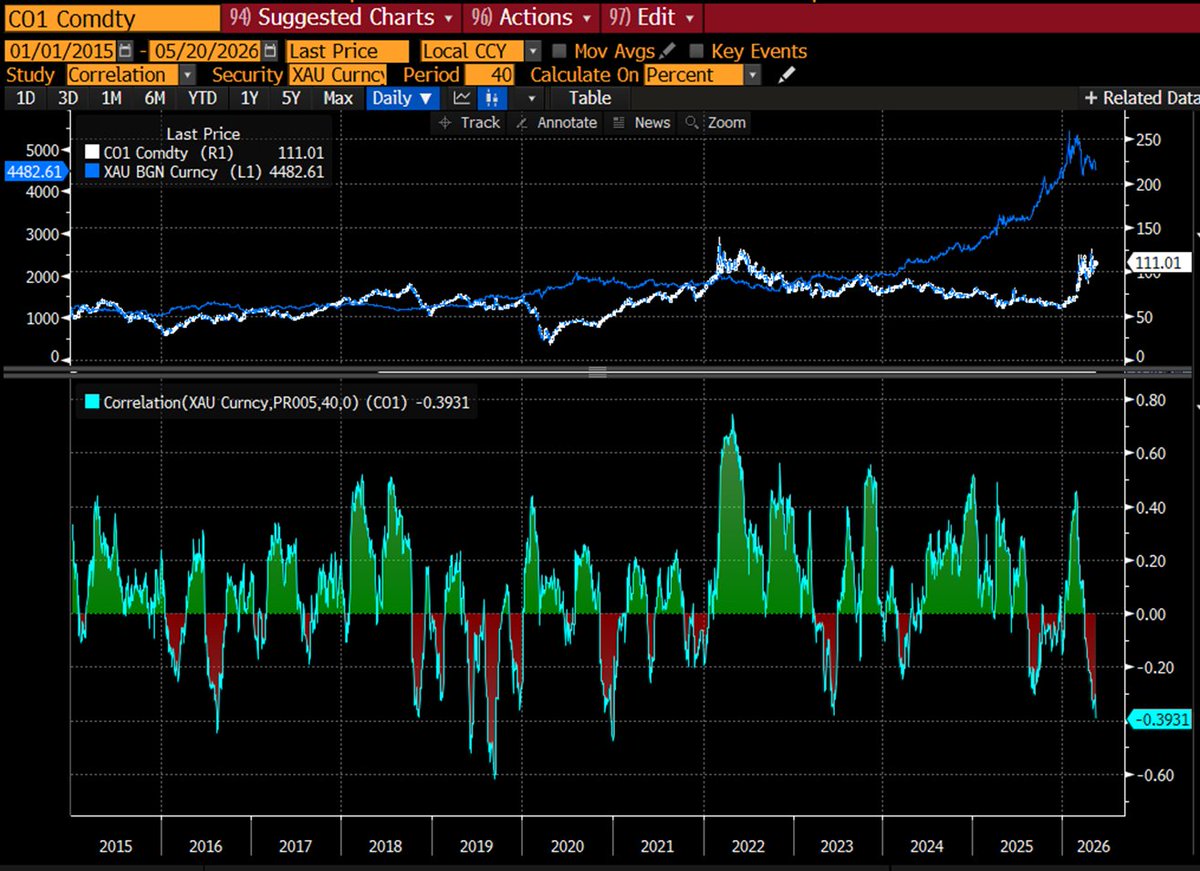
Since the start of the war, gold has been negatively correlated to oil. Oil up, gold down. Why? Because the marginal gold buyer is not the West, it is EM Asia and Turkey.
India alone is the world’s 2nd-largest gold buyer after China, across both central banks and retail. And the Rupee hates oil spikes, let alone an oil crisis like this. High oil intensity, limited crude storage, weak FX resilience.
The mechanism is self-reinforcing: Higher oil → weaker growth -> weaker Rupee → even higher import costs (also for oil) → even weaker growth → weaker Rupee again -> repeat.
That is precisely why Modi has moved to curb gold imports. He wants to support the Rupee (industry), not the consumer (gold is a hedge for a weaker Rupee). Well, not sure consumers will like it. So this will not last forever but I doubt it will stop before 2027.
Turkey already went further and dumped reserves to support its FX. Other EM Asian countries may follow. Not just Asian, perhaps also ME countries? They are hardest hit by this crisis. Qatar & Kuwait come to mind. They have plenty of SWF reserves but the hit is big and the invoices keep coming.
China offsets some of this through higher gold imports, but not enough, at least for now. Until the Strait of Hormuz situation stabilises, or EM Asia adjusts through demand destruction and policy responses, gold likely keeps bleeding, slowly, nothing dramatic, but bleeding.
And no, I do not think there is a quick fix for the SoH crisis. The two sides are too far apart. Weak regimes can survive longer than people expect (they had little oil exports under Trump 1.0 and survived for years). Trump has midterms ahead & is unlikely to escalate materially without political support. Without regime change, the structural issue remains.
So the oil market will likely solve this itself through painful adjustments into 2028: rerouted flows, new pipelines, permanent demand destruction, more coal, more efficiency.
For now, China is doing the heavy lifting. Chinese crude imports in May were down 45% vs February. That single-handedly balances a large part of this mess. But not indefinitely. Once China decides to normalises imports closer to baseline, or Japanese SPR drawdowns fade, Brent likely reprices higher again, ceteris paribus. Korea is another big player in the puzzle to watch.
Gold may stabilise before the full oil adjustment plays out. But I do not see much value in taking a rigid long-term view here. Too many moving parts. Mental flexibility remains key here.
We have been risk-off since week one of the war, largely because we understand commodity transmission mechanisms. If this turns into a healthy correction in quality miners, I am certainly happy to buy it as the structural gold story remains largely unchanged. I explained it in 2023/24/25 on this channel.
That is what I am watching.
Instead of watching an hour of Netflix, watch this 1 hour Yale lecture. It will teach you more about options trading and the exact models hedge funds use than most people learn in their entire careers on Wall Street.
یک کانال تلویزونی در امریکا وجود دارد به نام فاکس نیوز. اگر شما برای یک ماه به شکل متدوام تنها فاکس نیوز را تعقیب کنید، مشکل روانی پیدا می کنید، درک تان از مسایل کند میشود، شستشوی مغزی می شوید، و یک توهم جاهلانه از مسایل پیدا می کنید. این گپ ثابت شده شده است.
دو به ظاهر نهاد مرموز تلویزونی که در خارج از افغانستان ساخته شده وتوسط اعضای یک فامیل اداره می شوند، تقلید مضحک فاکس نیوز اند. اگر شما درک و پیش زمینه عمیق از مسایل ندارید و تنها منبع آگاهی تان این دو تلویزون است، متوجه باشید که امکان دارد در یک مدت بسیار کم به یک جهل مدرن دچار خواهید شد.
بمثابه کسی که سالهاست تحلیل گفتمان های میدیا را می کنم، خواستم برایتان بگویم.
What do you need to have global pricing power for #Gold and #Silver? You need the highest prices in the world and the highest physical Gold & Silver delivery volume out of all the major exchanges in the world.
The SGE delivers around 120 metric Tonnes of physical Gold per month and for a while it had the highest #Gold price in the world. The SGE therefore had global #Gold pricing power.
The COMEX is now delivering around 250 metric Tonnes of physical Gold per month and it now has the highest #Gold price in the world (slightly higher price than the SGE). The COMEX now has global #Gold pricing power.
Megacities population in 2100:
🇳🇬 Lagos: 88.3 million
🇨🇩 Kinshasa: 83.5m
🇹🇿 Dar Es Salaam: 73.7m
🇮🇳 Mumbai: 67.2m
🇮🇳 Delhi: 57.3m
🇸🇩 Khartoum: 56.6m
🇳🇪 Niamey: 56.1m
🇧🇩 Dhaka: 54.3m
🇮🇳 Kolkata: 52.4m
🇦🇫 Kabul: 50.3m
🇵🇰 Karachi: 49.1m
🇰🇪 Nairobi: 46.7m
Note: projected population in 2100
According to the World Economic Forum
This Exchange Stabilization Fund convertible bond approach to acquiring Bitcoin is already being discussed in El Salvador 🇸🇻 as a way to ‘Bitcoinize’ our Gold reserves.
We sell the development rights now for current & future payments in Bitcoin. https://t.co/s7q2kVRonV
The scenes from Sednaya prison in Syria are shocking; people wandering into the light after decades in detention & torture.
I interviewed @omarAlshogre, a former Sednaya child prisoner, about his reaction to history being made in Syria.
Full intv: https://t.co/sblHaojks6
To use Afghan parallels, are we facing the fall of Kabul a la 1992 (which unleashed a vicious war between rebel factions) or the fall of Kabul a la 2021 (which ended most killing, even though it established a repressive Islamist regime) ? Obviously parallels are valid only to a point.
How France Secretly Repatriated All Its Gold Before Nixon's Dollar Devaluation
President de Gaulle of France initiated the secret operation “Vide-Gousset” and repatriated 3,313 tonnes of gold reserves from the vaults of the Federal Reserve in New York and the Bank of England in London from 1963 until 1966. De Gaulle feared America’s deficit in its balance of payments would rupture Bretton Woods and lead to a devaluation of the dollar against gold.
All France’s dollars were converted into gold and to avoid treachery the metal was repatriated over the course of three years. It took 44 boat trips and 129 flights to bring home more than three thousand tonnes of gold to the Banque de France in Paris.
France’s decision turned out extremely well. As was foreseen by the French, the price of gold in dollars increased sharply, from $35 to $800 dollars an ounce from 1968 until 1980—the dollar lost 96% of its value against gold. Countries that held on to their dollars were less fortunate.
More recently, after the Great Financial Crisis, the Banque de France repatriated 211 tonnes, upgraded all its bars to current wholesale standards, overhauled its vaults, revived Paris as a trading hub for institutional investors, and history repeats itself as we are in a gold bull market presently.
Full article: https://t.co/m5d28tIUkF