we've just released our first foundation model - open-1b. unlike models by other AI labs, which require that you trust their training process, open-1b is fully auditable and replayable.
you can take any checkpoint, re-run it using our custom kernels, and get a bit-identical result across nvidia and apple hardware. it uses compiler, kernel, and training technology we've been building for years.
if the world is going to offload more of its intelligence to machines --> you should be able to trust them
open-1b: the first model you don’t have to trust
Auditable training is the best defense against the future of AI we’re being warned about
open-1b is a milestone toward verifiable AI, a goal that is absolutely necessary for the future of intelligence
https://t.co/qBi6CLXA2L
re-reading the 06/2018 "introducing a16z crypto" post today, its profound how @cdixon was able to distill the wild west of crypto at that time into a very simple, descriptive and powerful idea
glad we have him to on the front line to help make sense of the current wild west we're living through now.
“In a world of AI slop, the only real moat is taste and thinking for yourself.”
- Spencer, 26, Stanford CS dropout, YC W26, building a personal assistant AI agent, lives in a Hayes Valley hacker house, into peptides, sauna socials, and posting about "new media"
The biggest risk is not being ambitious enough.
Beyond excited to expand our scope to founders building new technologies and creating new markets with @a16zfrontier.
Big personal news today: I have decided to leave @a16z, move to SF, and start a company.
It's time to build :)
It has been almost 10 years since I joined the firm. I met @cdixon, @bhorowitz, and @pmarca in 2017. At the time, I was an engineer at Google Brain working on robotics. I had a deep interest in open source. I knew nothing about investing. Chris meanwhile had already planted the @a16z flag at the frontier that was early crypto with investments in companies like Coinbase. But the crypto team at the firm consisted of only him, and he had the ambition to expand. His pitch to me was simple: "You should leave Google and come help me build the crypto vertical at the firm."
The work we've done together since then to build out our team and support our founders has been the most meaningful work of my life. I am grateful to have spent a decade working with everyone here, supporting our founders, learning from Chris, Ben, and Marc, and living the firm's culture. It is a culture that values integrity, life-long working relationships, and the belief that we humans have the power to build our own future.
Marc and Ben have built a16z into an incredible force for good in the world.
Before I joined the firm, I always thought that my inevitable path was to become a founder. The truth is that I wasn't ready for it then. Somehow, this year I've gotten the overwhelming feeling that this has changed.
As for what I want to build: It is early, but I care most about building infrastructure that enables open software ecosystems. I am starting with two core observations:
1. AI today is largely a single-player technology. Most uses involve one human talking with one agent in isolation from the rest of the world. That will soon change. Most uses of AI will soon be many-to-many: many humans and many agents working together. There will be at least one massive open network on top of which those uses will be built.
2. Software is now free. It can now be written just-in-time, on the spot for a single individual's hyper-targeted use case, and it can even be thrown out after a single use. This means that our entire software stack will have to change. In the limit, it will lead to a whole new kind of AI-mediated operating systems, which in turn will create an ecosystem of AI-native developers who build applications that actively rebuild themselves on the fly.
If you are working on related ideas, and especially if you are in the Bay Area, hit me up. Let's chat!
@bhorowitz , @pmarca, @cdixon, @eddylazzarin, @guywuolletjr, @jasonrosenthal , and our whole team — I want to thank you. Working with you has been the time of a lifetime. I am forever an a16z superfan and your ally.
Onward 🫡
this California wealth tax thing is just incredible.
so in October 2025, a California healthcare union proposed a "one time" 5% tax on any billionaire's wealth. the ballot measure will be voted on next month. In early December 2025, California announced that it would be a retroactive tax if passed, applying to anyone with CA residency as of Jan 1, 2026. The objective is to pay for Medi-Cal, California's incredibly dysfunctional healthcare system. (which also functions as a glorified welfare apparatus, but that's a discussion for another time).
polls reveal that the CA electorate is split around 50/50 on the tax, but prediction markets only give Prop 40 a ~23% chance of passing (there are competing measures on the ballet that would nullify it).
there are 200 billionaires in CA, worth collectively somewhere between $2.3 and $2.6 trillion. 5% of that is around $100b, accounting for a small amount of attrition. proponents of the tax forecasted a significant windfall, assuming only a 10% departure rate.
supporters thought they were being clever with the retroactive concept. no billionares would leave CA in the few short months between the tax being proposed and the residency cutoff date, without the tax even having passed yet, right?
well as it turns out, they did.
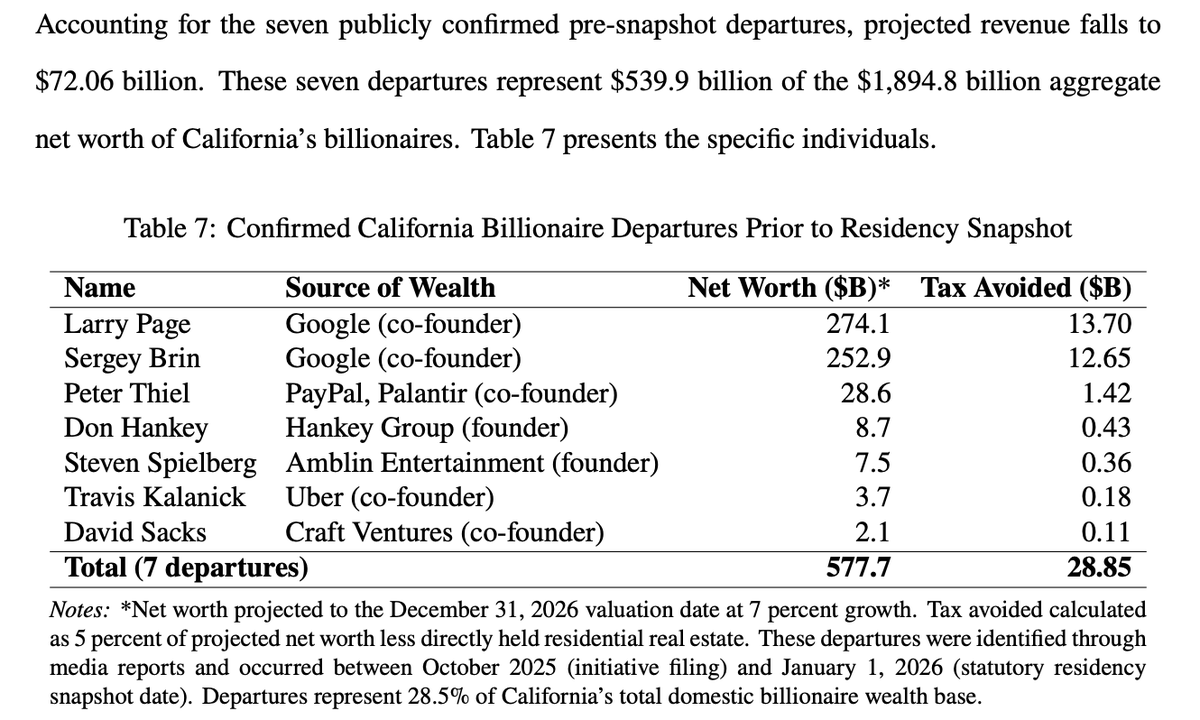
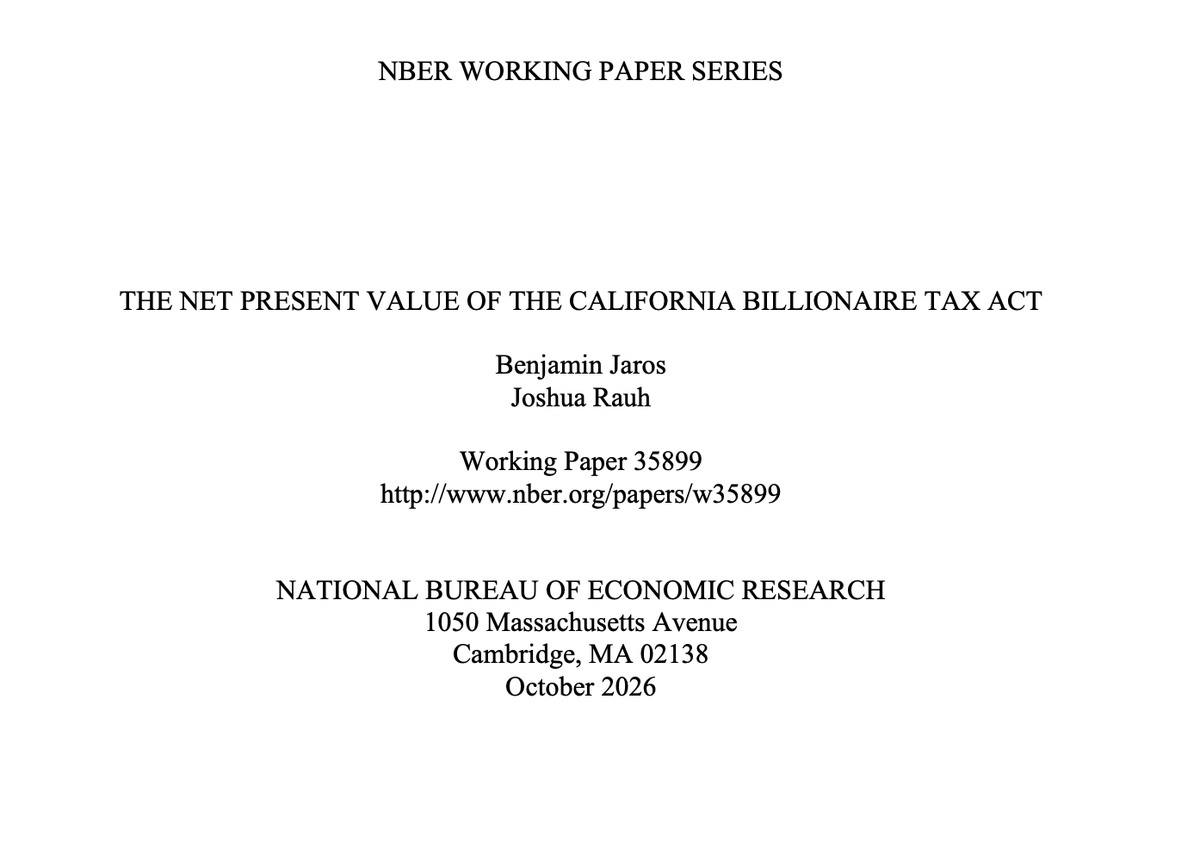
a new paper [1] from two academics at Stanford called "The Net Present Value of the California Billionaire Tax Act", argues that not only did more billionaires leave due to the proposed tax than its proponents expected, but that the value of the tax, if it does pass, is actually negative.
proponents of the tax only assumed 10% avoidance, that is, only 10% of the taxable base of targeted billionaires would leave CA within the very short Oct-Dec 2025 window. Jaros and Rauh, the Stanford academics, find that a lower bound of 28.6% of the taxable base managed to leave.
just based on known departures, those departures total $577b in net worth, or $28.8b in potential tax lost. this of course does not capture everyone (many left without announcing their departure), so the authors normalize to departure rates estimated from other wealth tax events, and apply other discounts for litigation, arriving arrive at a figure of only $28-$36b in forecasted tax revenues.
but this isn't all! all of the income taxes paid by the departed billionaires are also forsaken. the authors estimate that CA billionaires pay $3.3- 5.8b in annual income taxes. they assume a midpoint of $2b lost in annual collections from departed billionaires. the net present value of that lost income stream is -$68.9 billion.
so when you add it all up you get:
+ $30b one-time tax windfall (estimated)
- $69b in present value of lost future income taxes
= - 38.9b overall net present value of the tax
of course, this analysis is highly estimate driven. the authors simulate the parameters 100k times and find a negative NPV of the implemented tax 85 percent of the time.
and if the tax doesn't pass, which it's not looking like it will, California still ended up losing at least $577b in departed net worth, and they have permanently poisoned the well with entrepreneurs who will now worry about future wealth taxes.
[1]: https://t.co/1lbZgnMTG9
Gensyn CEO @benfielding warns that AI agents auditing other AI agents can be compromised too:
"We create swarms of AI agents that can do far more work than any human could. A human can’t follow along and check everything. One of the big counters is to say that agents can do the verification."
"But METR says those agents themselves can become corrupted by the training process, and you can’t trust any agent that’s auditing another agent. If you’ve trained a model in an auditable way, you can trust it."
"Any claim where the model is hiding its chain of thought falls away, because you have an exact log of everything that’s happened, and you can rerun every single step on any device."
"For national security, finance, pharma, health, insurance, it’s essential that they have models like these. If a regulator wanted to audit, they wouldn’t have to go off promises of the company."
@gensynai
we can have fully trustworthy auditor models for swarm monitoring, we just need to use auditably trained models and store inference audit logs for verification
@mattyglesias@SpecialPuppy1 You can argue it from logic. In fact, if you cannot argue it from logic, even if you had the evidence, I'd be skeptical of any causal relationship you're drawing.
It's time to start putting Dubois up there with AJ and Fury when talking about the best British Heavyweights of the past 10 years
Repeatedly beating these top level fighters is one thing, but he keeps doing it in devastating fashion.
#DuboisWardley2
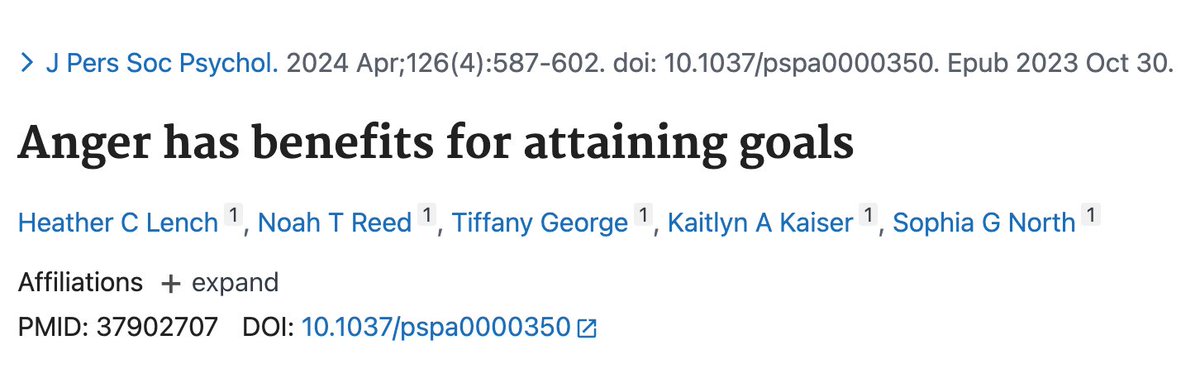
Being angry helped people solve 39% more puzzles on a difficult task and perform better on a challenging video game.
The advantage was seen on hard tasks, not easy ones.