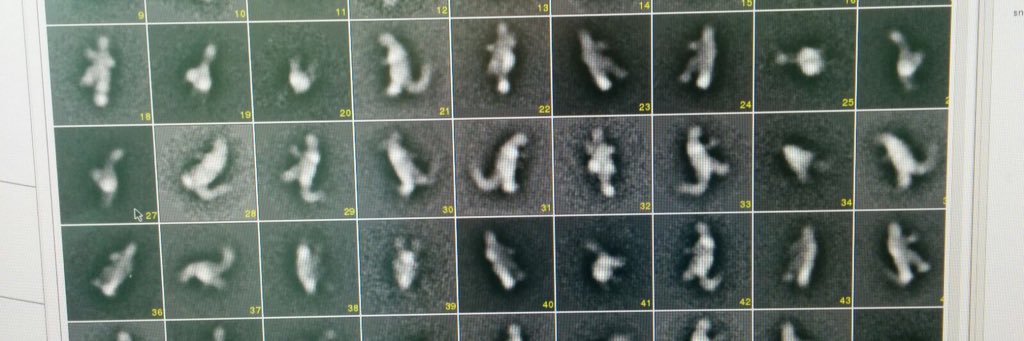
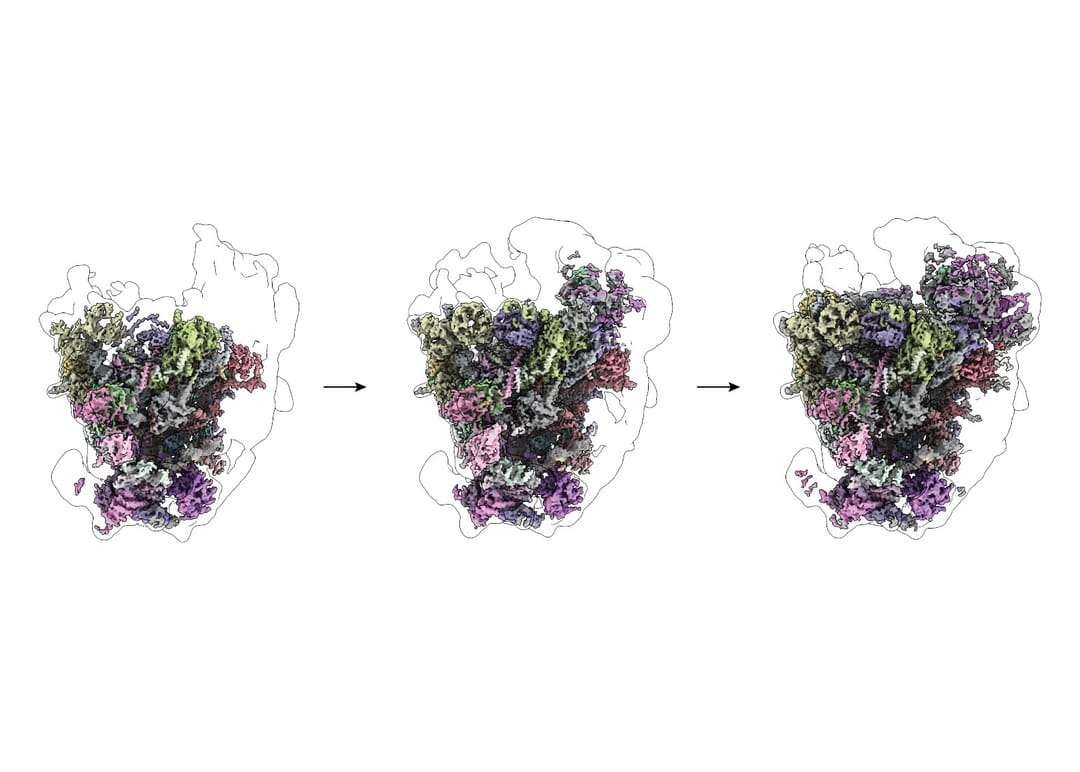
New Preprint: We have solved the structure of the proteasome in complex with two different ubiquitin chains: https://t.co/1TOgCKCYE1 This work spearheaded by PhD Student Sascha Amann
Let me walk you through it 🧵 1/9
I have stopped posting on social media, but this is a special occasion. I am glad to share that our work has been published in Science Advances! We made it work through great collaborations with outstanding colleagues. https://t.co/tiCIHNUlJd
This work was spearheaded by @HannaBrunner_ and is a collaboration with the Johannes Zuber lab. It features a saturation mutagenesis screen, a cryoEM structure of the import complex and a invitro reconstitution of the nuclear import process
To regulate gene activity, proteasomes - waste disposal machines of cells - must enter the nucleus. IMP Researchers now show how the adaptor protein AKIRIN2 helps ferry this massive complex through the nuclear pore: https://t.co/u51lvNosKg
We introduce a new method, EmbedOpt, for robustly steering protein sequence-to-structure diffusion models to fit experimental data (Cryo-EM, NMR) without training. 🧬📉 @mhli41@JiequnH@PilarCossio2
EmbedOpt tackles the brittleness of the previous coordinate-space steering methods by optimizing the conditional embedding instead. These embeddings capture rich co-evolutionary signals in protein diffusion models—unlocking a new, robust and semantically meaningful diffusion steering axis.
🚀 Result: Better fitting, wider hyperparam stability, and efficiency enabled by fewer diffusion steps
📄 Preprint: https://t.co/Ir7QcXyIW9
Sven Klumpe, joint Group Leader at the IMP and IMBA has received a grant by the Chan Zuckerberg Initiative’s Biohub to support fibsem-os, an open-source software platform for focused ion beam–scanning electron microscopy.
Read more 👉 https://t.co/B7CCCtmlbj
New work from our Haselbach lab with collaborators captures ribosomes 𝘮𝘪𝘥-𝘣𝘶𝘪𝘭𝘥 and reveals a flexible, modular strategy behind their assembly, rather than a strict assembly line.
Published in _Nucleic Acids Research _👉 https://t.co/ZaEmWLFtMi
the 4th paper in this week contribution from our lab tells about ribosome biogenesis in yeast. A follow-up story from our wonderful collaborators @UniGraz - the Bergler Lab. Structural work was again done by the amazing Lorenz Grundmann
https://t.co/Oy2FyEElU7
Happy I could contribute to this amazing story. Finally visualizing the activity of single proteasomes within cells a real dream come true. Check the preprint https://t.co/QvjiSH9VnB
New lab paper!! We develop a technology for live-cell, single-molecule visualization of proteasomal substrate degradation. We find that the site of substrate engagement by the proteasome determines decay kinetics, efficiency and co-factor requirement.
https://t.co/FltQFPYs8h
And another paper with our contribution. Sascha Amann managed to gain structural insights from this incredible hard to analyse cryo EM. Full story at: https://t.co/JErMyvyaw7
BLOC-1 and BORC help move and position lysosomes inside cells. New work from the Haselbach and Clausen labs shows they are not uniform complexes, but families of related protein assemblies. Published in PNAS: https://t.co/0Hm91imKD0
Have a look at our new structure of co translational folding in yeast. This is collaborative work initialized by the Rospert lab from the @UniFreiburg . Structural work has been done by the amazing Lorenz Grundmann.
🧪Scientists from our Haselbach lab captured how proteins begin to fold as they’re being made.
Using cryo-EM, they visualised chaperones guiding nascent proteins on the ribosome: https://t.co/MQEm21fWnV
🌍Open call: Junior Group Leader positions!
Join a world-class biomedical research institute at the heart of the Vienna BioCenter, where curiosity drives discovery.
Lead your own lab, pursue bold ideas, and shape the future of science at the IMP: https://t.co/sFyP1wqSLn
How do cells decide on the life or death of a protein?
🔬 Researchers around @HaselbachLab at the IMP have captured the first high-resolution view of the human proteasome reading different ubiquitin signals.
➡️Read the full story: https://t.co/UIXBZogn5C
Similar results have been obtained earlier this year by @PDraczkowski et al. using a different kind of K11/K48 branched chain. See also their preprint: https://t.co/kNsg4NcRQo 9/9
New Preprint: We have solved the structure of the proteasome in complex with two different ubiquitin chains: https://t.co/1TOgCKCYE1 This work spearheaded by PhD Student Sascha Amann
Let me walk you through it 🧵 1/9