@AshCrypto BTC's October 2025 ATH was around $126,200. The current level puts it more than 50% below that high, not just down 27% on the 20-day frame. This has been a six-month drawdown, not a sudden break
Two things worth flagging.
There are two competing bills here. Lummis-Begich BITCOIN Act keeps the 1M BTC / 200k per year purchase target. Begich's newer ARMA bill from May 21 quietly dropped that target and kept only the 20-year hold.
Both are introduced. Neither has passed. The Strategic Bitcoin Reserve already exists via executive order from March 2025, so "will ensure" assumes legislation that has not moved out of committee yet.
Small correction worth making: Taylor Hornby found it during a Shielded Labs audit he was commissioned for back in April. He built a custom auditing framework powered by Claude Opus 4.8 and used it to generate working counterfeit ZEC in a local test. "Claude AI finds vulnerability" undersells the researcher who designed the harness in the first place
Base being on the list is real and genuinely a win for them. "Mastercard is going onchain with Base" is the marketing edit.
Here's the unedited version: Mastercard's settlement upgrade supports 8 chains, not one. Base is in there with Ethereum, Solana, Polygon, Arbitrum, XRPL, Canton, and Tempo. Good company. Not an exclusive.
And Base isn't even Mastercard's first date here:
🔵 Visa already added Base to its own stablecoin settlement pilot back in April, alongside 8 other chains
🔵 Stripe, Visa, and Mastercard are reportedly building a joint stablecoin platform - with Coinbase, Base's parent, said to be in talks to join
So the real picture is every card network hedging across every major chain at once, and Base happens to be a major chain. Which it is. Coinbase's L2 earning a settlement slot at a $325B-market-cap moment is a flex worth posting.
Just maybe post the accurate flex.
Still waiting on that token though.
@Ltt68314038@Mastercard Good for stablecoins ≠ good for CRCL. USDC was one of six on that list, not the rail. Plumbing wins, the issuer's equity doesn't necessarily.
The restart is real. The footage is from a signing ceremony that has nothing to do with it.
Here's where the CLARITY Act actually stands as the Senate gets back from Memorial Day recess:
✅ Cleared all committee stages, passed Senate Banking 15-9
✅ Formally placed on the Senate Calendar June 1
⏳ Now needs 60 votes on the floor before the July 4 recess
That floor math is the whole story. Republicans have to peel off at least 7 Democrats or independents, and the fight is over the ethics provisions, not the crypto rules themselves. That's the thing that decides this.
Witt set an Independence Day target back in May. Same "imminent" energy we've heard for months. Lummis is out here saying we're closer than ever and "now is not the time to flinch."
Meanwhile Jamie Dimon is openly against the current draft, and Arthur Hayes is rooting for a Trump veto. Novogratz is calling June "now or never."
So yes, talks restarting today is genuine progress. But "IT'S FINALLY HAPPENING" over a recycled Oval Office clip is a different claim than "a bill cleared committee and got calendared."
If it slips past July 4, the midterms swallow it and we're talking 2030.
The headline is "build apps." The actual move is OpenAI trying to sit on top of every other SaaS tool you pay for.
Sites is the consumer-facing piece - Codex spins up hosted dashboards, planners, and internal tools you share by URL. Preview only, Business and Enterprise plans, rolling out wider later.
But look at what shipped alongside it:
🔌 6 role-specific plugins wiring in 62 apps - Salesforce, Figma, Snowflake - with 110 prebuilt skills
✏️ Annotations - point at a chart or a line of a doc and tell Codex what to fix
📱 Codex getting folded into ChatGPT "everywhere" in the next few weeks
The number that explains the whole thing: non-developers are now ~20% of Codex's 5M weekly users and onboarding 3x faster than the engineers.
That's the bet. Not "developers code faster." It's analysts, marketers, and ops people building their own tools and never opening the SaaS dashboard they used to.
Salesforce and Microsoft are running the identical play with Agentforce and Copilot. This is the orchestration-layer land grab, and it's getting crowded fast.
"Never been easier" is the same line every lab uses. The plugins are the part worth watching.
Building apps has never been easier.
With Sites, Codex can turn your work, ideas, and plans into an interactive website or app your team can explore, use, and share with a URL.
Rolling out to Business and Enterprise plans, before expanding more broadly.
Durov is bringing back the name the SEC killed.
🔵 Toncoin is rebranding to Gram - the original token name from TON's 2018 white paper.
The breakdown:
- Transition takes ~3 weeks, no token swap, balances/staking unchanged
- TON stays the name of the blockchain, only the currency becomes Gram
- Price ripped 15-18% on the news, trading around $2.10-2.19
- Up ~58% on the month, still ~74% below the $8.25 ATH
The context everyone's skipping: "Gram" is the exact name the SEC nuked in 2020. Telegram settled, paid $18.5M, returned $1.2B to investors, and buried the name.
Durov is now digging it back up and calling it step 4 of 7 in "Make TON Great Again."
This isn't a rebrand. It's a victory lap over a regulatory grave.
Same roadmap that already made TON 10x faster, dropped fees to near-zero, and put Telegram in as the largest validator.
Returning to your roots hits different when the roots got subpoenaed.
Saylor finally sold Bitcoin.
After saying "we'll never sell" for 5 years straight... Strategy sold 32 BTC for $2.5M last week.
But let's add some perspective:
📊 32 BTC = 0.0038% of their stack
📊 Strategy still holds 843,706 BTC ($61B)
📊 Sale price: $77,135 (ABOVE their $75,699 cost basis)
📊 Proceeds: funding STRC preferred stock dividends
Saylor literally telegraphed this back on May 5:
"We will probably sell some Bitcoin to pay a dividend just to inoculate the market."
The play is genius if you understand it:
- Strategy promises 11.5% yield on STRC preferred stock
- Capital markets froze, mNAV premium narrowed
- They needed cash for dividends
- Instead of issuing debt at bad rates, they sold a microscopic 0.004% of BTC
But the market reacted like he sold half the stack:
🔴 MSTR -5%
🔴 BTC dropped below $72K then $70K
🔴 $93M in long liquidations in ONE HOUR
The "never sell" narrative just officially broke.
Doesn't matter that it was 32 coins to pay dividends.
Matters that Saylor proved the unbreakable rule was always breakable.
Diamond hands look different now. The CT thesis just shifted.
Base just posted "..." with the chef's kiss meme.
1.1M views in hours.
Crypto Twitter is losing its mind because:
1️⃣ Base has been "exploring a network token" since September 2025
2️⃣ Jesse Pollak teased a "wrist-check, 12.18.25" event last December
3️⃣ JPMorgan projected $12-34B FDV for a Base token
4️⃣ Brian Armstrong said in 2025 it could be a "great tool for decentralization"
The "..." tweet pattern is unmistakable.
This is exactly how teams signal something is coming WITHOUT triggering SEC enforcement.
The hidden play:
- Base has 46.6% of all Ethereum L2 DeFi TVL
- 7-10M daily transactions
- Direct pipeline to Coinbase's 110M verified users
- CLARITY Act passing by July 4 = regulatory cover for a token launch
If they launch post-CLARITY at $12-34B FDV with even a 10% airdrop to active wallets, this is the biggest retail airdrop of the cycle.
Every base bridge, swap, NFT mint, and Aerodrome LP you've ever done is potential snapshot fodder.
The "..." is doing more lifting than any whitepaper could right now.
Don't sleep on Base.
The CLARITY Act is officially racing toward July 4.
Here's where we stand right now:
✅ Senate Banking Committee passed it 15-9 on May 14
✅ Stablecoin yield compromise REACHED (no bank-style yield, but activity-based rewards OK)
✅ Two Democrats (Gallego, Alsobrooks) already crossed over
✅ Trump publicly demanded faster movement
⏳ STILL NEEDED:
- 60 votes on Senate floor (need 7 MORE Democrats)
- Ethics provision compromise (the "Trump-specific" clause)
- House reconciliation with H.R. 3633 from July 2025
- President's signature
The $30 TRILLION number is real though:
- Total US household wealth: ~$167T
- Estimated TradFi capital sitting on the sidelines waiting for regulatory clarity: $30T+
- Once compliance frameworks exist, pension funds, endowments, and insurance companies can finally allocate
Witt himself said it best: "If we're not writing the rules, then we'll be following someone else's rulebook. And God forbid it's China writing them."
Bookmark July 4, 2026.
Either America's 250th birthday becomes the biggest day in crypto history... or the entire timeline slips to fall 2026 and momentum dies.
The next 6 weeks are everything.
Polymarket just got drained.
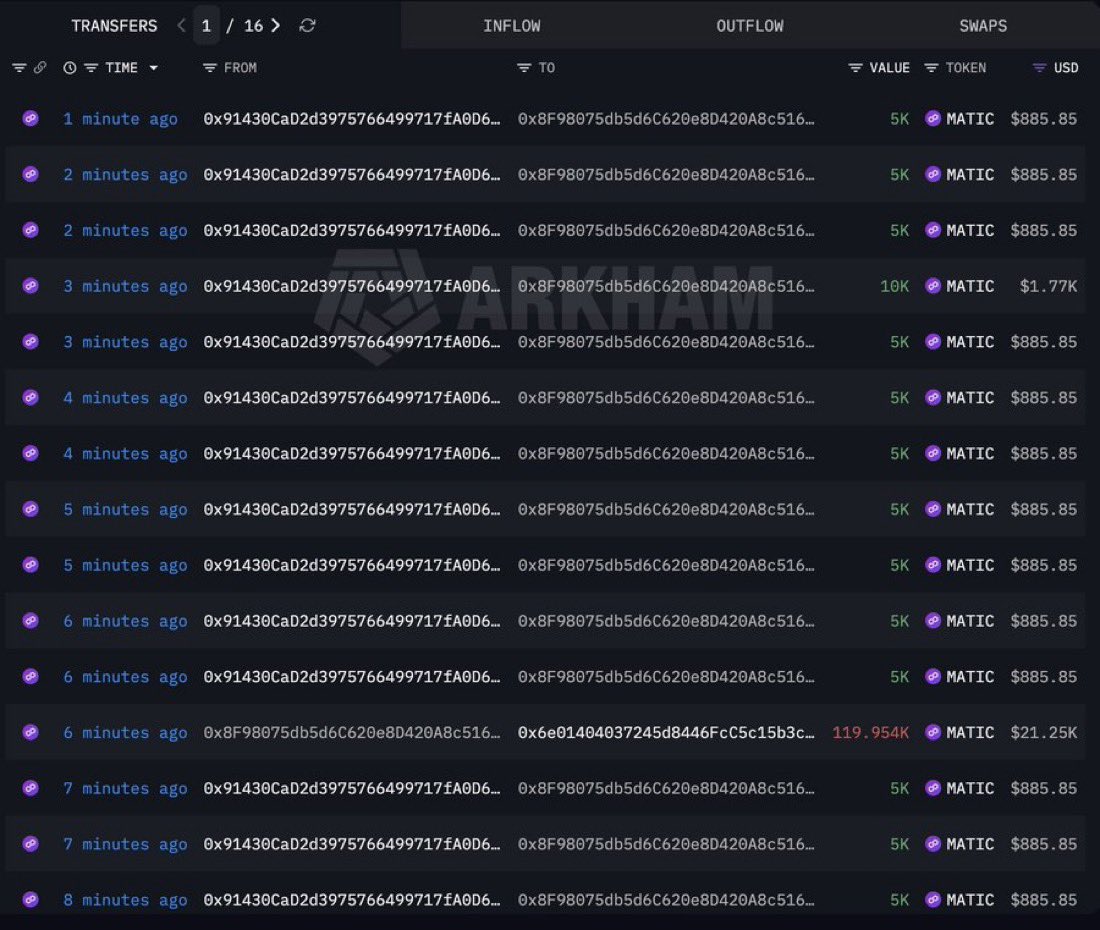
A 6-year-old private key was sitting in an internal "top-up" config… and someone finally walked through the door.
What actually happened:
🔑 An old admin key (not a contract) was compromised
💸 Attacker pulled ~5,000 POL every 30 seconds
📉 Losses climbed from $520K → $660K → ~$700K before it stopped
🧪 Funds split across 15+ wallets, some pushed through ChangeNOW
ZachXBT flagged it first. Bubblemaps, Lookonchain and PeckShield confirmed the drain live. Polymarket's VP of Engineering Josh Stevens admitted the key sat in an internal refiller service used to pay rewards.
The "good" news (per the team):
- No Polymarket or UMA contracts were exploited
- User funds and market resolutions are safe
- Key has been rotated, permissions revoked, everything moving to KMS-managed keys
Reality check:
- This is the second-largest prediction market on Earth ($3.7B monthly volume)
- A six-year-old hot key was still active in production in 2026
- 5K POL siphoned every 30 seconds for hours before it was contained
- It's the 19th DeFi exploit in May alone (~$38M total)
The contract wasn't broken. The opsec was.
"Not your keys, not your coins" cuts both ways — even for the platforms holding them.
DeepSeek just nuked AI pricing.
🐳 V4-Pro is now PERMANENTLY 75% OFF.
The new permanent rates:
- $0.435/M input tokens (cache miss)
- $0.003625/M cached input
- $0.87/M output tokens
- 1M context window
- 384K max output
For context:
- GPT-5.5: $5/M input, $30/M output
- Claude Opus 4.7: ~$15/M input, ~$75/M output
DeepSeek V4-Pro is now 35-100x cheaper than every Western frontier model.
The same Chinese students buying GPT-5.4 access for 96% off on Xianyu/Taobao can now just use DeepSeek directly at frontier-level performance.
This is the price war US labs have been dreading for over a year.
What happens next:
- OpenAI and Anthropic eat margin or watch enterprise customers migrate
- Token costs across the entire industry trend toward zero
- Every AI startup's unit economics get rewritten overnight
- Compute providers (Nvidia, SpaceX, Google TPUs) become the ONLY profitable layer
The race to the bottom on AI pricing just officially started.
The race to the top on AI capabilities continues regardless.
We are absolutely living through the most aggressive deflationary tech cycle in history.