On the “Druze are settlers” trope
Yes—Druze migration into Ḥawrān/Jabal al-Druze surged in the 18th–19th centuries.
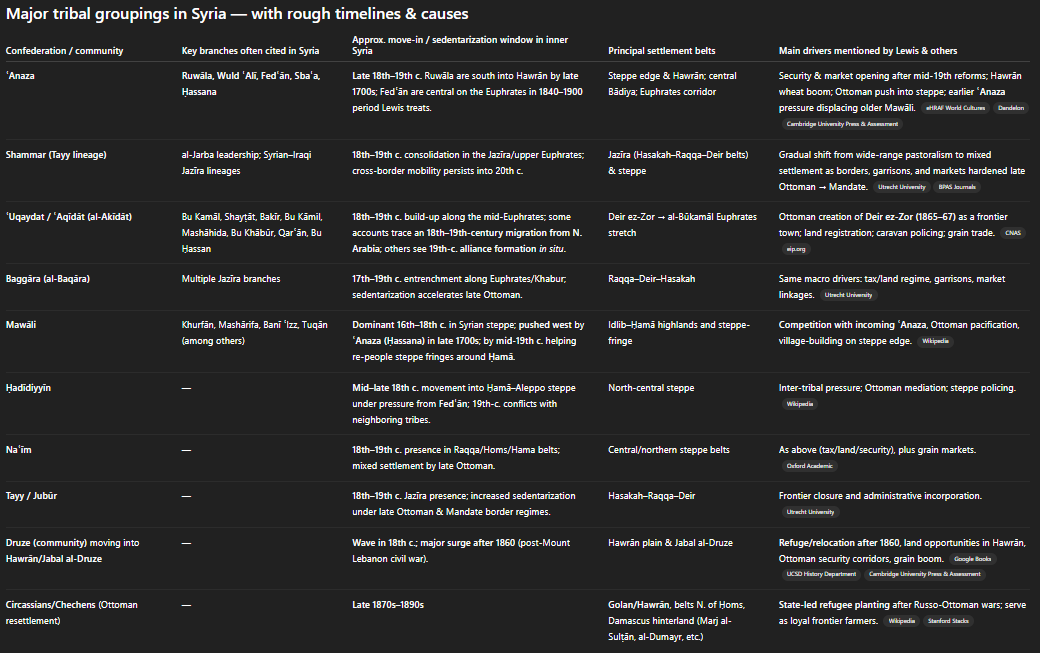
But so did almost everyone else in Inner Syria. Most nomadic and village communities there were fixed in place or arrived within the last 150–200 years. Outside the big old cities (Damascus, Aleppo, Homs, Hama, etc.), the modern peopling of the interior is recent.
If much of Inner Syria was (re)settled in the last two centuries—often under Ottoman security policy—why would Arabs hold a stronger moral title than Druze, Kurds, Circassians, Greeks, Turks, or Jews? Claims to exclusive indigeneity are weak; power and policy, not timeless entitlement, explain who ended up where.
What the record shows (simple version)
Pivot (1850–1900): Ottoman centralization (Land Code 1858), safer caravan/Hajj routes, and grain markets (especially Ḥawrān) drove rapid sedentarization in the interior.
Who moved/settled:
Arab confederations (ʿAnaza, Shammar, ʿUqaydat, Baggara); Druze into Ḥawrān (big jump after 1860); Circassian/Chechen resettlement (late 1800s); later Assyrian/Armenian/Kurdish inflows in the Jazira (1920s–30s).
Where towns crystallized (modern take-off):
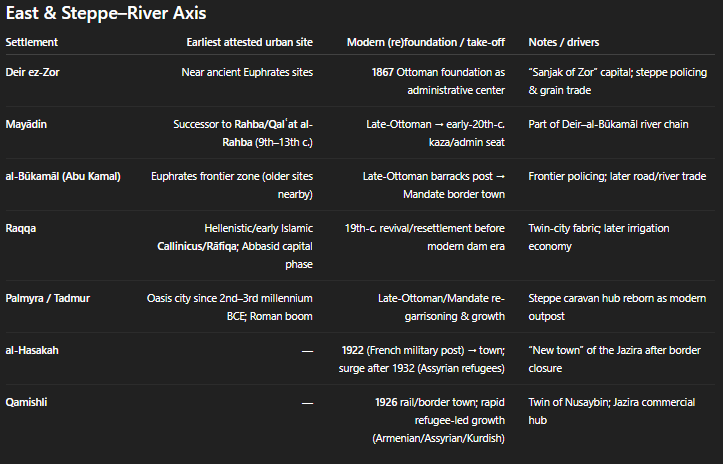
Deir ez-Zor (1867);
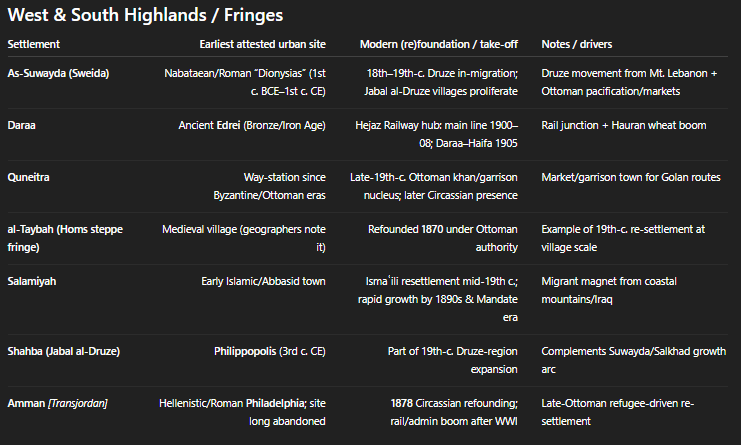
Amman (Circassians, 1878);
Daraa (rail hub 1905);
Palmyra/Tadmur (late-Ottoman/Mandate regarrisoning);
al-Hasakah (1922);
Qamishli (1926);
Not a blank slate:
Ancient cities and some village strings existed; what changed after ~1850 was the scale and spread of settlement into steppe-edge belts.
Thank you. My point stands. There's an implicit bias in the presentation of "narratives" regarding claims or rights to the land. The bedouin argument always uses precedent. In other words, they were there first. Or let me rephrase that: they were always there. The Druze, on the other hand, are the alien element, settlers who took the land by force of arms from the native inhabitants. You implicitly support that argument.
I'd like to point something out: I work in agriculture in Sweida. To a certain extent, I agree with your suggestion that climate change (among other factors) has strained Druze - bedouin relations. There are regions in the province (especially towards the south - in villages like Bekka, Dhibeen, Ghariyeh) where growing successful crops of rainfed grain has become nearly impossible.
Nevertheless, this low level, simmering conflict has always been managed at the local level. The exceptions you mentioned such as the ISIL incident, the 2000 flare-up, and other such severe conflicts have always been tied to intervention from external players (a fact you also mention in your article).
Yet even though you mention the Ottomans, Shishakli and the Ba'ath regime as external instigators of Druze-bedouin strife, you make no mention of the current regime in Damascus as an instigator of the latest massacres. Very strange - especially given the fact that tribes from all over the country flooded the province during those 4 or 5 horrific days.
Now let me go back to agriculture.
Abnormal weather conditions over the past decade have all but decimated rainfed crops (even though we had bumper crops 2 years ago - but that was an anomaly). However, what you completely overlooked in your article was an agricultural boom that was taking place thanks to the drilling of hundreds of water wells across the province.
The entire western plains of Sweida, which included villages like Kanaker, Tha'aleh, Mazra'a (all currently under occupation) saw the establishment of hundreds of new irrigated orchards - primarily peach, and other stone fruits.
Why does this fact matter? Because these orchards employed thousands of bedouin and other tribesmen - some of whom came from places as far away as Raqqa and Deir ez-Zor. They picked and sorted fruit, managed irrigation systems, assisted in spraying, weeding, tilling, etc.... Some large farms (300,000 - 400,000 sqm) hosted 100+ workers for 9 months of the year at least. Daily wages were 70,000 - 100,000 syp (depending on work) compared to as low as 40,000 syp in other provinces such as Homs.
In short, stresses created by drought or economic conditions could not have instigated the massacres carried out by bedouin and Arab tribesmen in Sweida -as you implied in your article. For although certain economic activities such as grazing may have suffered, others (such as orchard management) more than compensated - as indicated by the comparatively higher wages in Sweida and shortages of labor, in certain instances during the year.
Nor were the massacres a product of "ancient hatreds." These historical tensions always simmer beneath the surface, and are very real. However, they were methodically inflamed with the aim of turning them into a full-fledged war.
Taken together--the timing, synchronized media incitement, sudden influx of non-local tribes--all point in one direction: this was an instigated conflict, engineered from Damascus.
Neither I nor you decide. People on the ground decide. This debate is no longer limited to harmless academic halls thousands of miles away. It is an extension of a bloody conflict that - if allowed to reach its logical conclusion - could lead to the extermination of an entire community.
The US-based Middle East Institute, a think tank on Middle East affairs and US policy, announced that Syrian President Ahmad al-Sharaa will speak at the MEI in New York during the UN General Assembly.
He will participate in a conversation with Charles Lister, Senior Fellow and Director of the MEI’s Syria Initiative, where he is expected to discuss Syria’s trajectory, and its ties with Washington and other regional states.
It's funny how the article states that the Druze "described [the land] in their oral tradition as 'empty'." But then goes on to state as a matter of fact that the bedouin "used the land seasonally to graze their herds, navigating ancient migration routes...."
The authors apparently have never visited Sweida or even Deraa, where they would have seen hundreds of ruins of ancient Byzantine and Roman settlements.
I mean all you need to do is take a look at Bosra el Sham - where the Romans built a theatre that can still seat 50,000 people! Then you have the Byzantine Cathedral in Sweida that was conveniently buried. And of course you even have small Jewish ruins and graves that everybody just whispers about cos, you know, the last thing you want to do is have the Zionists learning about them - as if they didn't already know.
In short, the bedouin narrative that implies that the Hauran was their land since "ancient times" is just that: a bedouin narrative.
It's a very subtle "slip" from al-jazeera. Well done on their part.
He's a full fledged participant in the battle of narratives. His position as a "Fellow" in Washington DC is meant to give him credibility.
DC is a beautiful place to live in, but it's cut throat. One way o make it there is sell yourself to the highest bidder. But then, isn't that the way of the world nowadays?
When Bashar was in power, Lister used to be one of my go-to guys for news and analyses (Him and Omar Abu Layla). They were two guys who I felt stood for the underdog! For the right of people to choose who ruled them and how they were to be ruled.
But when their own side rose to power, it became clear they weren’t really fighting for the causes they espoused (democracy, pluralism, liberty, equality, etc...). They were fighting for a party to the conflict—using those causes as banners to promote their team.
Such a shame. It makes me wonder if we’re all like that—if this is simply a human weakness. Not only the urge to sell our “services” to the highest bidder, but the deeper inability to do anything other than take sides—always at the expense of fairness, merit, or objective judgment.
Is it just me, or do you also find it very interesting how, whenever these scuffles break out, it is always the fearful minority groups, desperately holding on to a measure of autonomy, who happen to provoke and attack first?
Meanwhile, the authorities in Damascus, who are openly bent on centralizing power, already have the distinction of committing two massacres in the last six months, and are dominated by religious extremists who view said opponents either as heretics to be slaughtered or as deviant Muslims to be subdued, are always reluctantly defending themselves from these saboteurs.
I can’t quite put my finger on it, but it’s something, alright.
What on earth is wrong with these minorities? Why do they keep provoking massacres against themselves? It’s truly baffling! 😄
Always a terrible sadness looking at pictures of people who have no idea they are on the eve of their world being completely destroyed - not just a cataclysm in which they probably died, but even if they lived there was nothing to come back to and no way to get there.
SDF chief warns that the “totalitarian and ultra-central system” of "Assad's Syria will not be restored,” he added.
Talks with the central government about implementing an agreement have stalled because of competing views for the future of the country.
https://t.co/DExfa0Ra6n
The tragedy is that other minorities helped dismantle the only imperfect but real model of minority preservation in the region — not because the model was irredeemable (though it had many flaws), but because they thought aligning with Arab nationalism and Sunni Arab majorities would serve them better.
Orthodox Christians like Michel Aflaq and Antoun Saadeh, Druze leaders like Kamal Jumblatt, Alawis like Hafez al-Assad — all embraced one or another variant of supra-communal nationalism. Whether in the guise of pan-Arabism or “Greater Syrian” nationalism, the effect was the same: their communities were urged to dissolve themselves into a larger identity to stand on equal footing with the Sunni Arab majority.
What they did not (or would not) see at the time was that Arabism (in its various fascist political manifestations) became the secular substitute for Salafi Sunni Islam: two sides of the same coin. All one needs do is look at the means employed by both while in power: death, terror, oppression, torture and genocide. And this was not incidental.
The intellectual architects of these various movements had chosen to anchor themselves not in the liberal French idea of a nation — voluntary, plural, civic — but in the authoritarian German model: nation as blood, language, destiny. It was a choice born partly of anti-colonial resentment against France and Britain, but it also revealed a deeper predisposition toward authoritarian unity, one that resonated with older Islamic-imperial instincts. The result was a politics that exalted homogeneity and erased difference.
For a time, it seemed to work. Aflaq co-founded the Baʿath party. Assad ruled Sunni-majority Syria. Jumblatt led Lebanon’s “Left.” Even Saddam Hussein, ruling Iraq as a Sunni Arab (minorities in Iraq), cloaked his fascist rule with the Ba’ath party.
But the cost was catastrophic:
• The very minorities that engaged with “Arabism” obliterated or warped their own histories — their pioneering roles in reclaiming land, founding towns, expanding education, culture, health and socio-economic progress.
• They surrendered their distinct identities in exchange for fascist, destructive ideologies that ultimately led to their own demise (just look at population figures today compared to 100 years ago).
• They gave up recognition in the public domain and received, in return, erasure — and often massacres (Sweida being just the latest manifestation).
Notice who did not buy in: the Kurds. Though Sunni, they identified as a distinct nation. For a Druze, Alawite or an Orthodox Christian, Arabism was supposed to be a ladder up. For a Kurd, it was a denial of existence. That is why Kurdish elites never became the faces of Arab nationalism. Their resistance exposed what others missed: that “Arab nationalism” (just like Salafi Islam) could only ever accommodate minorities by erasing them.
By contrast, the Maronites — vilified as “sectarian” and “reactionary” — clung to their model. Imperfect as it was, it enshrined their role in Lebanon’s system. Yet that model was met with relentless attacks. And though the decades’ old campaign succeeded in weakening it, the fact that it endures at all makes it the only surviving framework of minority preservation in the region.
That experiment must be replicated. Until we learn to "live and let live," there can be no real coexistence within a single state. The path is long: it begins with culture and education at the individual level, and with the elimination of Salafi Islam and every other extremist creed that denies plurality. Live and let live — that is the principle.
What the Sunni Arab majorities did to the Alawis, the Druze of Sweida, the Yazidis, and the Christians must remain engraved in memory for at least a century.
Minorities must act accordingly — not with illusions of safety through assimilation, but with the hard-earned wisdom that survival depends on preserving their own role, voice, and history.
There were so many "historical facts or givens" that I took for granted until the massacres in Sweida. My mom's side of the family are as Junblati as they get. Naturally, they imbued a lot of these beliefs in me.
Today, I'm questioning the very ground I walk on. For example, I'm no longer convinced that the Junblati decision to lead Lebanon's "Left" was actually the best possible path for the sect. At the most basic/selfish level, just compare the positions allotted to Druze in Lebanese state institutions today, compared to the 1950s and 1960s. From Ministerial portfolios down to the lowest levels of the bureaucracy.
I know I know... we could go on and on for years assessing this choice - and reach no viable or convincing answer. However, I just wanted to share my state of mind.
I used to tell myself: never start a thought with "should've, could've or would've" ... these sentences mean nothing. Now, though I can't help it.
Oppression seems inevitable whatever one does. At the end of the day you’re going to be asked “inte sinne wala dirze?”
I didn’t want to believe that until i saw what happened in Sweida.
The thing is, before the massacres, I also thought - like you - that a secular “Arabism” was the only way for minorities in the region. But nothing wakes you up like a really hard slap in the face!
Turns out that it was all a lie. And the biggest proof was the absolutely horrendous methods used by both the Syrian and Iraqi states to maintain a permanent state of servitude among the populace in general.
If i was to personify those two states to anything, it would be Frankenstein! A godless creation by godless men.
And what did the ruling minorities get out of it? Well… they ruled for a few decades, but in return, look at their status now! The ones closest to the state and its ideology in Syria today are in the worst shape (Alawis and Orthodox Christians - with Druze not so far behind).
Could there have been better alternatives? Should Sultan Pasha al Atrash have agreed to a separate Druze state? Would “Syrians” in general have been better off living in small statelets as opposed to the monstrosity of a Syrian state that no longer exists today?
I don’t know. But clinging to old constructs such as “secular Arabism” seems harmful and delusional to me today.
Another impressive in-depth analysis by @MazenEzzi, highly recommended to understand the STG's motive, its plan and preparations, as well as the axes of attack on as-Suwayda'.
This was a coordinated attempt to conquer as-Suwayda' and used a calculated weaponization of tribes.
Sheikh Mowafaq Tarif in Brussels.
His public demands:
-Return of kidnapped
-Humanitarian aid via international orgs
-Safe corridor for Druze aid
-Ceasefire & lifting the siege
-Return of displaced to northern & western Suwayda villages
Between the lines:
•Casting Sweida as a special case for international protection
•((MOST WORRYING)): Preparing for a long siege + displacement, not quick reconciliation
•Elevating himself into the global representative of the Druze — not just a communal cleric
•Building legitimacy through diaspora & foreign guarantees, not Damascus
His Eminence Sheikh Muwaffaq Tarif, spiritual leader of the Druze community, held meetings in Brussels with EU officials, including the European Parliament President and the EU Special Representative for Human Rights, to address the crisis in Jabal al Druze Syria. He presented evidence of atrocities against Druze and Christian communities, including killings, displacement, church burnings, and a 50-day siege.
Sheikh Tarif urged the EU to take an active role in addressing Syria’s humanitarian crisis to prevent further escalation.
@Europarl_EN@UNHumanRights
I suspect that over time a broad, cross-sectarian opposition to Jolani’s rule will emerge, bringing together Syria’s minority communities with the Sunni urban middle and upper classes.
Jolani has rushed to consolidate power before any opposition could organize, relying on mass mobilization to compensate for his lack of state capacity. So far, he has managed this skillfully, extending his support base beyond Idlib and core allies like the SNA militias to encompass: 1) large segments of Syria’s Bedouin tribes, now weaponized as shock troops, 2) rural areas far from his traditional strongholds, such as Dara’a, and 3) poorer provincial cities like Homs and Hama.
Yet this success creates its own vulnerability. Jolani now presides over a swollen coalition of tribes, rural communities, and struggling cities, all of which expect tangible rewards for their loyalty. This is where, I believe, the cracks will appear.
Even with sanctions lifted, Gulf money flowing in, and every MOU with a foreign corporation hyped as proof that prosperity is imminent, Syria’s recovery will almost certainly be too slow to satisfy the demands of such a large coalition. The problem is compounded by the regime’s lack of control over the resource-rich northeast.
This dynamic will force Jolani to undercut the image he has carefully crafted since December, that of a market-friendly, capitalist ruler in contrast to Iran’s revolutionary, leftist Islamism. That branding was meant to reassure the elites of Damascus and Aleppo, the diaspora, and foreign states, but in order to keep his coalition intact, he will have to pivot toward redistributionist rhetoric and policies, often couched in the language of “social justice” and rectifying the wrongs of the Assad era.
He will also very likely tolerate, or even actively rely on, predatory behavior to maintain his coalition, including conflicts between its own members. We may see patterns such as Bedouin clans extorting farmers, militias running protection rackets in regime strongholds, and allies preying on one another. In short, what began as a supposedly capitalist, state-building project will start to degenerate into an Assad-style mafia state.
Eventually, Jolani will also turn against the urban elites of Damascus and Aleppo, squeezing whatever wealth they have left to appease his restless base. Many will respond by emigrating, reinforcing a growing opposition abroad drawn from the same social strata already embedded in the diaspora.
“My father was killed by the security forces who failed this country. His Syrianness did not save him… they called him Druze.”
These are the words of the daughter of Munir Al-Rajma (منير الرجمة), filmed during one of the many field executions that took place on the outskirts of Suweyda. The killings occurred amid the Syrian transitional government’s bloody July offensive, carried out under the guise of a “security operation” to restore order but in reality aimed at subjugating the Druze.
Full video with subtitles.









![HassRaja's tweet photo. It's funny how the article states that the Druze "described [the land] in their oral tradition as 'empty'." But then goes on to state as a matter of fact that the bedouin "used the land seasonally to graze their herds, navigating ancient migration routes...."
The authors apparently have never visited Sweida or even Deraa, where they would have seen hundreds of ruins of ancient Byzantine and Roman settlements.
I mean all you need to do is take a look at Bosra el Sham - where the Romans built a theatre that can still seat 50,000 people! Then you have the Byzantine Cathedral in Sweida that was conveniently buried. And of course you even have small Jewish ruins and graves that everybody just whispers about cos, you know, the last thing you want to do is have the Zionists learning about them - as if they didn't already know.
In short, the bedouin narrative that implies that the Hauran was their land since "ancient times" is just that: a bedouin narrative.
It's a very subtle "slip" from al-jazeera. Well done on their part.](https://pbs.twimg.com/media/G1Bh5P4XcAA0B_1.png)