J’ai cartographié la chaîne de valeur des robots humanoïdes
Gardez-la en mémoire, elle est beaucoup plus large que ce que je pensais
Voici les trois goulots d’étranglement que je relève :
1. Les actionneurs et la mécanique de précision
Le rôle de cette brique clé, c’est de permettre aux bots d’obtenir suffisamment de force et de précision dans des articulations compactes, légères et fiables. Il faut faire tenir les moteurs, les transmissions et les capteurs dans un corps aux dimensions humaines, sans sacrifier les performances. Le sujet, c’est de produire des articulations qui tiennent dans la durée, à un coût compatible avec un déploiement massif
Trois noms ressortent : $SKF, Leaderdrive et Schaeffler ($SHA0). Le suédois SKF et le chinois Leaderdrive ont annoncé une coentreprise dédiée aux transmissions de précision pour les articulations des humanoïdes, en combinant expertise des roulements, savoir-faire robotique et capacités industrielles. L’allemand Schaeffler développe de son côté des actionneurs linéaires et rotatifs, avec des accords de développement et de fourniture déjà signés
2. Les mains et le sensing
Voir un objet ne suffit pas pour le manipuler. Il faut aussi doser la force, détecter qu’il glisse et corriger le mouvement avant de le lâcher. Figure explique justement avoir développé ses propres capteurs tactiles après avoir jugé les solutions disponibles insuffisamment robustes pour les usages réels. Le problème n’est pas seulement la dextérité, c’est la dextérité qui résiste à une utilisation répétée
Je m’étais intéressé à $VPG, notamment pour Micro-Measurements et ses jauges de contrainte utilisées dans la mesure des forces et des couples.
Mais il existe d’autres plays plus larges : Novanta ($NOVT), via ATI sur les capteurs de force et de couple, et TE Connectivity ($TEL), à la fois sur les capteurs et la connectique nécessaire à leur intégration
3. La vision et les capteurs de perception
Reconnaître une tasse sur une image et savoir précisément où elle se trouve dans une cuisine sont deux problèmes différents. Le robot doit estimer les distances, repérer les obstacles et suivre ses propres mouvements pour garder l’équilibre. C’est là qu’interviennent les capteurs d’image, les capteurs de profondeur et les centrales inertielles. Le vrai sujet va être de combiner ces données pour obtenir une perception fiable en temps réel, même quand le robot bouge ou que son environnement change. Et le marché est mûr, on a déjà eu l'incident caméra vs LiDar donc je pense qu'on verra moins de gros repricing sur ce domaine.
Ce qui m’intéresse ici, c’est cette capacité à fournir plusieurs briques ensemble, plutôt qu’un capteur isolé comme chez $STM, car les équipementiers vont chercher à centraliser les "suppliers"
Quelques noms à retenir : STMicroelectronics ($STM la stack est folle d'ailleurs, onsemi ($ON), Ouster ( $OUST )
--
Le narratif prendra probablement du temps à s’installer. On a déjà eu, et on aura encore, des phases de hype puis de repli. La temporalité peut très bien se décaler vers la droite. Mais à mon sens, ce thème restera l’un des narratifs les plus puissants des prochaines années
C’est justement pour cela qu’il est crucial de comprendre qui fait quoi dans la stack, où se situent la demande et surtout quelles sociétés pourront capter cette dernière.
My prediction.
- Fed holds
- Anthropic S-1 leads to a violent AI infra rally
- Anthropic IPO then triggers rotation out of semis into Anthropic (like space got rugged for $SPCX)
- Choppy for midterms
- We all go play GTA 6 until next leg up
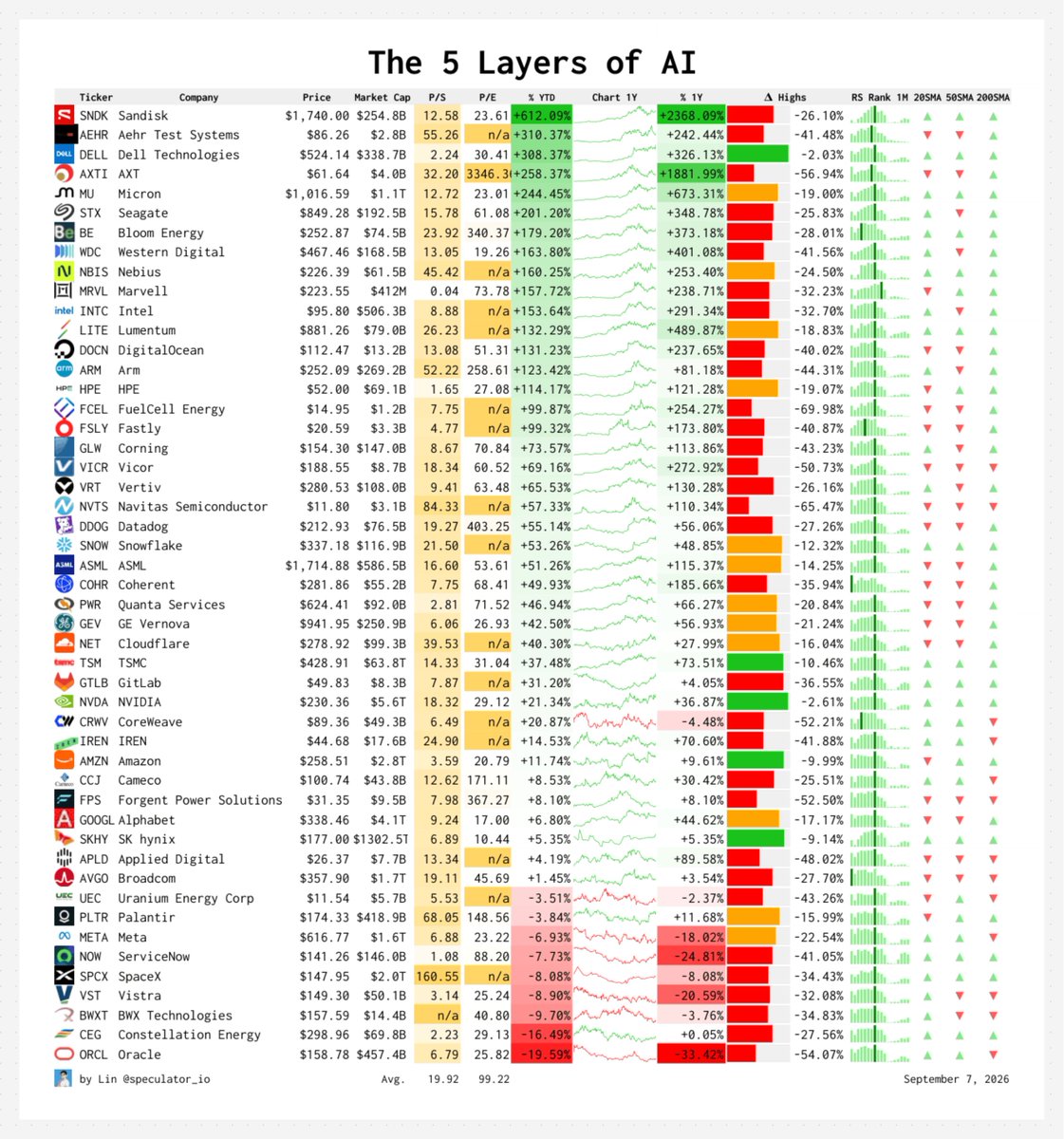
Listen carefully: The next trillion-dollar expansion will be built across these 5 sectors.
The leaders are already taking shape:
1. Robotics / Automation :
$SYM
$OUST
$SERV
$ARBE
$CGNX
2. AI Infrastructure :
$CRWV
$NBIS
$APLD
$IREN
$VRT
3. Space Economy :
$RKLB
$ASTS
$RDW
$LUNR
$BKSY
4. AI Power / Nuclear :
$OKLO
$SMR
$CEG
$NNE
$LEU
5. Cyber-AI / Software :
$PLTR
$PATH
$NET
$SOUN
$AI
The next generation of wealth will be built by investors who arrive before the sector rush.
Get there before the market makes it obvious.
If you're not following us with notifications turned on, you might probably not see us again.
10 WAYS TO PLAY ROBOTICS IN 2026
1. $TER tests AI chips & owns the cobots through Universal Robots
2. $NOVT precision photonics & motion inside surgical & industrial robots
3. $OUST eyes & perception for physical AI machines that need to see & map physical world
4. $HIMX provides vision & display chips that help robots process images, depth & sensor inputs at edge
5. $AMBQ low power edge AI layer for robots & devices that need intelligence without burning massive amounts of energy
6. $ON becomes physical AI edge stack after acquiring $SYNA combining power, sensing, connectivity & edge AI for robotics
7. $SYM warehouse automation pure play using robotics & software to redesign how goods move through fulfillment centers
8. $VPG sits in force sensing & precision measurement layer that helps robots understand pressure, weight & real world movement
9. $TSLA humanoid platform bet with Optimus combining custom hardware, AI inference, autonomy software & real world manufacturing scale
10. $CCXI gives public market exposure to Agility Robotics which is one of clearest pure play humanoid robotics companies through its Digit warehouse robot
September 16th is about to be a wild day.
We now have President Trump threatening to "stop trading" with all countries that the US has a trade deficit with if the Fed does not CUT rates.
This would effectively cut off trade with ~50% of all US trading partners, including Mexico, China, Taiwan, Germany, Japan, South Korea, Canada, and India.
Trump says the Supreme Court has ruled that he has an "absolute right" to do so.
Meanwhile, the market now thinks Fed Chair Warsh, who was just appointed by President Trump, will HIKE rates in his first rate move.
Just months ago, President Trump said it was a precondition that his Fed Chair appointee is willing to cut rates.
September 16th marks the next Fed decision.
If the Fed doesn't cut rates on September 16th, a potential of $300+ billion in monthly US trade volume could apparently come to a halt.
We will be breaking it all down in real-time.
Let me get this straight chat… you have:
$NVDA 70% supply constrained revenue growth projections (would be 100%+)
$AVGO AI revenue growing 100%+ Y/Y for next 2 years from mid ~$50B -> $230B
OpenAI Astra blowing away AGI benchmarks and starting to train itself.
$MSFT / $GOOGL / $AMZN stating compute demand imbalances into next year, with Nvidia projecting $1.3T spend for 2027.
You’re seeing this flow through supply chains from Samsung 70% capacity LTAs into 2031 to Powertech advanced packaging capacity 100% booked into 2030.
Even your legacy players like Winbond are starting 2029-2030 allocations.
Markets always have temporary drawdowns and macro scares… but…
How can anyone not think AI stock go brrr?
This is the best time in human history to be an investor.
The gap between what the average person thinks AI can do and what AI can actually do is already massive. And it keeps widening every day.
AI models are becoming so smart that they can already do things most people would have thought impossible just a few years ago. All of that intelligence requires compute, and demand is growing faster than we can build the physical infrastructure.
So, compute will likely be constrained for years.
I don't think the market has fully priced in what that means.
Bought some stocks today...finally.
1. $NBIS - Already a top 10 position for me, but one of my highest conviction names.
2. $INTC - I don't own enough Intel.
3. $CRDO - Averaging my position down on this earnings drop (I personally think earnings were good). I started my Credo position on last quarter's earnings drop.
4. $BE - We all know the bottleneck by now...
5. $AMZN - Can never own enough Amazon. Nearly 10% down in a month is a treat (imo). I don't care about day-to-day fluctuations w/ Amazon since I'll be a shareholder for a *very* long time.
If you've been reading my macro notes recently, you'd note that I've been holding cash (and buying some hedges like "defensive tech" AKA software).
But it got to a point today where I just couldn't resist buying some discounted names for my core AI portfolio.
This is obviously NFA - as per my macro note earlier, I think that semis still have room to go lower (war = bad narrative).
I personally have enough cash / hedges to unwind - to buy more semis on additional drops...idk if you do which is why this is never individual advice.