The healthiest people I’ve ever met are the most skeptical of doctors
If you’re not doubting almost everything your doctor says, and verifying it yourself— you are not being smart. Especially in age of AI
Double check whatever they tell you. I even tell my own patients that.
1958: two eggs, back bacon, a kipper, black pudding, fried bread in the dripping, and tea strong enough to creosote a fence. The posters told the nation to go to work on an egg, which it had been doing without instruction for several thousand years. You ate it at a table, then did a day's physical work on the strength of it.
2026: a cereal bar at the wheel and an oat milk latte.
The cereal was dreamed up in a sanitarium by a man who thought a dull enough breakfast would keep his patients off sex. He lost. His brother added the sugar, printed a tiger on the box, and sold it to your children as the most important meal of the day.
The latte is oats, water, rapeseed oil and a phosphate to stop it curdling, the oats enzyme-treated until the starch turns to sugar, which is why a cup hits your blood like a cola. Four pounds fifty for warm sweetened seed oil, and you feel virtuous, because the old version had a cow in it, and a cow is the thing we have decided to fear.
The eggs and the bacon are still on the shelf, ten feet away, for a fraction of the price.
We swapped the breakfast that built the country for one a Victorian crank would have called a triumph, and called it progress.
🏃♀️🏃♂️ 44 Real Food Runners took part at 29 events this weekend!
🎉 PBs for:
👏 Brian McMahon
👏 Alison Johnson
👏 Emma Milne
Great turnout across the country, with our biggest gathering at @maidenparkrun where 6 members met up.
Real food, movement and community in action. 🧡
The year is 1949.
The Nobel Prize in Medicine has just gone to the man who invented the lobotomy. Your doctor suggests one for your sister, who has not been herself since the baby came. It is the most celebrated advance in psychiatry of the age, and he is simply current. By the time the prize curdles into an embarrassment, close to twenty thousand Americans have had the operation, and proportionally more here in Britain.
The year is 1956.
Lay the baby down on his front, the doctor says. So does the most trusted childcare book ever written, the one on every new mother's shelf. On his back he might choke, the reasoning goes. Millions obey. The advice holds for nearly thirty years, long after the evidence has quietly turned, and a generation of cot deaths is counted before anyone thinks to roll the babies over.
The year is 1966.
A bestselling book informs your wife that menopause is a disease, that she is, in the author's word, a castrate, and that a small daily pill will keep her youthful and tolerable to live with. Her doctor agrees. The drug becomes one of the most prescribed in the country. Nobody mentions that the author sat on the payroll of the company that made it. That detail surfaces decades later, in the same year the landmark trial is halted early for raising rates of breast cancer, stroke and clots.
The year is 1979.
Your ulcer is caused by stress and sharp food, the doctor explains. Calm down, drink milk, take the antacid that happens to be the best-selling medicine on earth. Two Australians are about to prove that most ulcers are caused by a bacterium and cured by a fortnight of antibiotics. The profession laughs. One of them eventually drinks a beaker of the stuff to settle the matter. The establishment takes the better part of twenty years to stop laughing. The Nobel lands in 2005.
The year is 1985.
Butter is dangerous, the doctor says. Switch to margarine, it is modern, it is heart-healthy, the experts are united. The spread he nudges you toward is loaded with trans fats, which the next decade will identify as the genuinely dangerous one, and which will eventually be banned outright. The butter goes quietly back in the fridge. No correction is ever printed at the volume of the original warning.
The year is 1992.
There is a pyramid on the surgery wall, and the very same one in your grandchild's classroom. Bread, cereal, rice and pasta form the broad virtuous base, up to eleven servings a day. Fat is exiled to the tiny tip. The chart was reportedly held back a year while the relevant industries had their say. It is wrong at the bottom and wrong at the top.
Now it is today.
Your doctor has new guidelines, new studies, a fresh consensus, delivered with precisely the steady confidence of every guideline above. He believes it, and he has good reason to. So did every doctor in this thread. None of them were villains. Each was sincere, most were kind, and all were certain, reading from a map that somebody else had drawn and handed them. That is the part worth sitting with.
So when the man in the white coat tells you what to eat, what to fear, and what to swallow every morning for the rest of your life, you are allowed to ask. Who paid for the study. What the evidence says beneath the headline. What he was just as certain about thirty years ago, and where that advice sits now.
Then make up your own mind. Call it scepticism, or call it whatever your grandmother called it when she ignored the advert, kept the butter where it was, and lived to ninety-one.
It has outlasted every consensus on this list. It will outlast this one too.
🌧️ Heavy rain couldn’t stop the #RealFoodRunners this weekend!
👏 Slavena Jensen recorded her fastest time since surgery.
🇮🇹 Cate Norridge enjoyed parkrun tourism at Mura di Lucca.
🏊🚴🏃 @BenatarSally completed a triathlon at Dorney Lake.
Another brilliant Saturday! 🧡🏃♀️🏃♂️
I don’t have to be the smartest guy in the room to achieve outstanding health, fitness & quality of life results. Neither do you.
But you do need a few things:
• The belief that a path to better results exists and the determination to find it
• An open but skeptical mind
• The wisdom to protect what’s already working, at least until you have good reason to believe there’s a better way
• Patience, but not complacency
• The willingness to ask better questions, especially of people who have either conquered the challenge you’re facing or helped others do it
• Common sense
That last one is wildly underrated.
This episode was recorded just last Friday in their AMAZING London headquarters. @StevenBartlett was lively and properly interested. In it he is GIVING AWAY 1000 copies of @drjenunwin ‘s book on coping with ultra processed food addiction 🥳
Remember, this man is only a professor
Just because the knows a lot about biology, and his opponents don't, that is no reason to believe him if
you are sure he is wrong
Stop saying you can’t afford to "eat healthy." It’s a whole lot of baloney.
Your "too expensive" excuse is actually a "I don’t want to plan" excuse in disguise.
Here is the reality check you probably need:
1. The ROI of Health: No asset, not BTC, not real estate, beats your health. Healthy food is an investment that pays daily dividends in mood, libido, and energy. Junk food is a high-interest loan you’ll eventually default on.
2. The Price Illusion: A meal at McDonald’s or Chick-fil-A is ~$15. For $45/day, you can eat like royalty at home. Even grass fed beef and asparagus are cheaper than a DoorDash habit once you factor in the "service fees" and tips.
3. The Time Myth: Between the drive-thru line and the DoorDash wait, you could’ve seared a salmon and boiled potatoes. You aren't "saving time," you're just spending it doomscrolling while you wait for a stranger to bring you lukewarm seed oils and artificial flavors.
4. The Budget Audit: If you have money for alcohol, tobacco, designer shoes, or your 10th athleisure set, you have money for quality protein, fruit and vegetables. It's not a lack of funds; it's a lack of priority.
5. Nutrient Density: Calculate the cost per vitamin/mineral. Processed food is incredibly expensive when you realize you're paying for "filler" that makes you foggy and tired.
Conclusion:
Eating overpriced garbage and taking pills to mask the symptoms isn't "living." It’s a slow-motion car crash.
You have the sovereign right to be lazy and eat "engine lubricant" fries and a Big Arch Burger product, but stop pretending it’s a financial decision. It’s a discipline decision.
Own it. Then fix it. Or don't, the choice is yours.
The Nightmare of Modern Medicine revealed…
🚨 Join me for story time 🚨
Doctor:
We’re starting you on a GLP-1.
1 week later
Patient: I’m nauseous and vomiting.
Doctor: Take Zofran.
1 week later
Patient: I’m constipated.
Doctor: Take Metamucil.
1 month later
Patient: I’m losing strength and muscle.
Doctor: Let’s start testosterone.
1 month later
Patient: My labs show high RBC and hemoglobin.
Doctor: Donate blood.
1 season later
Patient: Now I’m anemic.
Doctor: Let’s do iron infusions.
1 season later
Patient: I feel depressed from all of this.
Doctor: Start an SSRI.
1 season later
Patient: No sex drive. Erectile dysfunction. Brain fog.
Doctor: Add Cialis.
And let’s try an experimental Alzheimer’s drug.
—
No one asked:
• Why did we suppress appetite pharmacologically?
• Why did lean mass drop?
• Why did erythrocytosis occur?
• Why did anemia follow?
• Why is mood collapsing?
One injection becomes:
Antiemetic → Laxative → Hormone → Phlebotomy → Iron → SSRI → PDE5 inhibitor → Cognitive drug.
Side effect → Prescription → Side effect → Prescription.
Polypharmacy as protocol.
My advice: find real doctors, be wary of polypharmacy
The ketogenic diet is the most powerful diet for the elderly.
I've used it in my assisted living homes to help residents lose weight, regain their energy and even reverse dementia.
The complete guide to the ketogenic diet:🧵
When someone asks me how do you get people in their 30s, 40s, and 50s to take their health seriously before dementia strikes, I tell them:
"Visit an assisted living home near you—not as a resident, as motivation. Everyone who comes to my home says I don't want to be here, I want to live at home."
Here's why:
"Something that's very important to know is dementia starts in your 30s 40s and 50s. You don't see the signs and symptoms of it until your 60s 70s 80s 90s, but what you do in your 30s 40s and 50s can very much affect what happens to you in your older life especially with dementia and Alzheimer's."
This is how to get started with reversing dementia now:
"Cut out one thing at a time—concentrate on that candy bar after lunch, get rid of that first, then cut out your breakfast cereal, then eat your burgers without a bun...Even if you don't go to the gym and work out, go walking, get out in the sunshine... just move."
The toothbrush is the most used household product, yet cavities are the most common chronic disease.
It’s not because we need to brush better. It’s because we need to eat better.
Zero cavities in 8 yrs of beefcentric eating for me because beef is the best toothpaste.
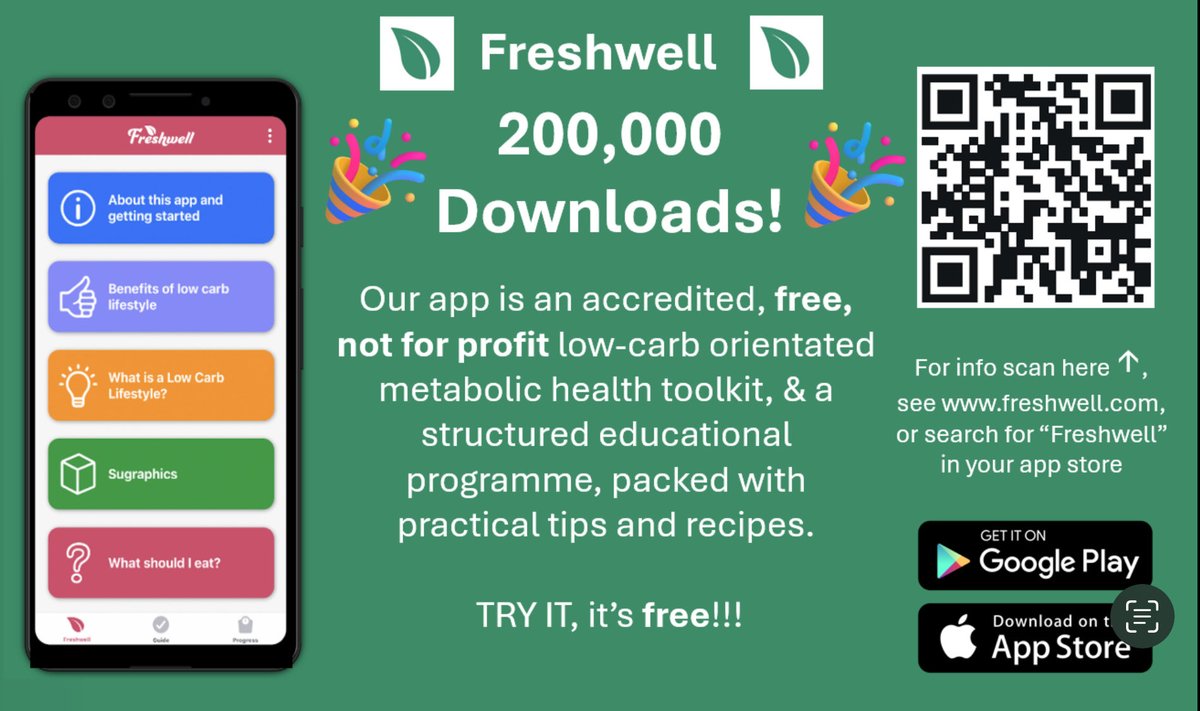
MASSIVE CONGRATULATIONS 200,000 Downloads! This wonderful low-carb App IS FREE WORLDWIDE so try it right now! The work of my good friends @LoCarbFreshwell & @DrKimAndrews it’s here https://t.co/CNtvVqPqpD
About 20 years ago, a friend suggested I try a ketogenic diet.
I was intrigued… and then I quickly dismissed it.
Everything I read online—from doctors, nutritionists, and mainstream experts—said the same thing:
Unhealthy. Risky. Unsustainable.
So I never tried it.
Fast forward 12 years.
At age 53, I was on the verge of throwing in the towel when it came to dieting. My health, fitness, and quality of life were all sliding in the wrong direction. I was at the end of my rope, grasping at straws.
Out of desperation, I reached out to a doctor friend on Twitter and asked a simple question:
“Is there anything diet-wise you think might actually help?”
His answer wasn’t a meal plan.
It was a book: Why We Get Fat and What to Do About It.
I don’t know why it took those extra 12 years, but this time I was finally ready to hear it.
The idea of a low-carb, ketogenic approach no longer felt outrageous.
Eight years ago today, I started the last “diet” of my life.
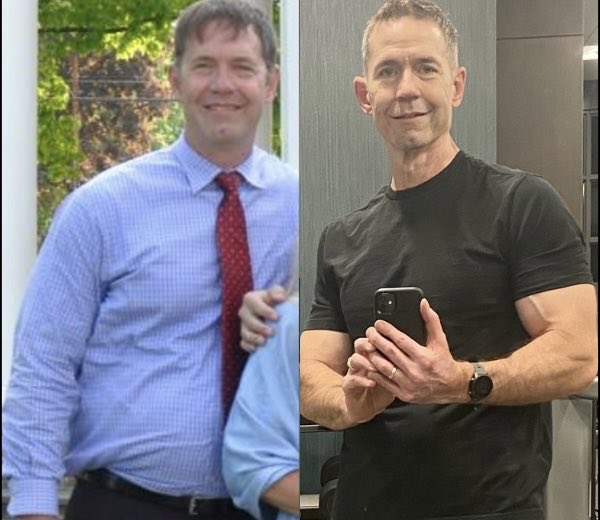
That single decision became the first domino, leading to an 80-pound fat loss and a complete overhaul of how I live.
Today, in 2026, at 61 years old:
• I’m stronger than I’ve ever been
• I ran my first marathon at 58
• I’ve run three half marathons
• I walk 10,000 steps a day
One thing I’ll say plainly:
You don’t need permission from a doctor, nutritionist, friend, or family member to decide what’s possible for you.
You get one shot at this thing called life.
Leaving potential on the table is a choice, but often an unconscious one.
Potential doesn’t disappear with age.
It gets acted on—or it gets abandoned.
The choice is up to you.