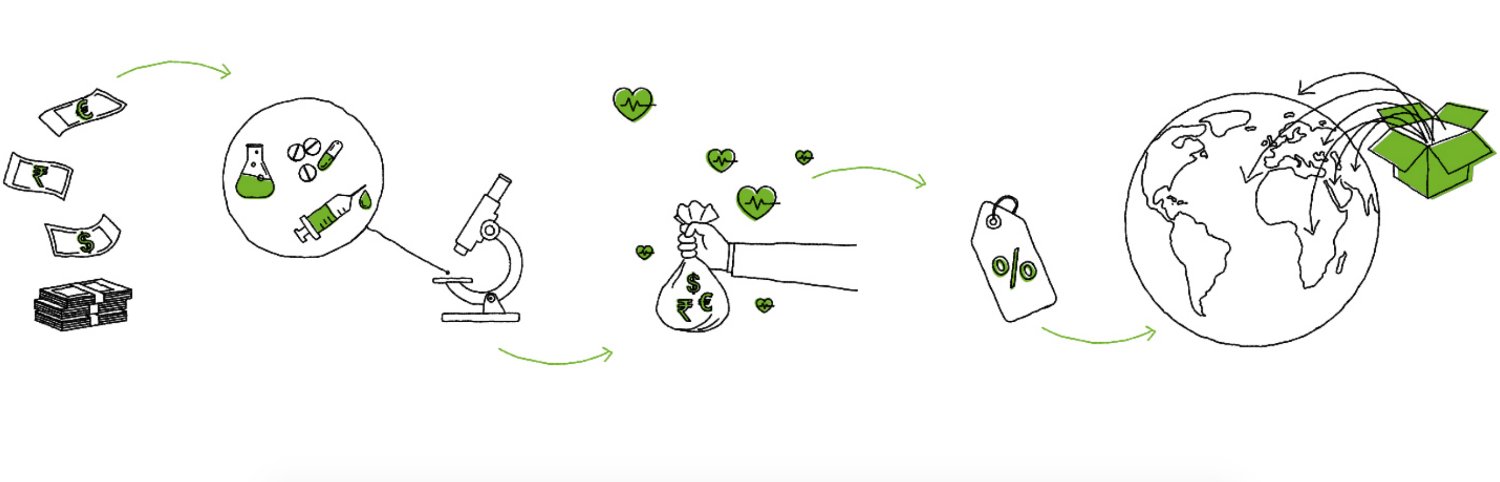
In this way, firms would be rewarded according to the health impact of their drugs rather than the volumes they sell. In fact, part of the idea is that the firms would be obliged to sell their drugs at or below cost price — so that their remuneration would be purely value-based.
“The share that each drug would receive would be based on an evaluation of the drug’s overall impact on global health. Those drugs that contribute most to global health would receive the greatest rewards from the pool.
“One proposed approach to co-ordination is the Health Impact Fund (HIF). This would be a government-funded agency that offers annual rewards pools, from which new drugs would receive a share.
https://t.co/ntDgNksx7Q We agree with Sen Bernie Sanders: "No one should die or suffer unnecessarily because they cannot afford a prescription drug which costs a few cents or a few dollars to manufacture." But what's the solution?
The Health Impact Fund model doesn't rely on open source drug development or "standing up to the industry", as Sen. Sanders proposes. Instead, it is about designing the incentives for industry to deliver what society values. Please check it out and see why this just makes sense!
Our sister organization, Africa Health and Economic Transformation Initiative (https://t.co/0unJ0u2Gmu) has just been very successfully launched in Kigali.
Its first aim is the Ubuntu Health Impact Pilot to improve access to medicines in Africa.
https://t.co/Z4VlkuHtWi
Sir Michael was an inspiration. He was generous and thoughtful. As head of NICE he showed enormous bravery in making hard decisions, and made it the leading HTA organization in the world. His wisdom on our advisory board will be deeply missed.
We are building #DeSci Impact Market for Public Good Medicines (eg generic ketamine to treat depression, fluvoxamine to treat Covid, keto diet to treat cancer) modelled on scaled down version of @HealthImpact Fund. Jump on our Discord to join us 🍄💊✊🏼https://t.co/h6T5CR1xla
We are building a DeSci Impact Market for Public Good Medicines (eg generic ketamine to treat depression, fluvoxamine to treat Covid, keto diet to treat cancer) modelled on scaled down version of @HealthImpact Fund. Interested? Jump on our Discord 🍄🔬https://t.co/h6T5CQJVWA
This is a really excellent analysis of the challenges of the "last mile" in health. And it's why the the Health Impact Fund is important.
Innovation alone is not enough. We need there to be rewards for making sure that medicines reach the people who need them.
In our analysis of 14 countries, including DRC, Haiti, Madagascar & Somalia, we found communities unreached by COVID health information, no access to self-tests, unpaid health workers, & that 'vaccine hesitancy' claims are not nuanced. Access report here: https://t.co/MJXC4gNlmL
@TakedaPharma's new #Dengue vaccine -- just approved in #Indonesia -- is an exciting step forward. But it should be made available at an accessible price everywhere it is needed. The @HealthImpact Fund is designed to make that happen.
If we want to encourage for-profit pharma companies to invest in diseases that primarily affect poor people (as Monkeypox used to be!) then we need to have a model that rewards them for it, not one that results in firms facing a huge financial penalty. Sustainability.
How broken is the system for supporting drug development for diseases mainly suffered by low-income people?
@GSK just got a contract for up to $170m million over 3 years for its novel malaria vaccine, Mosquirix. Enough to pay for production, maybe? https://t.co/e1kVKzsyLG
Bravo for GSK and partners including PATH and BMGF! Mosquirix is a tremendous step forward in parasite vaccine development. But this is not a step forward to having a sustainable system of drug development focusing on the needs of poor people.