How does evaluation for health justice partnerships work?
Respondents from our funding survey discussed the kinds of data collected to evidence their work as well as the challenges around building the evidence.
Find out more in our report: https://t.co/hr6pVPpdrX
@ARC_WM write on the bidirectional link between health and wealth, whereby wealth supports better health and better health supports individual and public wealth through economic returns and employment: https://t.co/QVJhCsbkON
Findings from our recent funding survey showed that although most partnerships have been running for 10+ years, funding periods are generally between 1-3 years.
Find out more in our report: https://t.co/hr6pVPoFCp
@Food_Foundation's food security tracker finds concerning increases in families cutting back on healthy foods, further impacting the health of those already living in deprivation and widening health inequalities: https://t.co/FH1fK8nwDe
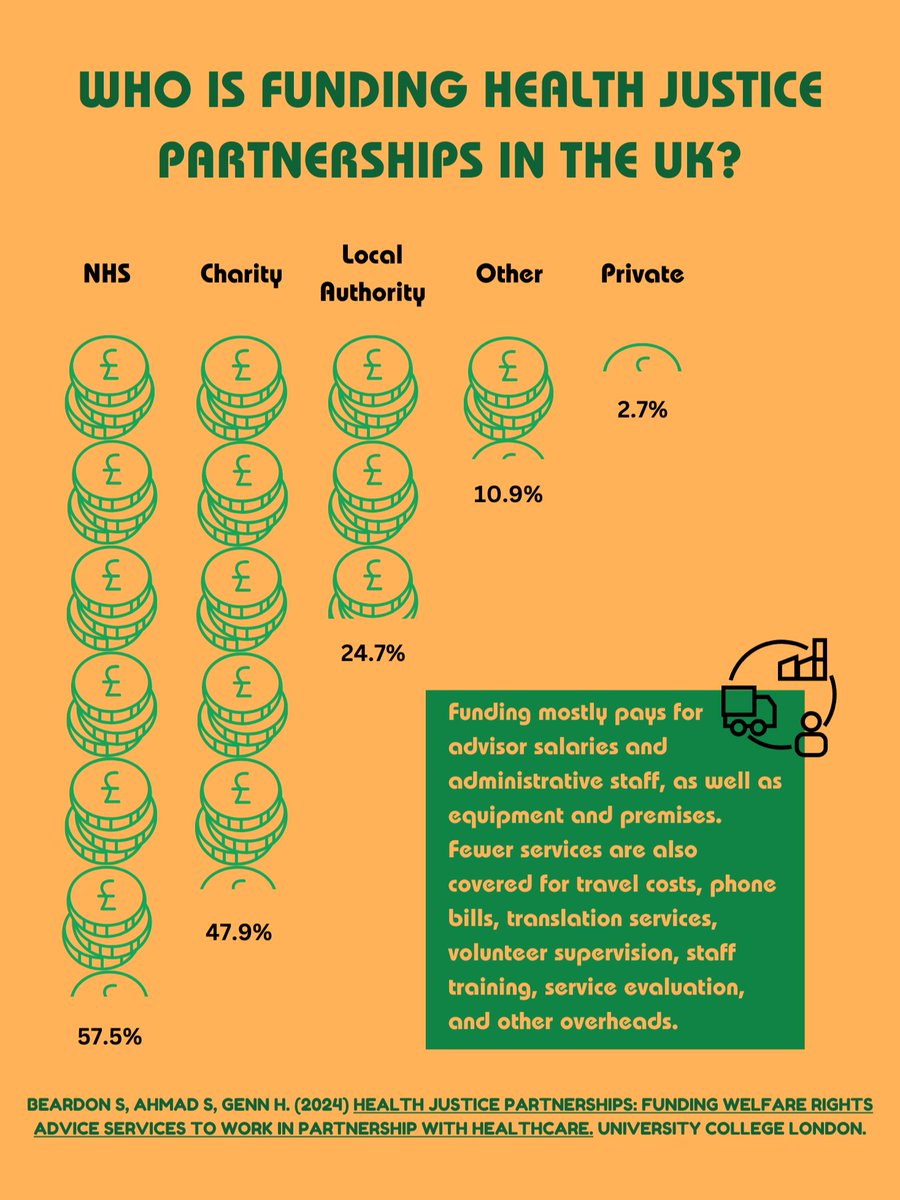
Which funders are funding health justice partnerships around the country, and what does the funding cover? Check out the infographic based on our research on current the nature of funding.
Find out more in our report: https://t.co/hr6pVPoFCp
New NIHR research shows the impact of fuel poverty on poorer mental health through unsafe home environments, fewer healthy behaviours, social withdrawal, and economic instability: https://t.co/EbMsEdMYCy
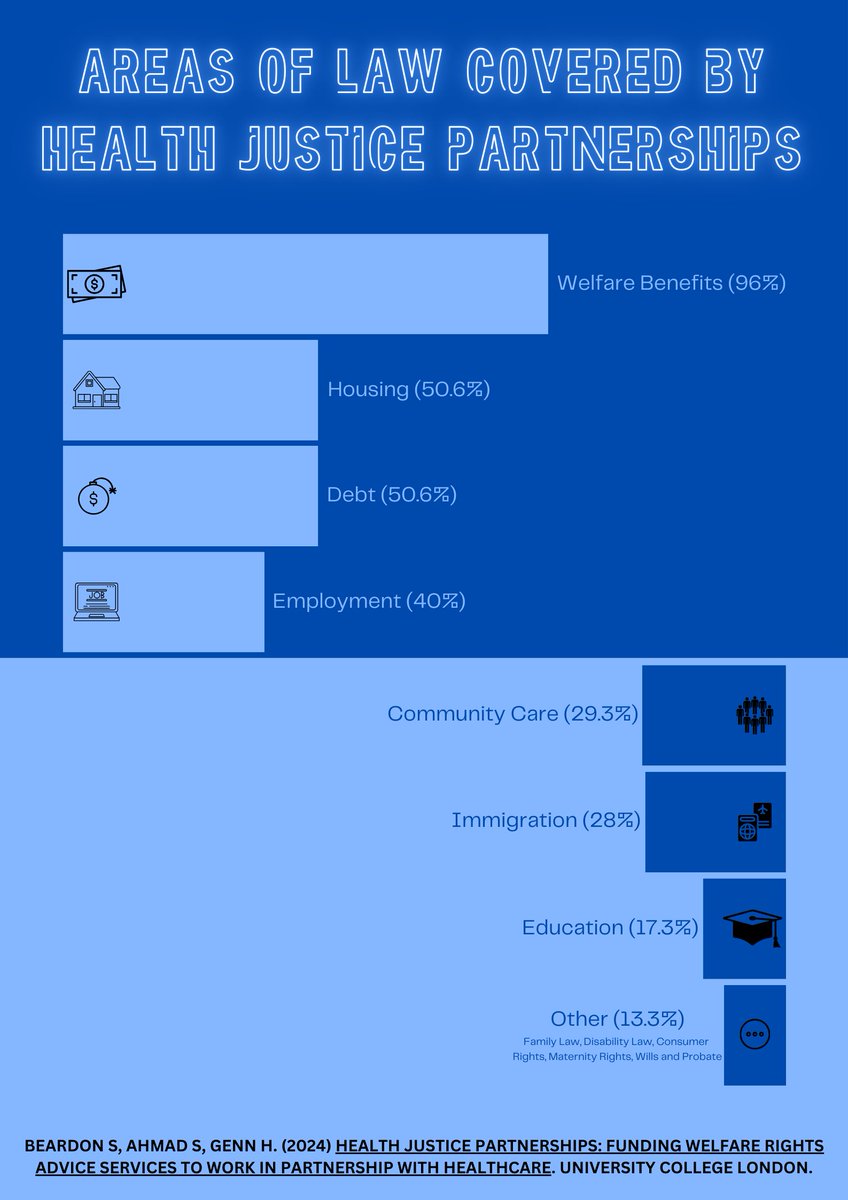
What areas of law are health justice partnerships addressing?
Our recent funding report found that many were supporting individuals primarily on welfare benefits as well as various other social welfare issues.
Find out more in our report: https://t.co/hr6pVPpdrX
@HealthFdn's in-work poverty report finds “an increased risk of being in poverty when people are in work, reflecting the growth in housing costs for working families”, with 62% of families with at least one part-time working adult in poverty in 2021-2022.
https://t.co/iIRB31UaYn
Whilst more that 50% of health justice partnerships are based in hospitals, our research shows that many are based on primary care settings, tertiary care settings, and community settings.
Find out more in our report: https://t.co/hr6pVPpdrX
How are ICSs tackling health inequalities?
@NHSConfed found that 50% of ICBs dedicated their entire health inequalities budget into evidence-based interventions, devolved into local levels, building capacity and capability, and pilot projects: https://t.co/xCBB8EaJ4F
Curious about how your residents' health and wellbeing needs are changing over time?
@HealthFdn's new Local Authority Dashboard provides area-specific data on health inequalities, welfare, and more
https://t.co/GvDDKjgFoL
From the @TheKingsFund report:
60% of people from deprived areas have poorer health, with 68% higher emergency attendance.
"NHS can only treat the symptoms of poverty; broader government, economic and civic society action is needed to treat the causes"
https://t.co/lj8tJxrsJD
Thinking of approaching funders for a new #HealthJusticePartnership but unsure where to start?
@HealthJusticeAu's handy advocacy tool outlines four key considerations to include when securing funding for partnership work:
https://t.co/6VQH8tcQEc
Another great report on the relationship between financial worries and mental health by @mmhpi
Collaborative work between healthcare providers and social welfare rights providers can ensure early resolution, improving long-term health outcomes
#HealthJusticePartnerships
This morning we’ve launched our latest research! 🚀
It looks at the impact of struggling with financial and mental health difficulties over different periods of time.
Here’s a thread on what we’ve learned and what we’re calling for 🧵 1/7
New event! 📢
Join us on Tuesday 12th March for an online lunchtime Masterclass with Professor Dame @HazelGenn, and gain valuable insights on public health impact, interdisciplinarity, and action on health inequalities.
Book your free ticket here: https://t.co/1Ja4Kto2UR
Who is funding #HealthJusticePartnerships in England and Wales, and what costs are covered?
This infographic breaks down the funders currently supporting partnership work around the country
More details in our latest funding report: https://t.co/hr6pVPoFCp
@HealthFdn's report on local government data gives insight into the challenges around robust data analysis between siloed housing, education, and care departments, calling for longer-term analyses to understand and tackle the wider determinants of health: https://t.co/9wVFC70knA
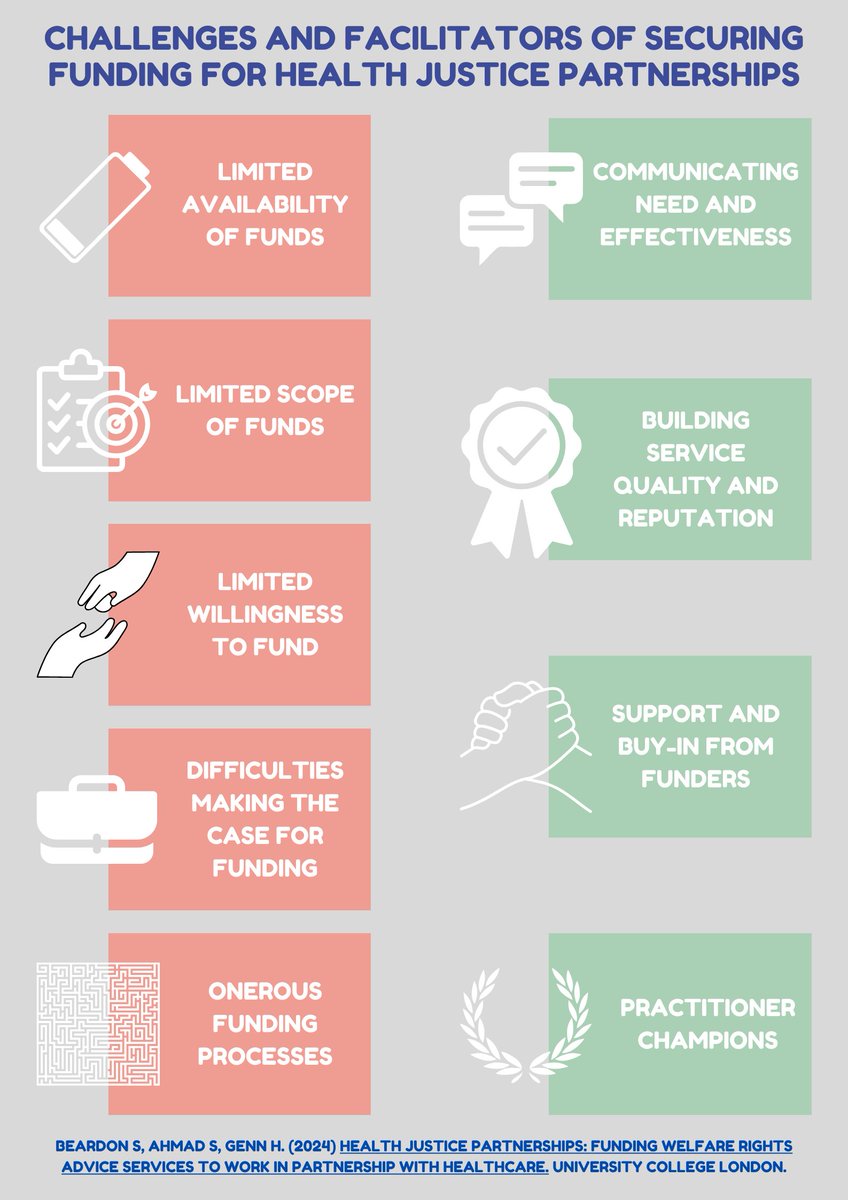
What funding challenges do health justice partnerships face currently, and what facilitates in gaining and maintaining funds?
See our handy infographic and find out more in our recent funding report: https://t.co/hr6pVPoFCp
A new report published by UCL Health Justice Partnerships @HealthJusticeUK discusses findings from research and reveals key challenges to funding health justice partnerships in the UK
https://t.co/KCRaW06rQp
‼️ We're pleased to share our latest report with @The_LEF on the nature of funding for health justice partnerships in the UK!
It highlights the challenges around short-term funding and the factors contributing to sustained funding.
Full report: https://t.co/hr6pVPoFCp