मेरे सम्मानित प्रदेशवासियों,
सनातन संस्कृति में प्रकृति के प्रत्येक जीव को सृष्टि का अभिन्न अंग माना गया है। जैव विविधता के संरक्षण का प्रयास तभी सफल होगा, जब जन भागीदारी बढ़ेगी।
मैं सभी से आग्रह करता हूं कि जब भी प्रकृति के बीच जाने का अवसर मिले, तो केवल पर्यटक बनकर नहीं, बल्कि जिज्ञासु विद्यार्थी की भांति उस स्थल को परखें। अपने अनुभवों को व्लॉग और आलेखों के माध्यम से साझा करें।
प्रकृति के प्रति जागरूकता और अपनापन ही हमारी जैव विविधता के सबसे बड़े संरक्षक हैं।
🦚 प्रकृति की रक्षा ही जीवन की रक्षा है! 🐯
✍️ माननीय मुख्यमंत्री उत्तर प्रदेश, आदरणीय @myogiadityanath जी की #प्रकृति_को_समर्पित यह #अनमोल_पाती हर उम्र के व्यक्ति को पढ़नी चाहिए। यह पाती हम सभी को प्रकृति से प्रेम करने के लिए जागरूक करती है। 💚
✨ जुगनुओं की चमक, 🐦 गौरैयों की चहचहाहट और 🐦⬛ पेड़ों पर मैनाओं का कलरव — यही तो जीवन का असली संगीत है! 🌳
🐅 UP में बाघ, तेंदुए व सारस की बढ़ती संख्या और रामसर सूची में 13 स्थान — विकास और प्रकृति का यह सुंदर संगम ही 'नया उत्तर प्रदेश' की पहचान है। 🦜
📖 आइये इस पाती को पढ़ें, आत्मसात करें और प्रकृति के प्रति अपनी जिम्मेदारी निभाएं! 🙏
🌱 जैव विविधता — हमारी सुरक्षा 🌏
#YogiKiPaati #UttarPradesh #NatureConservation #योगी_की_पाती
@myogioffice@CMOfficeUP@ChiefSecyUP@UPGovt@UpforestUp@KPMalik_BJP@rameshpandeyifs@AwasthiAwanishK
🦚 प्रकृति की रक्षा ही जीवन की रक्षा है! 🐯
✍️ माननीय मुख्यमंत्री उत्तर प्रदेश, आदरणीय @myogiadityanath जी की #प्रकृति_को_समर्पित यह #अनमोल_पाती हर उम्र के व्यक्ति को पढ़नी चाहिए। यह पाती हम सभी को प्रकृति से प्रेम करने के लिए जागरूक करती है। 💚
✨ जुगनुओं की चमक, 🐦 गौरैयों की चहचहाहट और 🐦⬛ पेड़ों पर मैनाओं का कलरव — यही तो जीवन का असली संगीत है! 🌳
🐅 UP में बाघ, तेंदुए व सारस की बढ़ती संख्या और रामसर सूची में 13 स्थान — विकास और प्रकृति का यह सुंदर संगम ही 'नया उत्तर प्रदेश' की पहचान है। 🦜
📖 आइये इस पाती को पढ़ें, आत्मसात करें और प्रकृति के प्रति अपनी जिम्मेदारी निभाएं! 🙏
🌱 जैव विविधता — हमारी सुरक्षा 🌏
#YogiKiPaati #UttarPradesh #NatureConservation #योगी_की_पाती
@myogioffice@CMOfficeUP@ChiefSecyUP@UPGovt@UpforestUp@KPMalik_BJP@rameshpandeyifs@AwasthiAwanishK
The @janaadharnews and @CharchitNGO organised this event at a local level in Firozabad. Ambassadors of @RedTapeMovement Journalist Pravin Kumar Sharma and Ms @AkashaAnam led the event along with Journalist Kashmir Singh. Thanks to dear organisers and participants. 🙏🌱💐
🌱 On #BiodiversityDay, the @RedTapeMovement came alive in Firozabad. 🐒
🎀 People from all walks of life tied red ribbons around majestic trees — a symbol of love, protection, and unbreakable promise to safeguard our green guardians. 💚
🌳 Together, they pledged to preserve trees, biodiversity, habitats, ecological niches and the delicate balance of nature. 🦋
👣 These heartfelt actions not only spread awareness but also strengthen our defense against future #zoonoticspillovers and #pandemics. 💝
👥 When communities unite for Mother Earth, hope grows stronger than any storm. 🌐
#InternationalDayForBiologicalDiversity #BiodiversityDay2026 #ClimateAction #SaveTrees #Firozabad #UNGA #KMGBF #COP17Armenia #IDB2026 #COP16
@UNBiodiversity@SchomakerAstrid@PeterDaszak@PeterHotez@environmentza@IreneVelezT@icarda@theNASciences@AntivirusPark
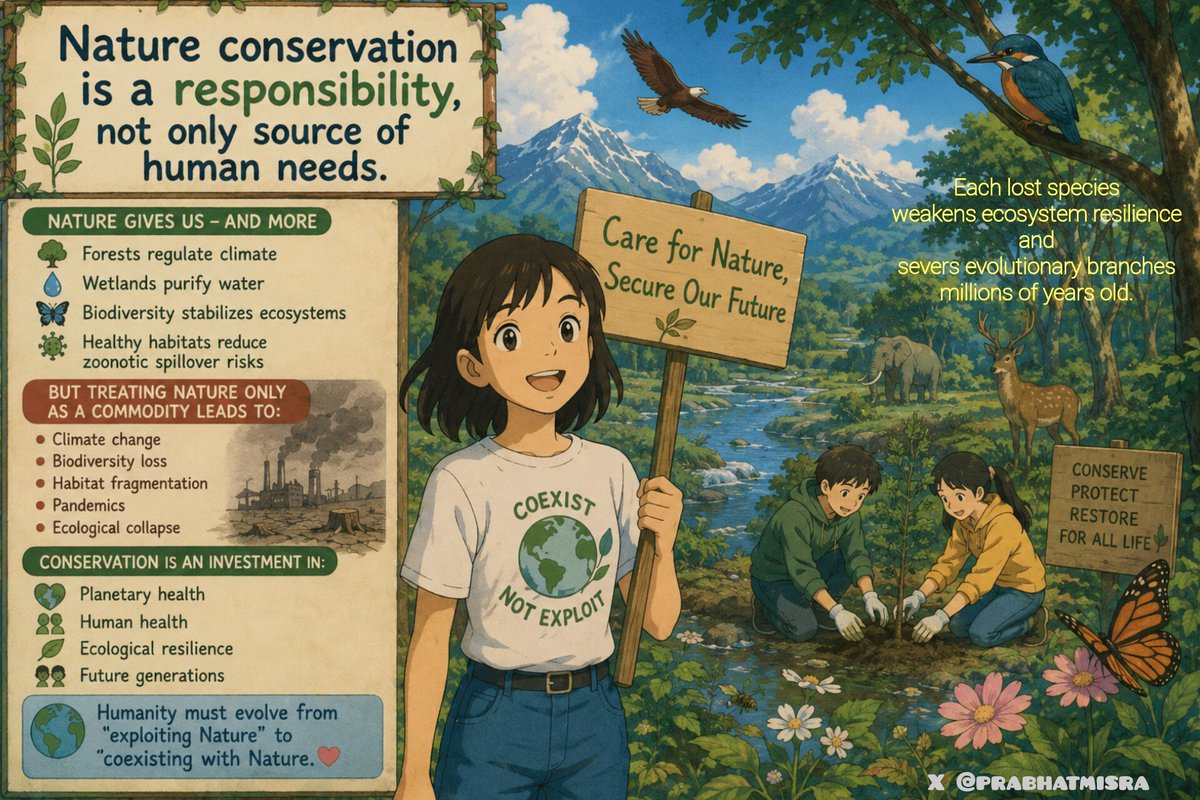
🌍 Nature conservation is not merely a source of human survival and resources — it is a scientific, ecological, and moral responsibility.
🌱 Forests regulate climate.
💧 Wetlands purify water.
🦋 Biodiversity stabilizes ecosystems.
🦠 Healthy habitats reduce zoonotic spillover risks.
⚠️ Treating Nature only as a commodity accelerates:
• Climate change
• Biodiversity loss
• Habitat fragmentation
• Pandemics
• Ecological collapse
🚨 Each lost species weakens ecosystem resilience and severs evolutionary branches millions of years old.
✅ Conservation is an investment in:
• Planetary health
• Human health
• Ecological resilience
• Future generations
🌏 Humanity must evolve from “exploiting Nature” to “coexisting with Nature.”
#OneHealth #ClimateAction #Biodiversity #pandemics #ebola #Hantavirus #NatureConservation
@doctorsoumya@PeterDaszak@PeterHotez@BenjaminMateus7@lovemoz1@GeoffreyLean@climate@1989_mariab
Mind boggling. There are 171 TRILLION pieces of Microplastics floating in the world’s oceans alone, surveys conclude. And they are indestructible, so there forever. What on earth are we doing?
https://t.co/y0GCuw3dDr
An Ebola outbreak that may have circulated undetected in Congo for several weeks is exposing the difficulty of detecting deadly viruses in regions where malaria, typhoid and other illnesses are common and health systems are stretched thin https://t.co/D8HfpIT0te
The World Health Organization has declared an Ebola outbreak in Congo and Uganda a public health emergency of international concern. Here's what to know about one of the world's deadliest diseases https://t.co/4D0pwjHrvR
🚨 Ignoring the science of pandemic origins, zoonotic spillover & vaccine development isn't just anti-science — it's deadly.
🦠 The #Ebola outbreak in central #Africa is a stark reminder: "when we dismiss research & defund global health, we lose our only tools to stop the next catastrophe. Millions of lives hang in the balance."
🌐 The world must understand that prevention begins long before hospitals — in protecting ecosystems, strengthening science, and investing in One Health approaches.
⚠️ Ignoring science today means challenges for millions of lives tomorrow.
#GlobalHealth #OneHealth #PandemicPreparedness
@OmarJimenez@PeterHotez@PeterDaszak@CNN
🌆 Urbanization on deforested and fragmented forest landscapes — followed by plantation and afforestation drives — cannot fully compensate for the loss of original ecosystems.
🌳 A planted forest is not always equal to a natural forest.
⚠️ When biodiversity, habitats, ecological niches, soil networks, and wildlife corridors are destroyed, the ecological damage often becomes irreversible.
🦠 Fragmented ecosystems increase human–wildlife interactions, zoonotic spillover risks, heat stress, floods, pollution, and ecological imbalance.
✅ True eco-friendly development means protecting existing forests first, minimizing fragmentation, conserving biodiversity, and integrating Nature into planning — not destroying ecosystems first and restoring them later.
#ClimateChange #Biodiversity #Deforestation #Urbanization #OneHealth #ZoonoticSpillover #Nature #Environment #Plantation #Hantavirus #Ebola
🌍 A silent green road in Lucknow is more than just urban beauty — it is a reminder that cities survive only when Nature survives with them.
🌐 As the world faces intensifying heatwaves, biodiversity loss, air pollution, zoonotic spillovers, and climate instability, every tree-lined road becomes a living shield for public health and planetary resilience.
🌱 Trees cool urban temperatures, absorb pollutants, support biodiversity, reduce stress, and strengthen ecological balance. Sustainable urbanization is not about replacing Nature with concrete — it is about designing human progress around ecological harmony.
🌳 The future of humanity will depend on how wisely we protect our green corridors, forests, rivers, and habitats in the age of climate change and pandemics.
#Lucknow #ClimateChange #Biodiversity #UrbanForests #OneHealth #Nature #Sustainability #GreenCities #Environment #Governance
🌎 In a world facing accelerating climate crisis, plant science is more vital than ever.
🍃 Just out: June 2026 issue of @NewPhyt (Vol 250 No. 5).
🌳 Tansley review on ecophysiology for climate-smart forest management.
🌱 New insights on treeline shifts as species' cold limits move faster with warming.
🏞️ Overlooked carbon-rich peatlands in Brazil's Cerrado under threat.
🌐 Critical reading for resilience.👇
🔗 https://t.co/xGhqLfBCKd
#ClimateCrisis #PlantScience #CarbonSinks
@MaarjaOpik@maarja_opik
🦇 Zoonotic spillover is no longer a rare ecological accident — it is increasingly becoming a structural consequence of anthropogenic disruption of nature.
⚠️ Over 70–75% of emerging infectious diseases in humans originate in animals (zoonoses), including COVID‑19, Ebola, Nipah, MERS, and many influenza strains.
📈 Recent global reviews show that zoonotic spillover is accelerating, with new spillover events rising at roughly 5–8% per year.
🦠 COVID-19 demonstrated how a single spillover event can reshape global civilization, economies, geopolitics, and public health systems for years.
🐀 More than 70% of emerging infectious diseases in recent decades have zoonotic origins, linked to intensified human-animal-environment interaction.
📍 Latest 2026 Hantavirus developments again remind the world that ecological imbalance can rapidly evolve into transnational health emergencies.
🛳️ WHO is currently monitoring a multi-country Andes hantavirus cluster linked to the cruise ship MV Hondius.
⛴️ Andes virus is particularly concerning because it is the only hantavirus known to show limited human-to-human transmission.
🦔 Scientists increasingly connect spillover risks with:
- Deforestation
- Habitat fragmentation
- Wildlife trade
- Intensive agriculture
- Urban sprawl
- Climate change
- Biodiversity collapse
- Global hypermobility and travel networks.
🐁🚶♂️ Human encroachment into wildlife habitats forces stressed animals, rodents, bats, and livestock into closer contact with humans — creating ideal “spillover interfaces.”
🐰 Rodent-borne diseases like hantavirus are increasingly influenced by ecological disturbances and changing climatic conditions.
🚨 Researchers warn that climate change is altering rodent population dynamics, migration, and virus distribution patterns, potentially increasing future hantavirus exposure.
📌 Environmental change + globalization = faster pathogen emergence and faster pathogen spread.
🌐 The COVID era already exposed the fragility of global preparedness.
✈️ The present hantavirus episode is not another COVID-scale pandemic, according to WHO, but it highlights how rapidly zoonotic threats can cross borders through modern mobility systems.
🔂 Increasing scientific consensus now supports the “One Health” framework:
Human health + Animal health + Ecosystem health are inseparable.
❤️🩹 Preventing future pandemics will require:
- Stronger wildlife surveillance
- Forest conservation
- Reduced ecological destruction
- Better biosafety systems
- Global pathogen monitoring
- Climate mitigation
- International scientific cooperation
- Early-warning public health networks.
🗣️ COVID-19 shrank the global economy by 4.4% in 2020 alone — nearly $14 trillion in losses up to 2024. By comparison, preventing spillover would cost just $10–31 billion per year globally — a tiny fraction of what a pandemic costs us. Yet governments keep spending on response, not prevention. Why? Because preventing something that "hasn't happened yet" is a hard political sell.
🥵 Every pandemic is a mirror — reflecting how we treat nature. Deforestation, wildlife trade, factory farming, and climate change are not separate crises. They are one crisis. And the next spillover is already in the making.
Reference URLs:
1- https://t.co/osK9us5ycu
2- https://t.co/R9yV70IxLX
3- https://t.co/FUcHvOMN4o
4- https://t.co/pROtZnwY7Z
5- https://t.co/jgSZALHEHr
6- https://t.co/Nfm4yMu2O4
7- https://t.co/Swk5qZrfAv
8- https://t.co/rdBCZQ5p93
9- https://t.co/CrZ87hniiA
10- https://t.co/2LsDljnfpN
11- https://t.co/lm78WHmGvG
12- https://t.co/ftnEC4ZAGb
13- https://t.co/d5gkzgMP5R
14- https://t.co/LADCOwEG3X
15- https://t.co/AtPKcnx8Kh
16- https://t.co/qcdkkAfmw7
17- https://t.co/QtPGtDFNPX
#ZoonoticSpillover #OneHealth #Pandemic #COVID19 #Hantavirus #ClimateChange #Deforestation #WildlifeTrade #PublicHealth
@PeterDaszak@PeterHotez@BenjaminMateus7@doctorsoumya@ramyakannan@AntivirusPark@RedTapeMovement
🦇How to Identify Spillover Sites👇
- Target areas with high biodiversity loss, deforestation, or rapid urbanization where human-wildlife contact is intense.
- Use web tools like #SpillOver to evaluate the risk of novel wildlife viruses based on host range and environmental stability. The tool was developed by a team of infectious disease scientists like Dr. Zoë Grange, Dr @JonnaMazet & @PeterDaszak led by the @ucdavis One Health Institute
- Monitor "interface" zones like live animal markets, intensive farms, and fringes of tropical forests.
- Use climate data (like isothermality and warming trends) to map shifting habitats for bats, rodents, and primates.
- Analyze non-invasive samples (saliva, feces) from reservoir hosts using metagenomics to detect pathogens before they emerge.
🦠 Identifying Zoonotic Spillover sites helps in tracking where animal pathogens "jump" to humans and in controlling Zoonotic Spillover and resultant Pandemics.
🔗
1-
https://t.co/ZAKRw8Gv0X
2- https://t.co/IFvox4HAun
3- https://t.co/YlS63HDxcY
#PublicHealth #OneHealth #PandemicPrevention #Zoonosis #ZoonoticSpillover #Pandemics
🤔 Do you remember old days? 👇
🚂☀️ In the summers, trains of Indian Railways carried hanging #chaagalbags — humble cloth pouches filled with cool water and a quiet sense of comfort. No refrigerators, no bottled water — just nature’s own cooling. 🌿
🚨 Today’s generation hardly knows this.
🛍️ The #chaagal (or #pakhal) was a traditional water carrier made from #thickcottonfabric. One end had a small opening, sealed with a wooden stopper or knot to prevent leakage. Crafted from multiple layers of coarse cotton, the bag was kept moist on the outside after filling it with water. During hot summers, evaporation through the fabric naturally cooled the water, offering refreshing relief — all without electricity or machines.
🌱 In a time before plastic bottles and steel flasks, people in villages carried water in these cotton pouches, bottles, and handmade containers.
💦 From rural households to soldiers, this simple water carrier was once a common companion.
♻️ More than just a cooling device, it symbolised a sustainable lifestyle and deep environmental wisdom.
💚 🇮🇳 Indian Railways should consider reviving these eco-friendly bags during summers and making them available to passengers at affordable prices. This could:
• Increase railway revenue
• Reduce plastic pollution
• Enhance the commitment to environmental sustainability
#IndianRailways #OldIsGold #IncredibleIndia
#VocalForLocal #Swadeshi #ClimateAction #sdg13
(@narendramodi@PMOIndia@AshwiniVaishnaw@RailMinIndia@IRCTCofficial@byadavbjp@moefcc@doctorsoumya@mssrf@ramyakannan@AdityaRajKaul)
🤔 याद है वो ज़माना?👇
🚂☀️ गर्मियों में भारतीय रेलवे की ट्रेनों में #छागल_बैग्स लटके होते थे — मटमैले कपड़े की थैली, ठंडा पानी, और एक अलग ही सुकून। न फ्रिज, न बोतलबंद पानी — बस प्राकृतिक शीतलता! 🌿
🚨 आज की पीढ़ी ये नहीं जानती।
🛍️ #छागल या #पखाल एक खास किस्म के मोटे सूत (कपास) के कपड़े से बनी थैली होती थी, जिसका एक सिरा बोतल के ढक्कन जितना छोटा होता है। इस सिरे को लकड़ी के स्टॉपर या गांठ से बंद किया जाता है ताकि पानी आसानी से न गिरे। यह देसी जलपात्र मोटे सूती कपड़े की कई परतों को जोड़कर बनाए जाते थे, जिनमें भीतर पानी भरने के बाद उन्हें बाहर से गीला रखा जाता था। गर्मी के मौसम में कपड़े की परतों से होने वाला वाष्पीकरण पानी को स्वाभाविक रूप से ठंडा बनाए रखता था, जिससे प्यास बुझाने पर ताजगी महसूस होती थी। कपड़े की यह थैली धीरे-धीरे पानी को ठंडा रखती है, और खास बात यह है कि इसमें बिजली या किसी मशीन की जरूरत नहीं होती।
🌱 पुराने समय में जब न तो प्लास्टिक की बोतलें थीं और न ही स्टील की थर्मल फ्लास्क, तब गांवों के लोग पानी ले जाने के लिए सूत (कपास) के कपड़े से बनी थैलियों, बोतलों और डब्बेनुमा गैलनों का इस्तेमाल करते थे।
💦 पुराने ज़माने में गांव-देहात से लेकर सैनिकों तक, हर किसी के पास यह जलपात्र हुआ करता था।
♻️ यह जलपात्र न सिर्फ पानी को ठंडा रखता है, बल्कि देसी जीवनशैली और पर्यावरण के प्रति समझदारी का प्रतीक भी था।
💚 🇮🇳 भारतीय रेलवे को गर्मियों में इन बैग्स का पुनः निर्माण करके इनको यात्रियों को उचित दर पर उपलब्ध कराने पर निर्णय लेना चाहिए। ऐसा करने से
- रेलवे की आय में वृद्धि होगी
- प्लास्टिक प्रदूषण पर नियंत्रण होगा
- पर्यावरण के प्रति योगदान बढ़ेगा।
#IndianRailways #OldIsGold #IncredibleIndia
#VocalForLocal
#Swadeshi #ClimateAction
(@narendramodi@PMOIndia@AshwiniVaishnaw@RailMinIndia@IRCTCofficial@byadavbjp@moefcc@doctorsoumya@mssrf@ramyakannan)
🦠 Zoonotic spillover isn't random — it's a perfect convergence. 🔁
Ecology. Epidemiology. Human behaviour. Immune vulnerability. ALL must align for a pathogen to cross from animal to human. 🐾
When barriers weaken — through immune stress, habitat destruction, or forced human-wildlife contact — the virus finds its door. 🚪
Nature doesn't wait. Evolution doesn't pause. 🌍
Every degraded lake, every cleared forest, every stressed immune system is one less wall standing between wildlife pathogens and a human pandemic. ⚠️
📖 Plowright et al., 2017 — Nature Reviews Microbiology
🔗 https://t.co/ucZIKyjAQC
#ZoonoticSpillover #OneHealth #ClimateChange #PandemicPrevention #InfectiousDisease #EcoHealth #PublicHealth
@PeterDaszak@rainamontana@WOHCongress@NatureRevMicro@AntivirusPark