Bitcoin miners had EH/s.
For AI Factories, AI compute:
1 GW of H100 ≈ 2 ZFLOP/s
1 GW of Blackwell/GB300 ≈ 5–8 ZFLOP/s
1 GW of Vera Rubin GPUs ≈ 10–12 ZFLOP/s
So ZFLOP/s or maybe EFLOP/s, but I don’t think the industry wants to talk about it that way. It’s easier to throw around MWs as a measure than introduce a new term. Although $IREN will end up with much better EFLOP/s per MW than $CRWV because CRWV already owns a massive old fleet. Whoever deploys the most Vera Rubins the fastest will come to be the leader of the Neoclouds. My bet is on $IREN. It’s another reason it appears as if they are dragging their feet, but really it is strategic and will allow them to deploy almost twice as much compute per MW by waiting for Vera Rubin. On top of that, the cooling is easier for VR vs Blackwells as the water only needs to be 45C. So I think they save costs on VRs for less complicated cooling maintenance. We are entering the phase of Vera Rubins, and $IREN is about to scale exponentially across multiple sites in 2027-2030.
@IREN_Ltd
If you have a demographic situation where half your population thinks the solution to their problems is to steal capital from the winners and allocate it to the losers, you have entered an economic death spiral where capital and jobs disappear, prosperity declines, and asset seizure increases.
When all this fails, the same people think the answer is to take even more next time round and try another reallocation.
History already shows you how this works out in the end, and it also shows you how people in the past dealt with it: their solution was to not give everyone an equal vote and let that determine the outcome of your society, it was to take power back absolutely and then make sure those people dumb enough to think capital theft is beneficial for your country never get a vote again - no legal right to vote.
Much of history makes more sense once you view it in this lense. They dealt with the consequences and were forced to usher in harsh, brute force mechanisms to stop it.
Eventually things get bad enough that both sides realise seizing absolute power before the other side does is all that matters.
This is the crossroads the entire West finds itself at.
There is unlikely to be a democratic solution where merely voting for 'muh side' fixes anything material.
Only a Great Man of History can solve it and if they're hamstrung by 'muh representatives' you're stuck in the same loop of idiots in the way of change they are too stupid to understand.
You might not like it, indeed I don't like it either, but it seems to be the case, at least historically.
We must stop pretending we live in this make believe world where everyone is magically equal, has magically equal IQ and magically equal views of reality of equal importance - and that therefore every vote is equal.
Most people's map of reality is incomplete and unverifiable, their ideas are not only stupid but dangerous, and if these are the people you cede power to you end up in a zero sum death spiral where everyone is worse off.
Companies are not run by the junior employees and effective corporations don't govern by consensus decision making - they govern top down.
Representatives elected in a system where everyone gets a vote are an unbelievably poor proxy of what is good for your society, because most people are retarded and if you average out the vote of retards you end up with retard 'representatives' making retarded decisions, predictably.
Yesterday Treasurer @JEChalmers chose to target critics of his destructive CGT changes, on Australian businesses, from Coward’s Castle instead of defending the policy. He claimed parties vote the way “Gina Rinehart and Geoff Wilson” tell them to.
This is deflection, not debate. I will benefit commercially from his insane new CGT and am still opposing it because it will bring significant harm to Australian businesses, entrepreneurs, workers and productivity.
I challenge @JEChalmers to a public debate outside Parliament.
Personal attacks don’t create jobs. Good policy does.
#auspol #AussieDreamKiller #AspirationTax
Dear @JEChalmers and @AlboMP,
Thanks for the admission yesterday.
But sticking a narrow startup and small business carve out onto these tax changes is like putting a band aid on a broken leg.
If the reforms are so damaging that they need special exemptions, that’s a sign the policy itself needs a rethink!
The good news is that if you play your cards right, Australians will stop talking about what a disaster this Budget was for investors, entrepreneurs, aspiration and productive businesses.
Absolutely address the distortions and improve housing affordability. But don’t kneecap the people and businesses that create jobs, innovation and prosperity for Australia.
If your first thought is to count the ethnic backgrounds of our national soccer team to score political points, you’re the one obsessed with race.
And if you can’t tell the difference between violent criminals and elite athletes because they have the same skin colour, then that makes you the racist.
Australia has a relatively small population.
We share no land borders and are protected by vast oceans.
We have abundant agricultural land, enormous natural resources, and some of the world’s most valuable exports.
We’ve enjoyed more than 80 years without war on our own soil and never experienced a civil war.
There is no reason poverty should be increasing in this country.
There is no reason the middle class should be shrinking.
There is no reason each generation shouldn’t have the opportunity to live better than the last.
Australia’s challenges aren’t the result of a lack of land, resources, wealth, or stability.
They are the result of political decisions.
And for too long, we’ve kept electing politicians who fail us.
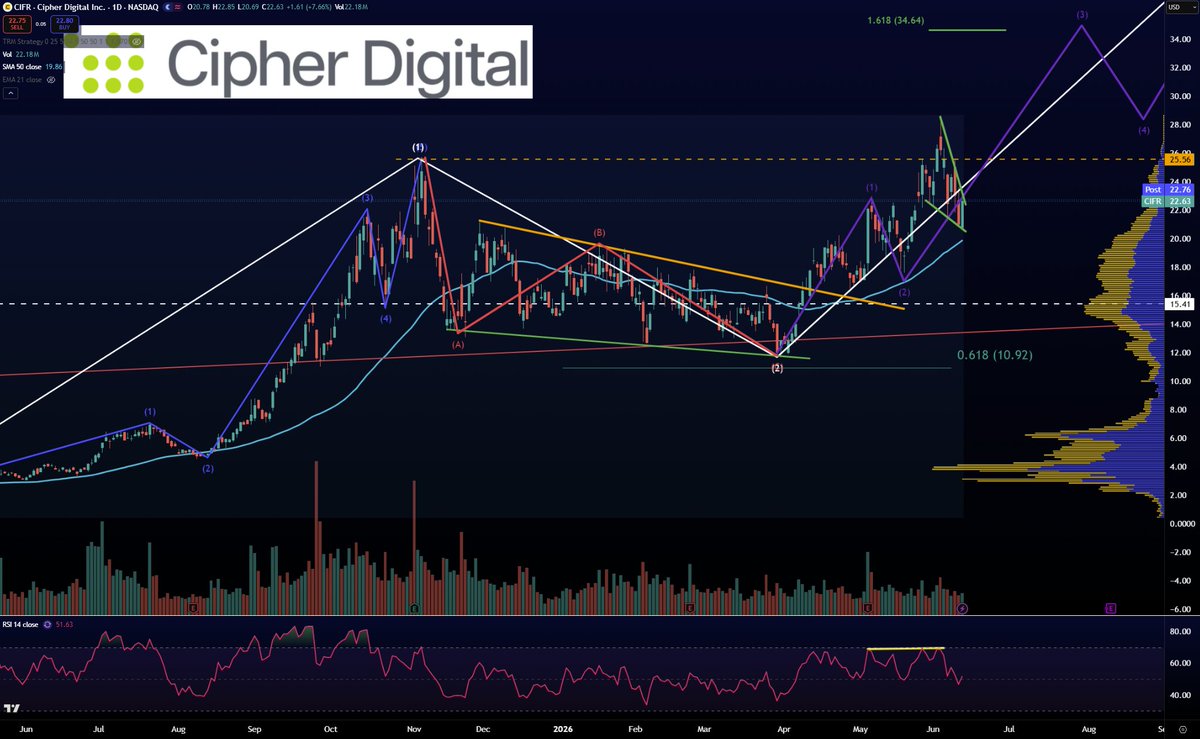
$CIFR got a little off track
Didnt quite make the 50d so overall stronger than some peers
Recently at ATHs
Bullish looking wedge and should resolve to the upside
https://t.co/6GPddbapLN
The Market’s Current Obsession and $IREN’s “Bottleneck-First” Principle
Today, IREN announced that it has signed a transmission connection agreement to support the development of an 800MW data center campus at Bundey in South Australia. The project has secured a high-voltage transmission connection to a utility substation and is expected to begin energization in 2028. Through submarine cable connectivity, it will be able to serve major demand centers across the Asia-Pacific region. The power supply will be primarily supported by renewable energy sources.
Under the agreement, IREN has secured access rights to four 330kV feeder bays at the utility substation, providing support for up to 800MW of load capacity without requiring grid upgrades. Subject to regulatory approvals and the satisfaction of conditions associated with the transmission connection agreement, IREN intends to commence early-stage construction activities and equipment procurement.
Several key points stand out from this announcement:
No grid upgrades required means the project can be deployed as quickly as possible, making this aspect particularly valuable.
South Australia’s high penetration of renewable energy provides long-term access to green power.
The 800MW scale creates significant economies of scale—and this is only the beginning.
Australia serves as a launch point for reaching the broader Asia-Pacific market.
Overall assessment: considering scale, expandability, environmental sustainability, grid integration, geographic reach, population served, and economic significance of the surrounding region, this is an A+ class scarce asset.
IREN’s current portfolio of 5.8GW power sites broadly meets the criteria of A+ scarcity assets. AI data centers are increasingly becoming an important financial asset class and will gradually emerge as a key valuation anchor. At today’s relatively early and unsophisticated stage, the market has not yet fully recognized this reality. The prevailing attitude is still “as long as there is power available, that’s enough.” However, sovereign AI initiatives are already demanding much more than that, and the value of these attributes is likely to become increasingly important as the sovereign AI market develops.
Sovereign AI is not limited to governments. It revolves around ownership and control of data. Industries such as finance, healthcare, energy, and defense cannot tolerate data leakage or dependence on opaque cloud infrastructure, and are increasingly moving toward sovereign computing environments. This migration shifts AI data centers with sovereign-AI characteristics away from low-margin customers and toward strategic customers with larger budgets and stricter compliance requirements, creating substantial premium opportunities.
Through segmented compute zones and physical isolation, operators can transform closed environments into certainty and trust, providing localized, high-value operating environments for financial institutions, governments, healthcare organizations, and advanced foundation-model developers. As a result, data centers can move beyond commoditized competition and become high-barrier sovereign infrastructure.
These assets provide not only large-scale dispatchable green energy but also a form of irreplaceable exclusivity. Once such sites become foundational infrastructure for sovereign AI training, their asset characteristics may eventually support securitization.
Because these assets combine multiple forms of physical scarcity, each one secured reduces the pool of available opportunities. They are fundamentally difficult to replicate. Due to the background and experience of IREN’s management team, they recognized this years ago. Site selection efforts were conducted globally long before the market appreciated these dynamics. Work that began eight years ago has evolved through continuous learning and industry development into a highly refined understanding of what constitutes a truly valuable site.
This is fundamentally different from today’s industry behavior, where many participants simply pursue any available power source without regard for broader considerations. The commercial outcomes of these two approaches may ultimately prove dramatically different.
In a recent article that I refer to as the “IREN Development White Paper,” CEO Daniel Roberts argued that these scarce, high-quality sites have already been largely secured by early movers. New entrants may soon discover that even if they are willing to wait, sites of comparable quality are simply no longer available. Even paying a premium lease rate may not be enough to gain access.
That opportunity window has effectively closed. Over the next two years, additional windows may close as well. The ladder leading to the top tier of infrastructure operators with genuine pricing power is gradually disappearing. While AI still presents many opportunities, much of the remaining space is likely to become increasingly commoditized and competitive.
The market today has not fully interpreted these dynamics. As a result, $IREN’s stock merely finished positive while broader indices declined. The market’s current obsession is straightforward: companies such as $NBIS that continue signing contracts with hyperscale customers are viewed as the winners.
Questions such as:
How much power has actually been secured?
What is the source and quality of that power?
Does the project depend on third-party partners?
Could delays occur?
Is it environmentally sustainable?
Could environmental objections force a redesign?
Will more expensive behind-the-meter solutions eventually be required?
are entirely ignored.
As long as contracts are being signed, early access to systems such as Vera Rubin is secured, and high-profile supporters are involved, investors are eager to buy.
Meanwhile, IREN’s advantages in scarce resource positioning and cost structure receive far less attention. Some NBIS supporters argue that these advantages can simply be purchased later—that NBIS could buy IREN, lease IREN’s facilities, or otherwise replicate these capabilities. As amusing as that may sound, many people genuinely believe it.
Markets naturally focus on what is immediately visible. Looking purely at reported financial results, NBIS currently presents stronger numbers, while IREN has missed expectations. Share-price divergence under those circumstances is understandable. But if investing were only about reading surface-level metrics, the process would be much simpler than it actually is.
Anyone familiar with IREN during the Bitcoin mining era will recognize a recurring pattern. In HPC infrastructure, being first is not always advantageous.
For years, IREN remained a secondary player in mining. It waited until its own data center infrastructure was complete and mining hardware efficiency had improved dramatically. Only then did it move aggressively, eventually leaving competitors behind and becoming the only consistently profitable miner.
The AI cloud industry is significantly more complex, but the principle remains similar.
Consider CoreWeave. It moved fastest, but is its current situation ideal? Its debt has been rated below investment grade, resulting in high borrowing costs. Regardless of how attractive the industry may be, many sophisticated investors avoid businesses that develop credit-related concerns. Operational mistakes can be forgiven; credit problems are far less acceptable.
NBIS currently appears to be performing best. But is it truly operating optimally?
Forget software advantages for a moment and focus on basic business logic. Its own secured power resources are relatively limited, yet it has already committed portions of those valuable resources to customers through bare-metal contracts. While positioning itself as a full-stack cloud platform, it has sold its most important resource at bare-metal economics.
By contrast, IREN is often viewed as the pure bare-metal provider despite the fact that it has not sold a single watt.
At the same time, NBIS relies heavily on third-party power arrangements. Environmental approval issues have already forced alternative plans, increasing costs while still leaving uncertainty regarding successful execution. Similar challenges may continue to emerge in the future.
Forget about how ‘brilliant’ this team claims its tech is — just look at these two decisions. Most corner‑shop owners would’ve shown better judgment. Running a business doesn’t magically change just because you sprinkle some AI on it.
IREN has returned to a position of patience. It has spent more than six months without signing major contracts. During that time, The unit price for GPU compute leasing has surged by roughly 30% compared with the levels when CRWV and NBIS signed their contracts, while demand remains extremely strong.
Yet IREN continues to wait.
Its approach is different. I call it the “bottleneck-first” principle: solve the hardest problems first, and you gain both optionality and pricing power.
Bottleneck #1: Power Resources
IREN began working on this challenge years ago and focused on securing high-quality assets rather than simply accumulating capacity. Those efforts are now beginning to produce visible results.
Over the past six months, investors have watched IREN nearly double its portfolio of premium power assets across major economic regions worldwide. I believe we will continue to see additional sites secured.
Bottleneck #2: High-Performance Data Center Technology
This encompasses rack density, liquid cooling, orchestration, networking, topology optimization, operational management, and overall performance at gigawatt scale.
IREN has now advanced to the point of partnering with NVIDIA to build the DSX AI Factory, which is expected to become the flagship deployment site of its kind.
Bottleneck #3: Large-Scale Compute Deployment
IREN now controls approximately 5.8GW of power capacity. Much of this infrastructure can be energized before 2028. Leaving such resources unused would represent an enormous waste.
For IREN, the pressure to activate power capacity is as real as Anthropic’s accelerating demand for compute. The challenge is not securing symbolic advantages such as being among the first suppliers to receive Vera Rubin systems. The challenge is deploying GPUs safely and efficiently at massive scale.
That is why IREN is working with BE to use digital-twin technology to evaluate the performance characteristics of a 50,000-GPU Blackwell deployment before large-scale implementation.
These issues are far more important than near-term contract announcements or short-term AI revenue growth.
The relationship between markets and Companys is often like the relationship between a person and a dog on a leash. The key question is whether the dog is dragging the person, or the person is leading the dog.
Those things that please the market in the short term are often nothing more than a trap.
If you are an Opendoor shareholder, I have an ask.
Proxy advisors at ISS and Glass Lewis have recommended shareholders to vote against me at our Annual Meeting. I don’t take this personally. This is the fifth time in my career these same people have told people to vote against my team.
These proxy advisors have built no companies and are not meaningful shareholders of OPEN. They're a checkbox industry charging fees to tell other people what to do with shares that aren't theirs.
Usually most companies can’t do anything about this since many institutional shareholders will just vote the way ISS tells them to.
But Opendoor has the Open Army! It is important that we stand up against this separation of management from shareholders.
If you are so inclined, help tilt the world in favor of shareholders and away from bureaucrats.
Find out how (ask your broker, check your emails) and vote your shares. Our board is excellent. We are back on mission and we are winning.
Don't outsource your vote. Read the proxy. Vote your shares.
$IREN
AFR article covering the new 800MW datacenter site in South Australia.
"Roberts said Iren had started talking to potential customers including big US cloud services companies and large language model owners."
Anthropic anyone? 😎🔥
$IREN Announces 800MW data center at Bundey substation.
I talked about this almost a month ago in the quoted comment, and have been researching this site on my subscriber Discord since April.
Well done @IREN_Ltd !
Now get Anthropic on board and let's go
IREN has announced a planned 800MW data center campus in Bundey, South Australia.
This marks IREN’s first announced Australian data center project and one of the largest in the Asia-Pacific region announced to date.
Learn more: https://t.co/3bOYCUG3pk
Australia’s prime minister, @AlboMP, says he will not get involved in the “culture war” of amending the sex discrimination act to ensure women are accurately defined in it.
Fun fact: he didn’t dismiss it as a “culture war” in 2013 when he voted to remove women from the SDA.
Misleading.
Private sector USING PUBLIC GRANTS aka 'renewable energy' companies.
The Treasurer should be forced to separate TRUE private sector figures that CREATE wealth.
And private businesses living off public money.
The Treasurer knows this, of course, but chooses not to say.
One final call out to @AustralianLabor@AlboMP@JEChalmers (or anyone happy to talk long term policy and economics with 100-200k+ Aussie viewers/listeners).
We’ll fly to you, give you an entirely open platform to share your perspectives and policy (not just budget related | no name calling, just honest discussion). We will respect your time.
This is a genuine media opportunity to inform the Australian people about your economic policy.
We’ve already heard from @ajamesbragg at Parliament House yesterday and the discussion will be *extremely popular* (private feedback has been very compelling - goes live Friday).
While I’m a small business owner and represent 200k+ investors (and have been outspoken about the min CGT) I will always approach this with an open mind and let our community decide.
We’re also happy to hear from others, including independents (@DavidPocock@spenderallegra).
DMs are open. If anyone has the ALP ear - come and convince us!