The S&P June rebalance was announced June 5 and the Hedgeye Index Adds ETF $ADDS had 5 names hit across all three indices: S&P 500, MidCap 400, and SmallCap 600. Full details below.
For important investor information, including prospectus, current holdings and risk considerations, visit: https://t.co/GvQVhjuf1F
🚨 MOAT EROSION $ASML
The word that should terrify you the most.
The best protected monopoly in technology just met its one real threat.
For years the story was simple. ASML is the only company on earth that can build the machines that print advanced chips. No substitute, no competition, a monopoly you could set your watch by.
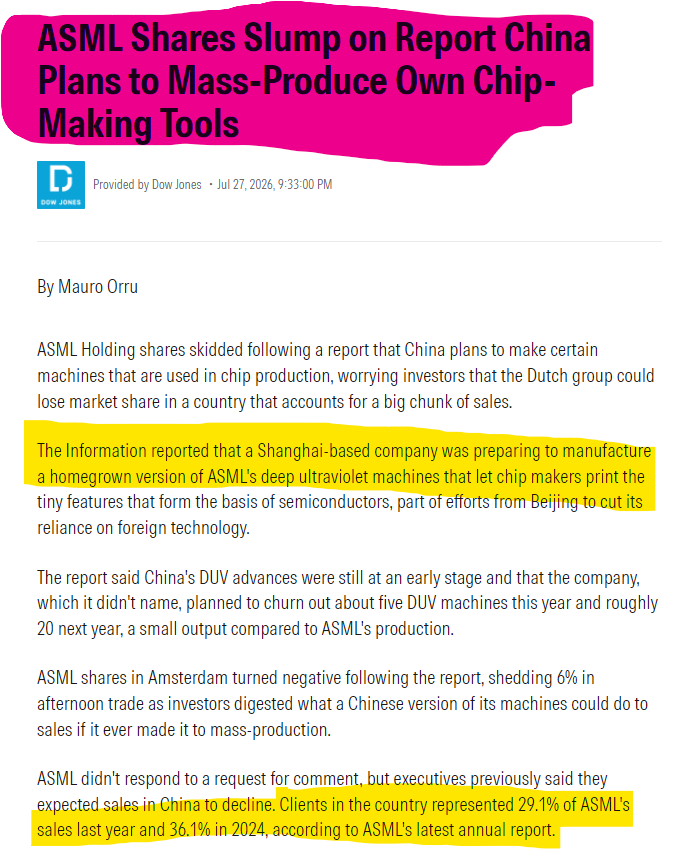
Then Washington banned it from selling its best machines to China. So Chinese fabs stockpiled the older DUV tools instead, and those sales quietly became one of ASML's biggest revenue drivers. China was 36% of sales in 2024, still 29% last year.
Today The Information reported a state-backed Shanghai company has started mass-producing its own homegrown DUV machines. ASML gave back a 2% gain and turned negative. Applied Materials, Lam and KLA fell with it.
The output is tiny for now, roughly five machines this year, maybe twenty next. A rounding error against ASML's production. The market didn't sell the numbers. It sold the one word that terrifies every owner of a great business.
Moat erosion.
It is the most dangerous thing that can happen to a compounder, and the most underestimated. A collapse in earnings is loud, obvious, and often temporary. Moat erosion is silent. It shows up years before the income statement admits it, in a share price that stops believing the monopoly is forever. A monopoly is worth a premium only as long as it's a monopoly. The day a second supplier exists, even a small and worse one, the story stops being "no alternative" and becomes "for how long." That question never gets un-asked.
The moat didn't break today. Someone just proved it has a far side.
Also, just riffing, but there are so many ways to trade pockets of risk now perhaps the blob of risk seeking capital is more into triple levered semis than just levering up QQQ.
It would potentially mean less spillover into other pockets of the market - which wouldn't be a bad thing.
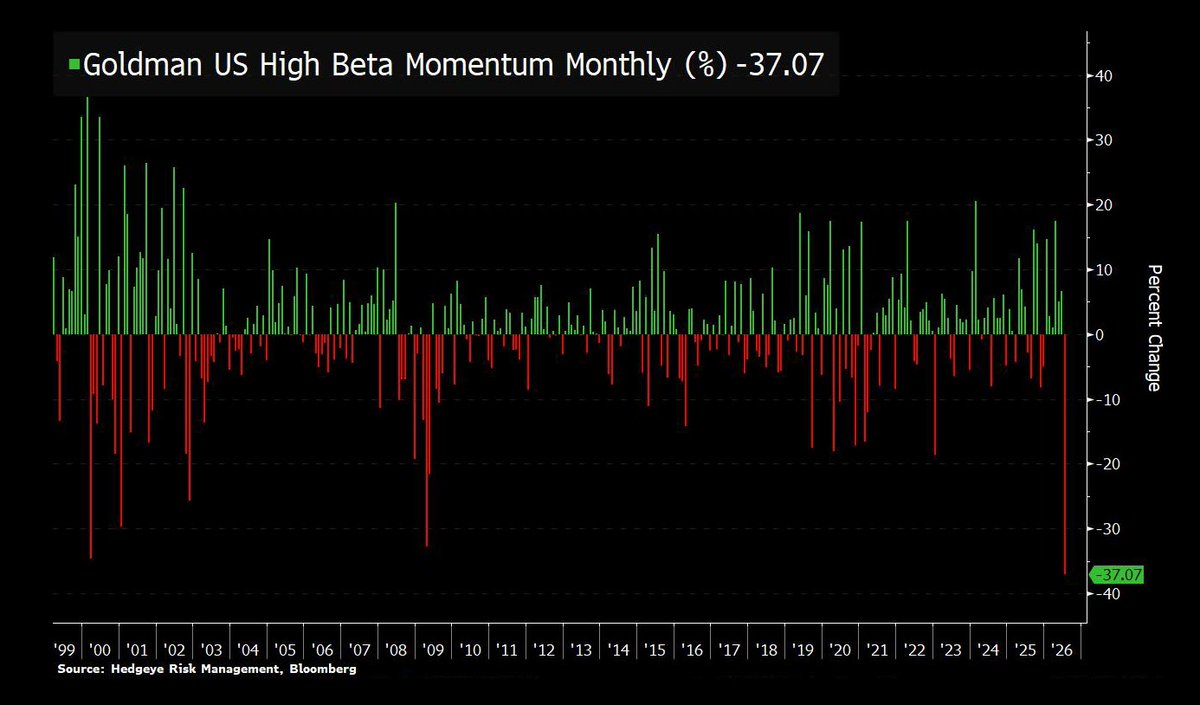
I'd rather see semi's trading at 80 vol than see 1 in 30 adults getting margin called like what we're seeing in korea.
AAPL, MSFT, Energy, Healthcare
Huge rotation today.
When I traded PT, Tuesdays were generally the busiest day for blind risk bids (ie quant rebalances). This is a very dated anecdote - so plenty could have changed.
Broadly speaking the past few days have felt like a flight to quality, just within equities.
Also, the game has kind of changed - we have corporate debt that the market deems less risky than treasuries so the next true flight to quality might look very different.
The free float true ups are dynamic. If a company is more mature and doing buybacks indexers turn seller.
That's why the index rebalance trade is inherently long growth short value (new company insiders selling [or issuing] and mature companies buying back [or doing nothing at all]).
FWIW mag 7 muddled this somewhat in the past few years because they were buying back while still growing.
SpaceX listed 4.9% of itself. That scarcity is the entire reason the stock did what it did.
The first unlock step comes on 8 August. Then roughly every two weeks. By day 366, Musk's 46.1% becomes eligible and the free float goes from about 51% to 97% in a single day.
Everyone on that calendar is currently watching their net worth move 10% between coffees. Ask yourself honestly what you would do holding a decade of income in something that trades like that.
The scarcity was never a moat. It was a countdown.
@SahilBloom The best sports cars aren't just about horsepower. Yes it matters, but beyond a certain point you will struggle to get it down the road.
Handling, comfort, reliability, looks, and price all play a role.
Now is as good a time as any to remind people that Korea:
Is a developed market in the eyes of FTSE (not in VWO)
Is an emerging market in the eyes of MSCI (is in EEM)
Chart from Portfolios Lab
Korea just about ready for that IMF bailout: Kospi halted 20 mins after crashing 10.8%, 2nd biggest drop on record, 200DMA is the last support. Millions liquidated after relentless margin calls on levered ETF products.
Books are just the delivery vehicle for content.
Agree with licensing framework but the horse is out of the barn for "general knowledge".
A lot could depend on how that term is defined. Maybe it goes the way of pharma where exclusivity is protected for a period.
MCP connectivity and licensing of "current content" might take center stage ?
@Jason Content is king.
Could we end up with a cable TV like assortment of LLM channels ? Surely not every model needs access to every bit of training data ? Especially if Exclusivity carries a premium ?
It's conceivable that an individual tasked with centrally planning an economy could be the smartest single person in a given society (although unlikely).
However, to assume that a single person, or even a committee of "experts", will be more capable than the knowledge base of everyone combined is absurd.
Companies in the S&P 500 currently average about 15 years tenure (down from 61 in 1958 and 33 in 1965).
Longest: ~69 years for originals still in since the 1957 launch (e.g. 3M, Coca-Cola). ~53 originals remain.
Shortest: Often under a year—some get added then quickly removed after failing to maintain size, getting acquired, or during market shifts. High churn reflects fast creative destruction.
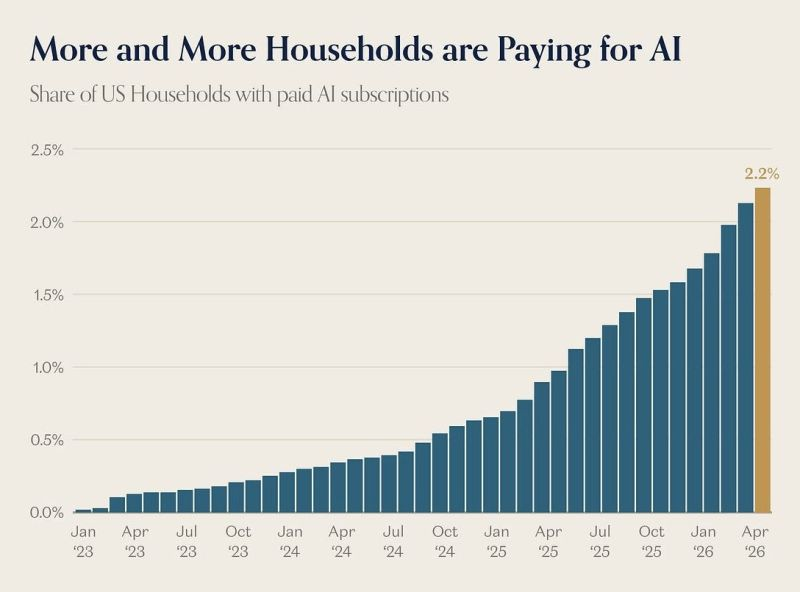
🦔2.2% of US households pay for an AI subscription as of April. The median spend is $20 a month. More Americans pay for sports betting apps (5%) than pay for AI. ChatGPT has 900 million weekly users but only 5% convert to paid. 37% of consumers say none of AI's uses are helpful. 30% say they're less likely to buy a product marketed as "AI-powered." Companies are spending $600 billion on AI infrastructure this year to serve a market where 97.8% of households don't pay for the product.
My Take
2.2% penetration nearly four years after ChatGPT launched. Netflix hit 25% household penetration in a similar timeframe. Spotify hit 15%. The growth is fast in percentage terms but off a base so small that doubling it still leaves you in single digits. The capex projections, the bond issuances, the IPO valuations all assume consumer adoption eventually catches up to the spending. Nearly four years in, it hasn't.
The pushback I'll get is that enterprise revenue is what counts and consumer subscriptions are a sideshow. Alphabet's cloud grew 82%. Anthropic reportedly hit $4.5 billion in ARR. But a lot of that enterprise spending is funded by VC money and hyperscaler capex, which makes it circular. Consumer willingness to pay is the closest thing to a genuine market signal, and right now that signal says $20 a month from 2.2% of households. The $600 billion in spending this year is a bet that the other 97.8% eventually show up. I'm not seeing it.
Hedgie🤗