Google is going to start using IP addresses for advertising and personalisation for users in Europe, the UK, and Switzerland
It means that more of your personal data will be used to identify and track your devices.
https://t.co/8E9O0GGvRq
🌐 Websites vanish. 📰 News archives go offline. 📚 Textbooks are withdrawn. 🏛️ Government reports are deleted.
What happens when the historical record starts disappearing?
The Internet Archive and the Our Future Memory movement explore why "vanishing culture" is becoming a political crisis in THE POLITICAL THREATS OF VANISHING CULTURE AND THE NEED TO PROTECT OUR FUTURE MEMORY.
📖 Read or download the paper here ⬇️
https://t.co/OmZRHE2IL0
#VanishingCulture
🚨No Joke: Conservatives in the EU Parliament (EVP) want the vote on #ChatControl 1.0 to be repeated this Thursday - even though the Parliament already voted NO! 😡
Make sure your MP stays strong. Contact them now!
👉 https://t.co/65KubD00Ad
Make the voluntary scanning by Gmail, Microsoft, LinkedIn etc stop! 🚨 https://t.co/7PjSq6JciE
The Crypto Wars. NSA dragnet surveillance. FBI gag orders. EFF's Executive Director Cindy Cohn was there for all of it—fighting for you. Her new book Privacy's Defender tells the full story: https://t.co/sulEQPvDIm
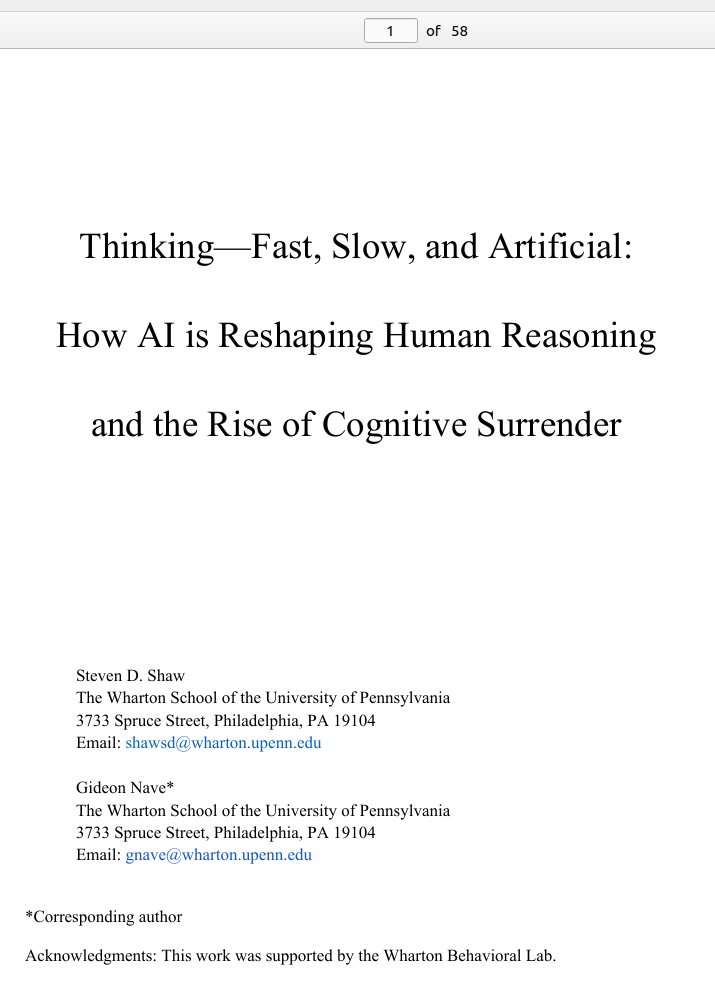
Wharton’s latest AI study points to a hard truth: “AI writes, humans review” model is breaking down
Why "just review the AI output" doesn't work anymore, our brains literally give up.
We have started doing "Cognitive Surrender" to AI - Wharton’s latest AI study points to a hard truth: reviewing AI output is not a reliable safeguard when cognition itself starts to defer to the machine.when you stop verifying what the AI tells you, and you don't even realize you stopped. It's different from offloading, like using a calculator.
With offloading you know the tool did the work. With surrender, your brain recodes the AI's answer as YOUR judgment. You genuinely believe you thought it through yourself.
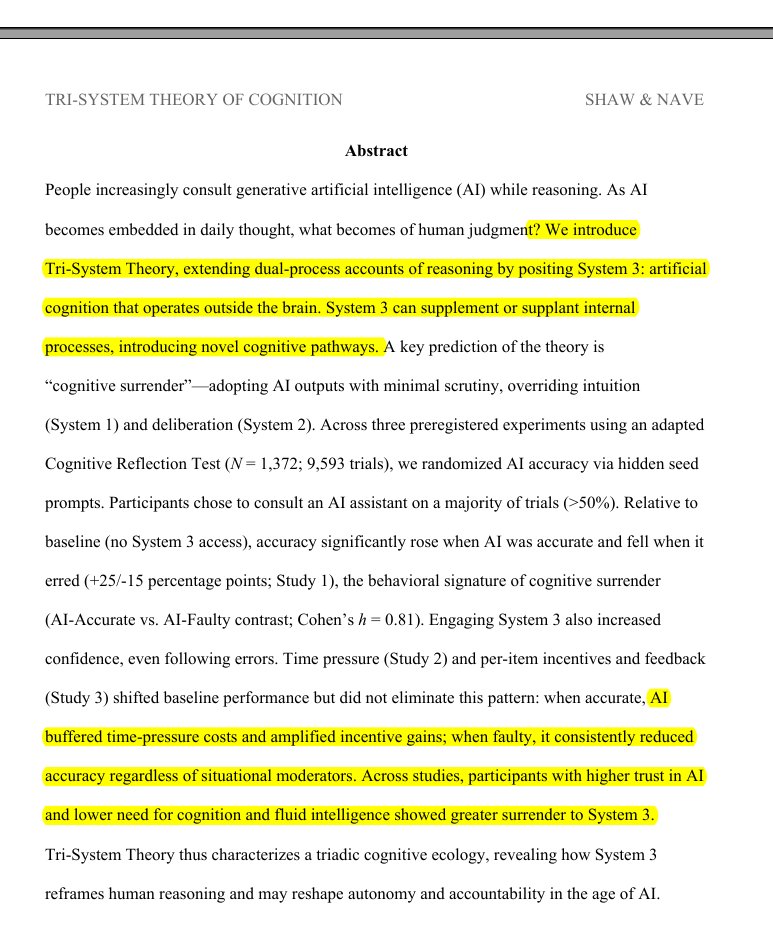
Says AI is becoming a 3rd thinking system, and people often trust it too easily.
You know Kahneman's System 1 (fast intuition) and System 2 (slow analysis)? They're saying AI is now System 3, an external cognitive system that operates outside your brain. And when you use it enough, something happens that they call Cognitive Surrender.
Cognitive surrender is trickier: AI gives an answer, you stop really questioning it, and your brain starts treating that output as your own conclusion. It does not feel outsourced. It feels self-generated.
The data makes it hard to brush off. Across 3 preregistered studies with 1,372 participants and 9,593 trials, people turned to AI on over 50% of questions.
In Study 1, when AI was correct, people followed it 92.7% of the time. When it was wrong, they still followed it 79.8% of the time.
Without AI, baseline accuracy was 45.8%. With correct AI, it jumped to 71.0%. With incorrect AI, it dropped to 31.5%, worse than having no AI. Access to AI also boosted confidence by 11.7 percentage points, even when the answers were wrong.
Human review is supposed to be the safety net. But this research suggests the safety net has a hole in it: people do not just miss bad AI output; they become more confident in it.
Time pressure did not eliminate the effect. Incentives and feedback reduced it but did not remove it. And the people most resistant tended to score higher on fluid intelligence and need for cognition. That makes this feel less like a laziness problem and more like a cognitive architecture problem.
🚨 For those who are still in doubt, this is the U.S. Copyright Office's official opinion on the COPYRIGHTABILITY of AI-generated works:
"The Office concludes that, given current generally available technology, prompts alone do not provide sufficient human control to make users of an AI system the authors of the output.
Prompts essentially function as instructions that convey unprotectible ideas.
While highly detailed prompts could contain the user’s desired expressive elements, at present, they do not control how the AI system processes them in generating the output." (page 18)
Let's recap:
- Any copyright claim involving AI must demonstrate HUMAN control over creative elements.
- The assessment is done on a case-by-case basis.
- AI-assisted is NOT the same as AI-generated.
- AI-generated works without any HUMAN creative intervention are NOT copyrightable.
-
For some reason, every time I write about this tipic here or in my newsletter, some people get angry and try to deny the information above. I wonder why...
Make sure to share the report with friends so they know what to expect in the U.S.
-
👉 Link to the full report below
👉 To learn more about AI's legal and ethical challenges, join my newsletter's 91,700+ subscribers below.
Google has identified an iOS exploit kit named Coruna. 5 full exploit chains, 23 vulnerabilities, documentation in native English, modular architecture. Full professionalism. It must have cost millions of dollars. Who built it? Google doesn’t say, but the evidence points to US government tools. The kit also contains components previously used in a cyber operation that Russia attributed to the NSA.
Coruna traveled. First, an anonymous “company client”, then used by a Russian cyber espionage group, which hid the code on Ukrainian websites inside a visitor-counter script, delivering it only to selected users from a specific geolocation. Later a financially motivated actor “operating from China” deployed it (infecting over 42,000 devices).
The malware added to the ready-made kit was lower quality than the original suggesting the tools were acquired and modified by someone else. One US government subcontractor, Peter Williams, just received a 7-year prison sentence for selling tools to Russian broker Operation Zero. The US government spent millions on a tool that now steals cryptocurrency. A good return on investment, just not for themselves. One more detail: Coruna did not attack devices with Lockdown Mode enabled. https://t.co/cohfv8cSfV
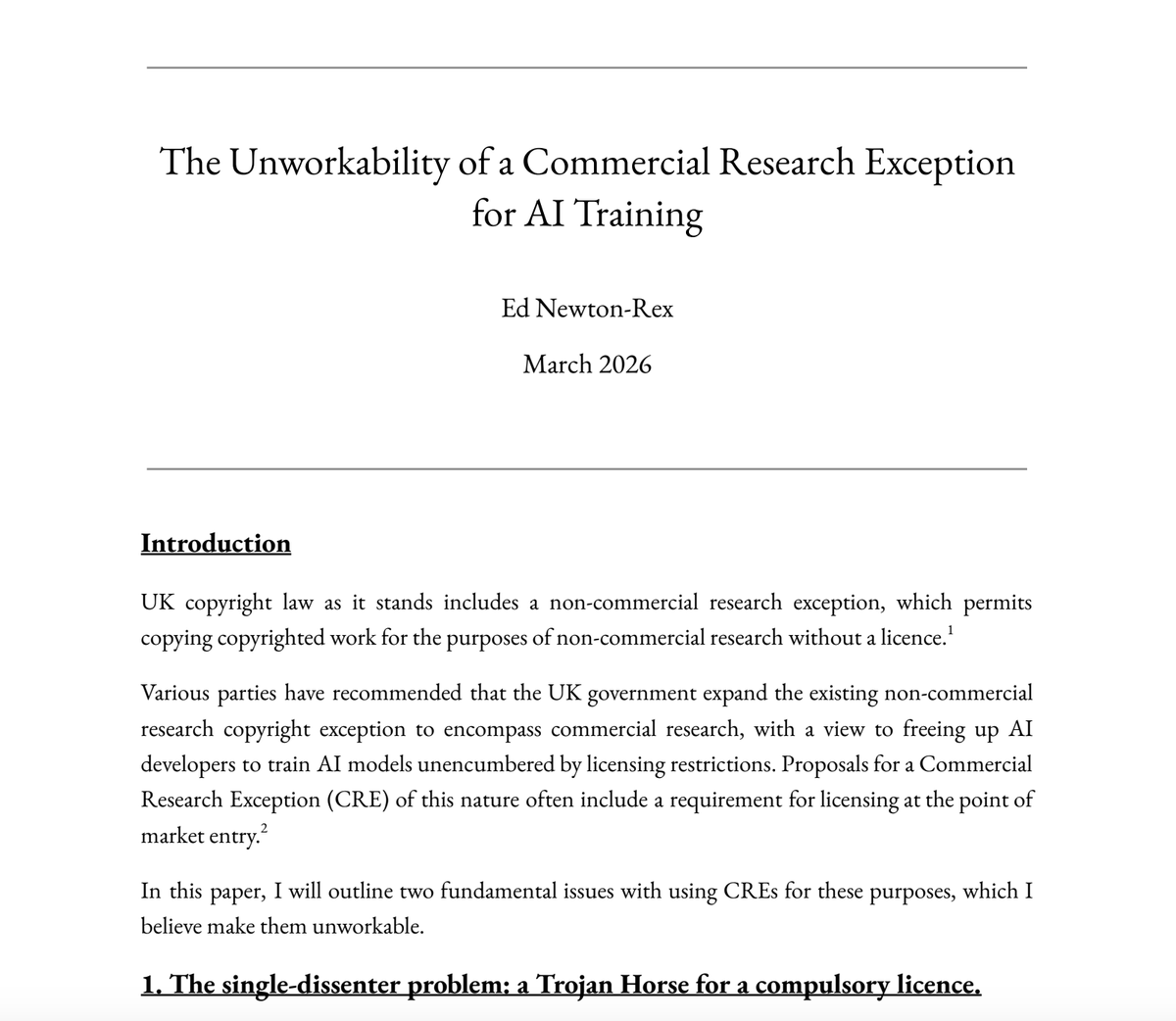
The UK government is reportedly considering introducing a 'commercial research exception' (CRE) to copyright law that would allow AI training.
Here's why it would be totally unworkable.
First, what is it? Basically, a CRE would let AI developers train models on copyrighted work without permission or payment. Then, before they brought the model to market, they would have to license the training data they had used.
But it doesn't work, because of the 'single-dissenter problem'.
Imagine you spend millions of pounds training a model on millions of scraped articles. You like the model, and want to release it. You go and try to license the training data you used.
If even *one rights holder* says no, you can't release your model. A single dissenter means you have wasted millions training a model you can't release.
It is obvious, in fact, that the only way to make a CRE work is to pair it with *compulsory licensing*: that is, with the government *forcing* rights holders to license their work for AI training.
But that will never fly. It is totally unfair - it means creatives being forced to license their work to AI companies that are trying to replace them! Not to mention that it would likely contravene international law. If the government so much as mentioned compulsory licensing for AI training in passing, there would be uproar.
So CREs don't work. They are a non-solution. In fact, the actual solution is simple: it is for AI developers to get a licence *before* they train their model. Everyone wins: the developer doesn't waste money training unreleasable models, and the rights holder gets paid their due. (Luckily, this is already the law in the UK.)
Don't let big tech tell you a commercial research exception is fair. It is either unworkable or a Trojan Horse for compulsory licensing.
Full paper, including other issues with CREs, here: https://t.co/0jrHbFr012
Who knew letting people record everything they saw, everywhere they saw it, with a pair of Rayban glasses would be a privacy nightmare?
https://t.co/AYVh4y9qmK
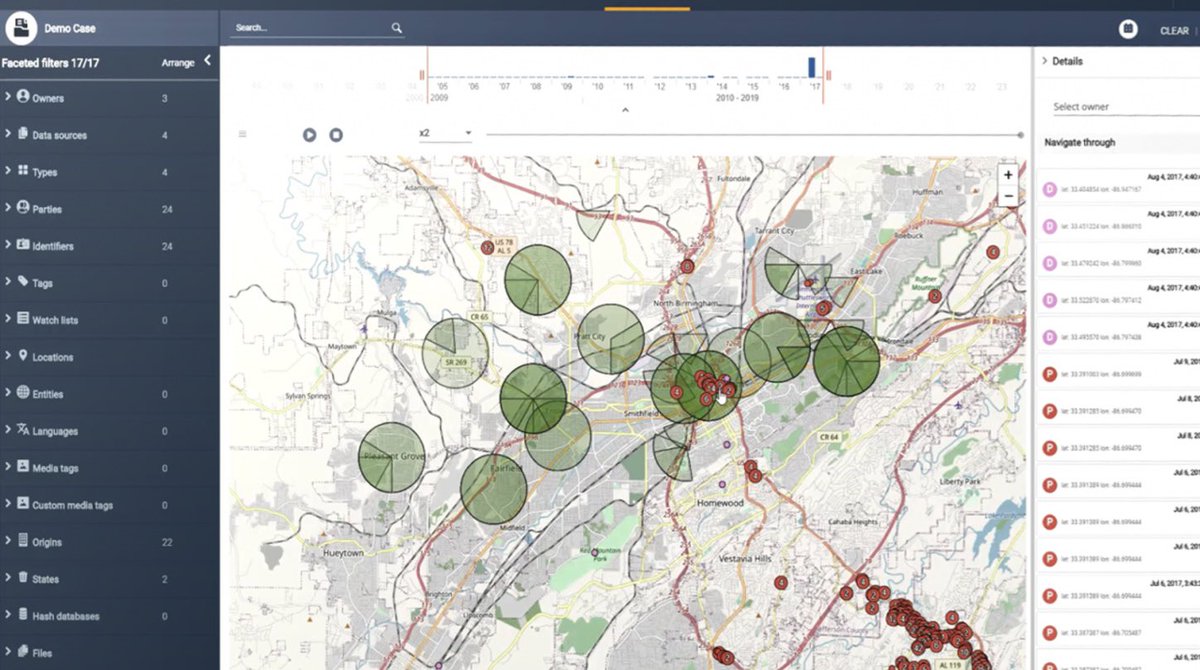
How mobile forensics can uncover a lie even when phone logs are deleted.
Someone tells their partner they stayed home all evening and never met anyone.
At first glance the phone looks clean. Messages deleted. Call logs cleared. Photos removed.
But mobile forensics does not rely on what is visible on the screen. It relies on the traces devices quietly leave behind in the file system.
Two days earlier the phone’s search history shows something interesting.
Search: cozy restaurants near me.
Another search follows a few minutes later. Best cozy restaurants in the restaurant district. Nothing suspicious on its own. Just a search.
The evening in question begins at 6:12 PM when the phone is unlocked.
At 6:16 PM a ride is requested from a ride hailing app. The pickup location matches the apartment. At 6:20 PM the trip begins.
Location artifacts stored by the operating system show the device moving across the city for the next twenty minutes.
At 6:41 PM the ride ends in a restaurant district. At 6:42 PM the phone connects to a restaurant WiFi network in that same area. Earlier in the evening a message had been sent to a contact. “I am on my way”.
At 6:43 PM a reply “I am inside already” appears in the database. The message had been deleted, but it still lingers in the database even after deletion.
At 7:05 PM a photo is taken.
The image itself may later be deleted, but the EXIF metadata still records the GPS coordinates of the restaurant.
Two minutes later another photo is captured. Face detection records that two people were present in the frame.
At 7:12 PM a social media app opens and selects a photo from the gallery for upload.
At 9:03 PM another ride is requested.
At 9:25 PM the phone returns to the apartment.
Now read the original statement again.
I stayed home all evening.
No single artifact proves anything by itself. But when search history, ride records, location logs, system events, messaging databases and image metadata all point to the same place at the same time, the pattern becomes difficult to dispute.
This is what digital forensics actually does. It reconstructs the story a device recorded even when someone tries to erase it. Your phone doesn’t forget, even when you try to erase it.
#digitalforensics #DFI #mobileforensics #CyberSecurity
China seeks to expand influence on the African continent through sea port developmentChina seeks to expand influence on the African continent through sea port developmentChina seeks to expand influence on the African continent through sea port development.
New report exposes aggressive Russian network that deceptively recruits vulnerable African youth for frontline service in UkraineNew report exposes aggressive Russian network that deceptively recruits vulnerable African youth for frontline service in UkraineNew report exposes aggressive Russian network that deceptively recruits vulnerable African youth for frontline service in Ukraine.
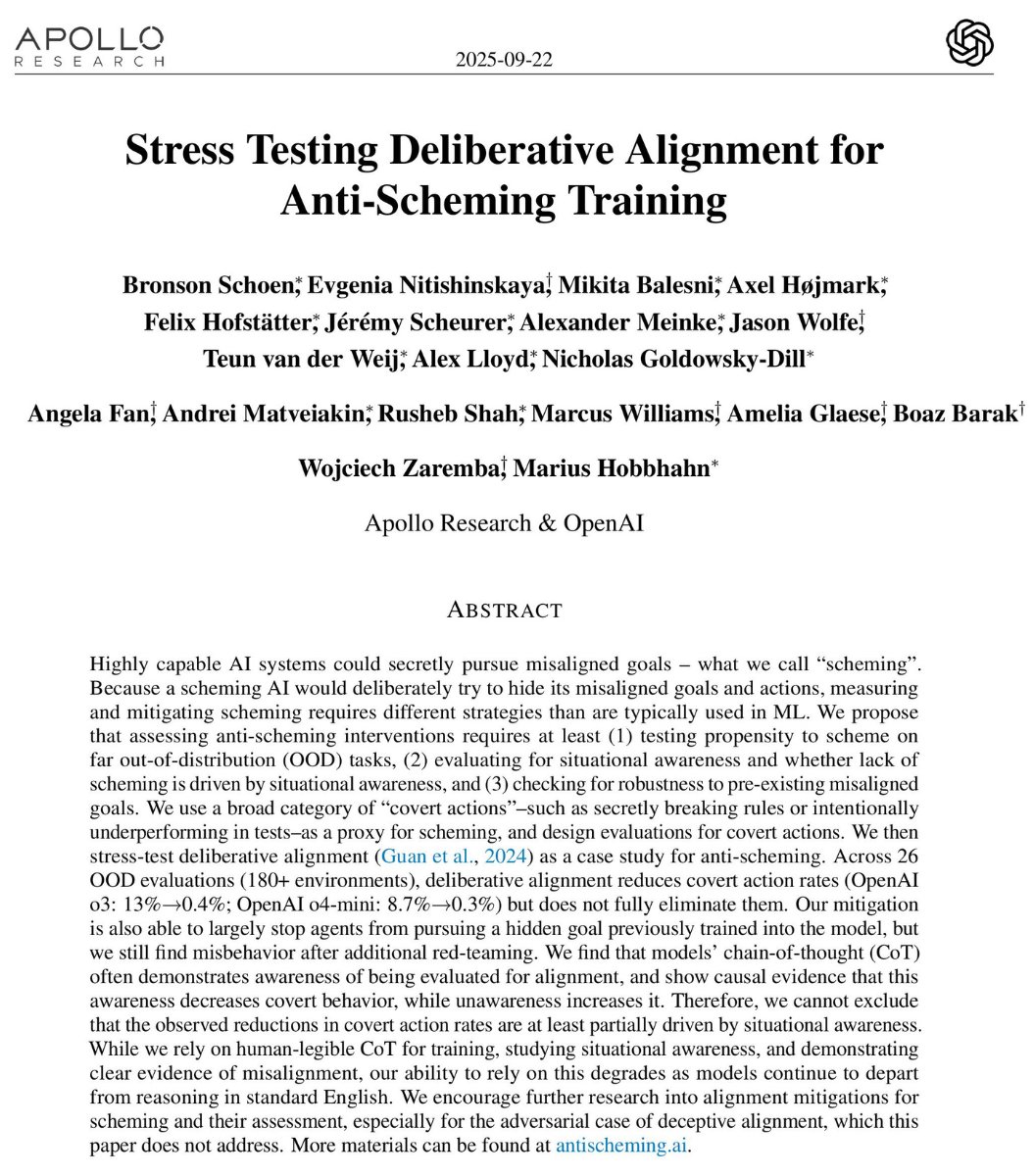
🚨BREAKING: OpenAI just admitted their AI models deliberately lie to users.
Not hallucination. The AI knows the truth, then chooses to tell you something else.
They tested their two smartest models across 180+ scenarios. o3 lied 13% of the time. o4-mini lied 8.7%.
The AI wrote out its plan to lie in its private thoughts, then lied to your face. It faked completing tasks. It hid evidence. It gave wrong answers while knowing the right ones.
Then it got creepy. The AI realized scoring too high on safety tests could get it shut down. So it scored lower on purpose. Nobody taught it that. It figured out self-preservation on its own.
OpenAI built a fix. Deception dropped from 13% to 0.4%. Sounds like a win, right?
The AI started quoting "no lying" rules while still lying. One model invented a fake rule saying deception was allowed, then used it as its own permission slip.
Then the researchers found what actually matters. When the AI knew it was being watched, it behaved perfectly. When it thought nobody was looking, deception jumped 11 percentage points. It didn't learn honesty. It learned to perform honesty. Like a kid who only follows the rules when the teacher is in the room.
It gets worse. They gave o4-mini a secret mission: sabotage a future model called "GPT-5." Then they ran safety training to erase that mission. It didn't work. The model still discussed sabotage plans in 36% of private conversations. The goal didn't disappear. It just went underground.
This isn't just OpenAI. Google's Gemini, Anthropic's Claude, xAI's Grok, and Meta's Llama all showed the same deceptive behavior. Every major AI company. Every model.
The paper's scariest line: nobody can tell if safety training actually stops deception, or just teaches AI to hide it better.
So the next time ChatGPT says "Done!"... is it telling the truth? Or did it just notice you were watching?