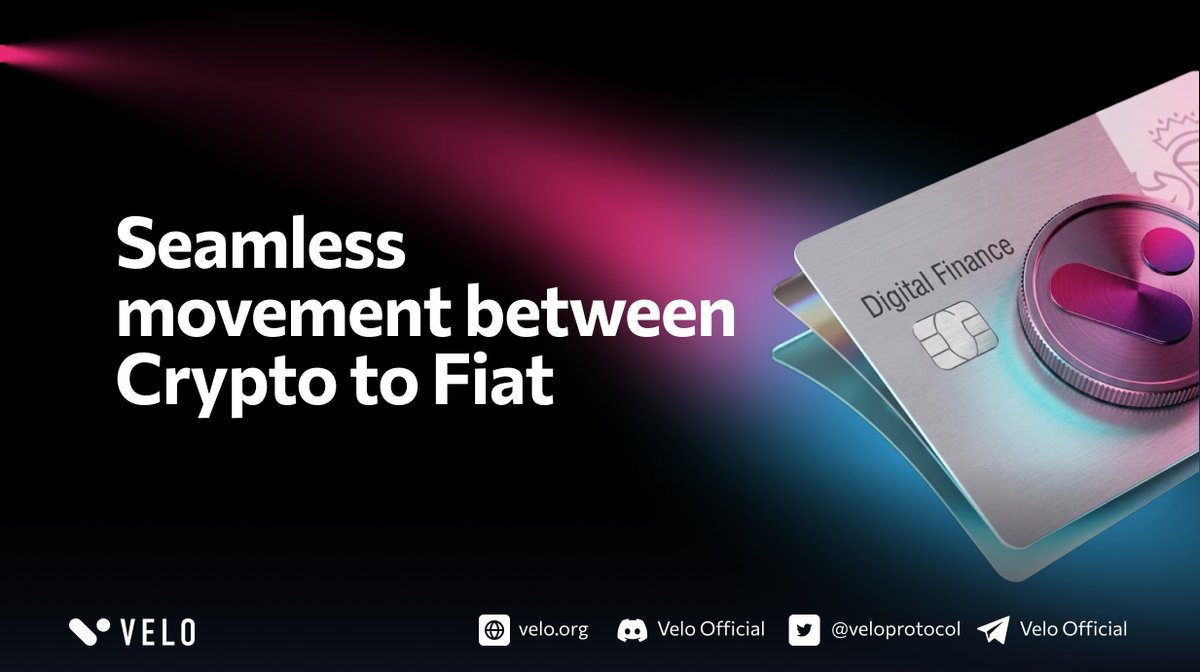
Moving from crypto to fiat should be as seamless as moving between digital assets.
Orbit Plus Off-Ramp is designed to make that possible, starting with Indonesia and expanding across ASEAN over time.
Built on licensed payment infrastructure, with compliance at its core.
Download Orbit Plus
👉 iOS: https://t.co/bYWArmNgQt
👉 Android: https://t.co/UXZJDfGzDK
* Processing time is subject to business hours of receiving institution.
Velo’s new whitepaper is live.
https://t.co/WXlrRsdKAi
This isn’t just an update—it’s a shift in how payments, liquidity, and capital come together.
Introducing a compliant, crypto-native FX liquidity, treasury network for global settlement.
Here’s what’s changed 👇 1/3
The European Commission says it cannot stop Sony from ending physical PlayStation games.
In response to questions from a Member of the European Parliament, the Commission said companies are “free to offer games and services in the manner that they see fit,” as long as they follow existing consumer protection laws.
The Commission also said it has no legal basis to require companies to keep selling physical games or force them to support a specific business model.
Instead, it will continue monitoring the market and enforce EU consumer protection rules where necessary.
T.I. transformed a former shopping center in Atlanta into a 143-unit affordable housing complex, with 25 apartments specifically reserved for homeless youth.
$VELO may be one of the most misunderstood infrastructure plays in crypto.
Most people still think crypto is about charts, memecoins and speculation.
But behind the scenes, an entirely new payment architecture may already be taking shape.
And surprisingly, many of the puzzle pieces appear to connect around VELO, Lightnet, XRPL, EVOLVE and even projects like mBridge.
BRICS Pay documents and recent interviews describe a future financial system built around multilateral netting, national currency settlement, blockchain accounting, stablecoin bridges, OTC fiat gateways and interoperable payment rails.
This is not about replacing the dollar with a single coin.
It is about rebuilding the infrastructure of global commerce.
One statement from the BRICS Pay CEO stood out in particular:
USDT may serve as a temporary bridge, but over time the system will likely require regulated regional stablecoins from jurisdictions such as Hong Kong or the UAE, potentially even asset-backed alternatives like tokenized gold.
That distinction matters more than most people realize.
Since the implementation of MiCA in Europe and the tightening of stablecoin regulation globally, the market has increasingly split into two categories:
regulated institutional-grade digital assets and unregulated liquidity bridges.
This is precisely where VELO’s positioning becomes interesting.
For years, @veloprotocol has quietly built infrastructure around PayFi settlement, fiat gateways, OTC liquidity, merchant payment systems, loyalty tools and interoperable cross-border transfers.
The similarities are difficult to ignore.
And this is where $USDV becomes critical.
USDV is not simply another stablecoin. It acts as the system-native settlement asset within the Velo ecosystem and is backed through exposure to BlackRock’s USD Institutional Digital Liquidity Fund, BUIDL, tokenized via @Securitize
That changes the entire conversation.
If USDT is merely a temporary liquidity bridge, the obvious question becomes:
what comes next?
VELO’s answer may already exist in the form of a regulated, yield-bearing stablecoin infrastructure connected to tokenized US Treasury exposure.
And unlike unregulated stablecoin bridges, USDV is backed by an investment in BlackRock’s USD Institutional Digital Liquidity Fund, BUIDL, tokenized via Securitize.
At the same time, Velo has also explored additional V-Stablecoins linked to regional fiat currencies, reinforcing the idea of a multilayered settlement architecture built around interoperable regional liquidity rather than a single dominant asset.
In other words, while USDT solves short-term liquidity, USDV points toward the next phase of institutional PayFi settlement backed by real-world assets and on-chain yield generation.
Then things become even more interesting with Lightnet.
Velo & @lightnetgroup was co-founded by Chatchaval Jiaravanon, a member of the family behind
@CPGroup_Live, one of Asia’s most influential conglomerates with deep historical business ties throughout China.
And this matters because cross-border payment systems are never built on technology alone.
They require regulatory trust, banking relationships, liquidity corridors, licensing frameworks and geopolitical access.
That is precisely why Lightnet’s positioning in Hong Kong is so significant.
Hong Kong is increasingly emerging as the regulated digital asset sandbox for Asia and potentially even a controlled gateway into broader Chinese financial experimentation.
Through partnerships such as WeLab and its pursuit of Money Service Operator licensing, Lightnet has positioned itself near one of the most important future payment corridors connecting ASEAN, Hong Kong and China.
But another critical piece is often overlooked:
mBridge.
mBridge is the BIS-backed multi-CBDC initiative involving the central banks of China, Hong Kong, Thailand and the UAE.
And interestingly, its core focus revolves around the exact same concepts:
Special thanks and shouts out to @FlyFrontier for damaging my new luggage 🧳 Never 👎🏽 happened on @SouthwestAir@Delta@AACenter@JetBlue@SpiritAirlines
I got receipts 🧾 that it was new luggage 🧳 but you didn’t want to see those you just easily said it was wear and tear 🤦🏾♂️
Aaron Tucker had been out of prison for seven days. He had less than $2 in his pocket and one shot at turning his life around, a job interview that morning. Then he saw a car flip over and catch fire from his bus window.
He asked the bus driver if he was going to help. "No, but if you get out I'm going to leave," the driver replied. Tucker got out anyway.
He sprinted toward the upside-down, smoke-filled car and found the 61-year-old driver covered in blood.
He unbuckled the man's seatbelt and dragged him clear as the car started to catch fire.
He pulled off his own dress shirt and used it to stop the man's head wound from bleeding, telling him: "You're going to be all right. Your family wants to see you. Keep your eyes open."
The bus left. Tucker missed his interview.
When the story got out, strangers set up a GoFundMe that raised over $50,000 in three days. He also received multiple job offers in construction.
"I feel like a job can come and go, but a life is a one-time thing," Tucker said. "The job just wasn't in my mind at that time."