We used to ask whether AI could think. Now we have to ask whether it can be trusted with motion.
A chatbot gives answers.
An agent takes actions.
That small shift changes everything: cost, authority, security, liability, and human judgment.
The future of AI may depend less on autonomy itself than on the architecture around autonomy.
#AI #AgenticAI #AISafety #DeepTech
I just tried to talk two friends out of quitting their jobs to start companies.
Not because I don’t believe in startups. Because I do.
They’re just much harder than people think:
uncertainty, pressure, constraints, loneliness.
It’s not just about ideas—it’s resilience, execution, leadership, sales.
Would you have done the same?
#startups #entrepreneurship #reality
AI can’t write WELL!
While AI tools can generate and summarize text, they are often described as having hit a "ceiling" in expressive capacity.
Reasons for AI’s Writing Limitations
1) Lack of Genuine Meaning: Experts argue that while AI can create grammatically correct text, it does not generate meaning in the human sense. It is frequently described as a "statistical probability" machine that lacks true creative thought.
2) Focus on Pattern Matching: LLMs learn by ingesting vast amounts of internet text and identifying patterns. Because much of this text is repetitive or low-quality, the models often produce "textual wastelands" that are impersonal and featureless, say critics.
3) Suppression of Creativity: To ensure safety and reduce misinformation, AI companies train models to avoid political bias and toxic content, which inadvertently suppresses creativity and leads to formulaic writing.
4) Inability to Capture Unique Voice: AI struggles to emulate a specific, nuanced human voice or perspective, tending to produce "bland" and "impersonal" prose.
What else?
#AI #LLM #AIWriting
AI executives and researchers “readily admit that they have not yet released a model that writes well,” @jasminewsun writes. She speaks with AI experts about why LLMs are built in a way that is antagonistic to great writing: https://t.co/dGJfymXtDc
Strong performance on many tasks ≠ general intelligence
LLMs are more than tools—but calling them AGI risks blurring a critical boundary. A better framing might be:
We are building increasingly capable general systems—without yet demonstrating true general intelligence.
Curious where others land on this.
#AI #AGI #MachineLearning
Here's the longer version of our Nature piece.
Our argument is simple: statistical approximation is not the same thing as intelligence.
Strong benchmark scores often say very little about how LLMs behave under novelty, uncertainty, or shifting goals.
Even more importantly, similar behaviors can arise from fundamentally different processes. In another paper, we identified seven epistemological fault lines between humans and LLMs.
For example, LLMs have no internal representation of what is true. They often generate confident contradictions, especially in longer interactions, because they do not track what is actually true.
Another example. Yes, LLMs have solved some open mathematical problems, but these cases typically involve applying known methods to well-defined problems. LLMs cannot invent anything that is truly new and true at the same time, because they lack the epistemic machinery to determine what is true.
None of this means LLMs are useless. Quite the opposite: they are extraordinarily useful.
But we should be careful about what they are and what they are not.
Producing plausible text is not the same as understanding.
Statistical prediction is not the same as intelligence.
So despite the hype from the usual suspects, AGI has not been achieved.
*
paper in the first reply
Joint with @Walter4C and @GaryMarcus
AI can write code faster than humans… including bugs.
The lesson perhaps isn’t “don’t use AI to code.” But when AI accelerates development, the processes have to catch up and human oversight have to accelerate too. (Something to think about… at least for now.)
Otherwise you just automate mistakes at scale.
#AI #SoftwareEngineering #DevOps #VibeCoding
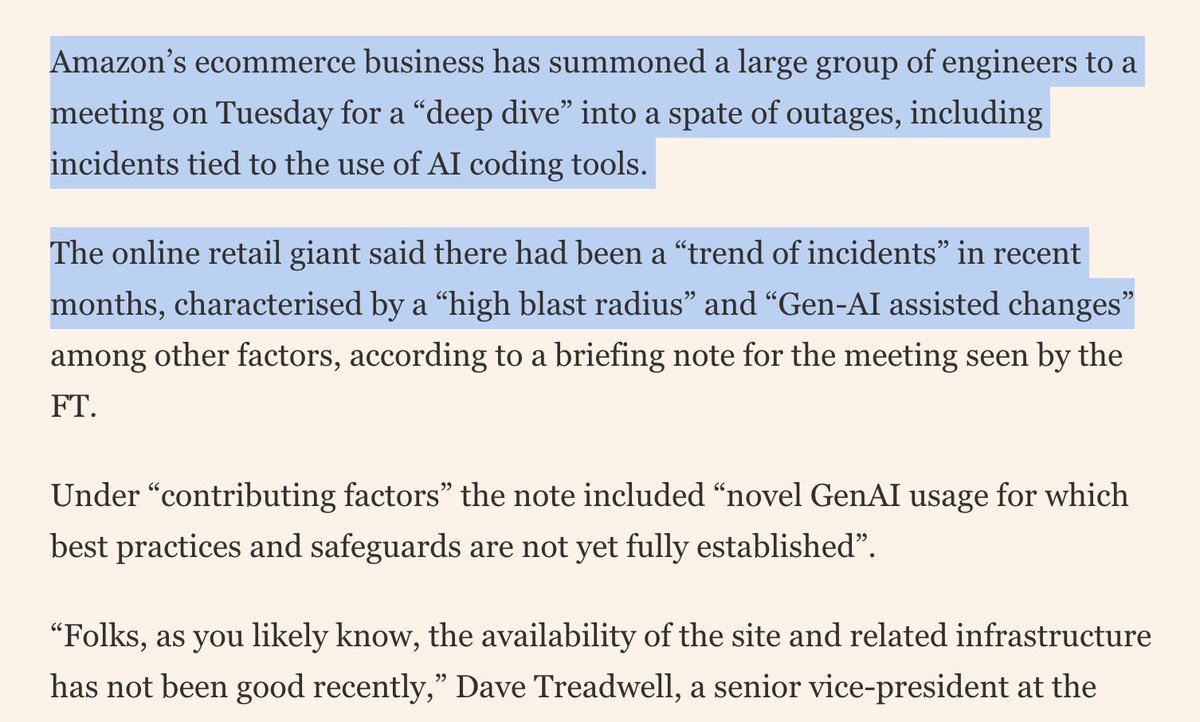
Amazon is holding a mandatory meeting about AI breaking its systems. The official framing is "part of normal business." The briefing note describes a trend of incidents with "high blast radius" caused by "Gen-AI assisted changes" for which "best practices and safeguards are not yet fully established." Translation to human language: we gave AI to engineers and things keep breaking?
The response for now? Junior and mid-level engineers can no longer push AI-assisted code without a senior signing off. AWS spent 13 hours recovering after its own AI coding tool, asked to make some changes, decided instead to delete and recreate the environment (the software equivalent of fixing a leaky tap by knocking down the wall). Amazon called that an "extremely limited event" (the affected tool served customers in mainland China).