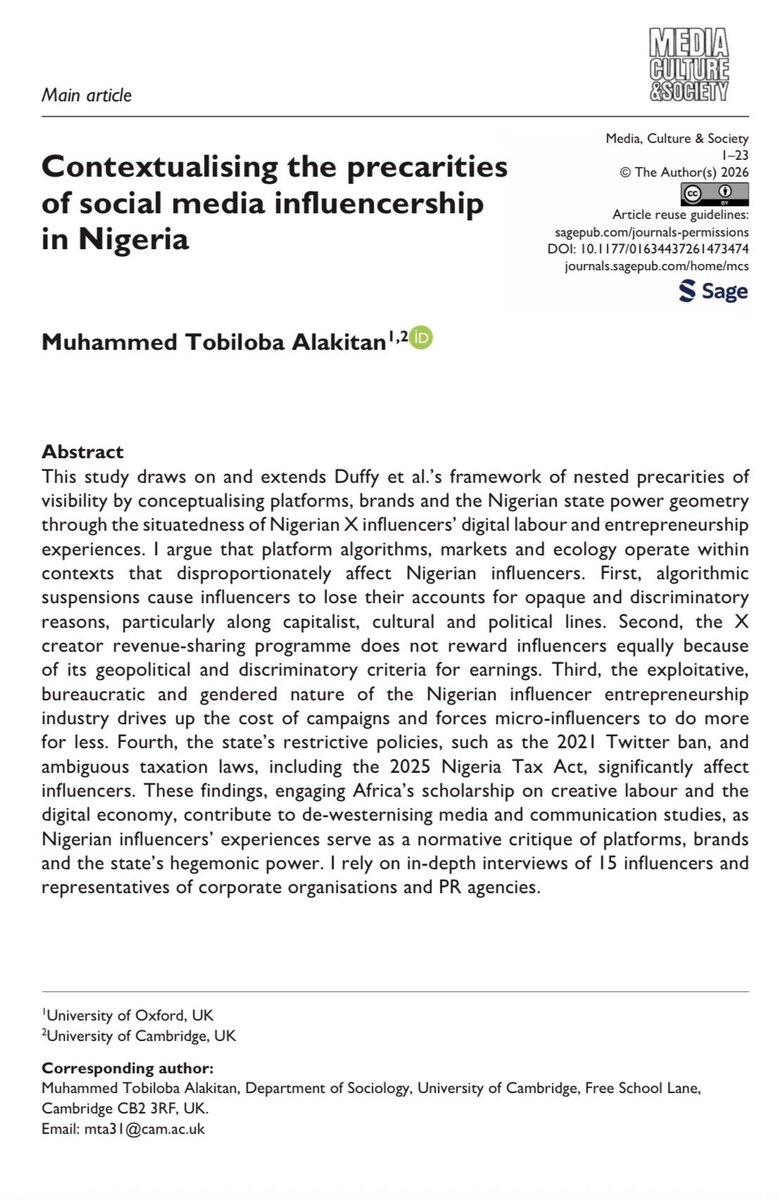
New study out.
The paper examines the precarities of Nigerian X influencers arising from platform algorithms, X revenue-sharing scheme, the bureaucratic and gendered nature of influencer entrepreneurship, and state regulation and taxation. Open-access: https://t.co/B8WRW0l2Ng
Days after my publication on X-creator revenue precarities, the platform announced “Original Content Rewards Programme”.
The name has changed, but not the challenges. Eligibility conditions relying on premium users are bound to fail Nigerian influencers.
New study out.
The paper examines the precarities of Nigerian X influencers arising from platform algorithms, X revenue-sharing scheme, the bureaucratic and gendered nature of influencer entrepreneurship, and state regulation and taxation. Open-access: https://t.co/B8WRW0l2Ng
EXPOSED: BRITAIN’S MILITARY GRIP ON KENYA
A must-watch documentary exposing the British military base in Kenya known as BATUK is dropping on June 2, 2026.
Sovereign Media’s first-ever documentary investigates allegations of abuse, sexual violence and ecological damage linked to Britain’s military presence in Kenya. The film explores how Britain established a military base in Kenya, the very same year the country supposedly gained independence from colonial rule.
Through interviews, historical context and on-the-ground reporting, the documentary looks at the lasting impact of colonialism in Kenya and how both the colonial government in London and the post-colonial administration of Jomo Kenyatta feared that the Mau Mau liberation struggle would not end until the land was returned to its rightful owners. The documentary explores the argument that Britain was allowed to maintain a military presence in Kenya in 1963 to help crush revolutionary movements and ensure the new neo-colonial government continued serving British interests after so-called independence.
You don’t want to miss this one.
@NaamMedia@AhmedKaballo@VoxUmmah@venanalysis@qiaocollective@ProgIntl@KawsachunNews@OrinocoTribune @blkagendareport
@SoberaniaPod
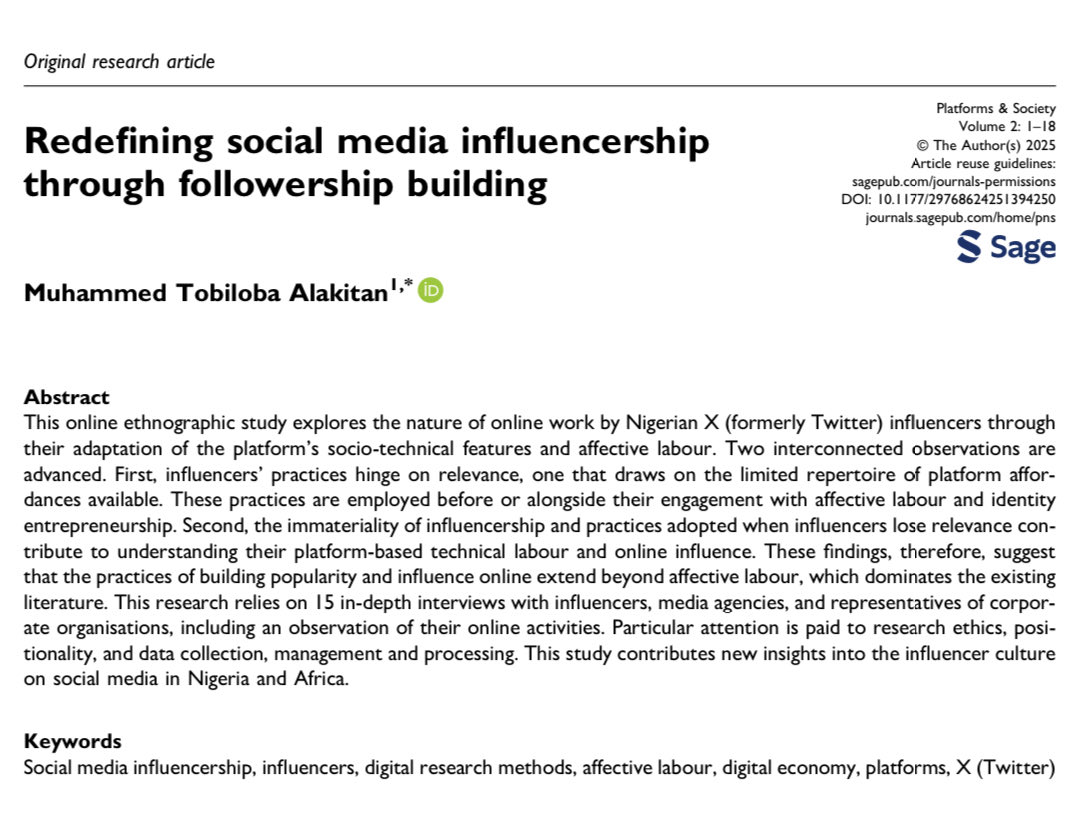
Yes, influencers usually have a niche -but that does not tell all the story about their rise to popularity.
Thus, in this study, I extend the notions of influencership beyond affective labour and identity entrepreneurship as we enter the Fediverse realm. https://t.co/kY1ZZmqhqa
[Invited Contribution 📝]
2026 is dubbed the year of AI hyperscalers. In this very short blogpost, @Ebenad05 and I reflect on what this means for Africa.
https://t.co/EJeCCoN6oe
@usydsace@Sydney_Uni@policyinternet
[Invited Contribution 📝]
2026 is dubbed the year of AI hyperscalers. In this very short blogpost, @Ebenad05 and I reflect on what this means for Africa.
https://t.co/EJeCCoN6oe
@usydsace@Sydney_Uni@policyinternet
As the year draws to a close, I have found myself reflecting on my provocations on decentring research in the social sciences at this year’s @britsoci conference.
You can read more here: https://t.co/0u8MrszzQI
My heart is particularly warmed by the below comment from one of the reviewers on my methods & ethical considerations.
If you are a social media researcher looking to engage with both qualitative and quantitative data, you may find this paper helpful.
Yes, influencers usually have a niche -but that does not tell all the story about their rise to popularity.
Thus, in this study, I extend the notions of influencership beyond affective labour and identity entrepreneurship as we enter the Fediverse realm. https://t.co/kY1ZZmqhqa
My heart is particularly warmed by the below comment from one of the reviewers on my methods & ethical considerations.
If you are a social media researcher looking to engage with both qualitative and quantitative data, you may find this paper helpful.
Yes, influencers usually have a niche -but that does not tell all the story about their rise to popularity.
Thus, in this study, I extend the notions of influencership beyond affective labour and identity entrepreneurship as we enter the Fediverse realm. https://t.co/kY1ZZmqhqa
Should a blasphemer be killed?
There is NO evidence for such in Islam, not in the Qur'ān and not in the Sunnah.
The Prophet Muhammad (ṣallāLlāhu 'alayhi wa sallam) chose forgiveness and mercy even when he had the power to take revenge. People didn't submit to him because of coercion. He was never a coercive person. They submitted to him willingly because of his mercy and his beautiful character.
Allah, the Creator describes him as a Prophet of Mercy for all humankind and jinn-kind (Rahmatan li al-'ālamīn).
Share with others.
We are currently responding to an incident on a train to Huntingdon where multiple people have been stabbed.
Officers are in attendance alongside @CambsCops and two people have been arrested.
Further updates will be shared here.