🔥 THE 6 PILLARS OF SUCCESSFUL TRADING
1️⃣ Master ONE Strategy First (Not 12)
Most traders fail because they dabble in too many systems.
Pick one core strategy and excel at it before adding anything else. Some proven ones:
- Breakout trading
- Trend continuation
- Mean reversion
- High-timeframe swing trading
- Indicator-based confirmation (like OBV or Top Goon X)
Your goal: 👉 Turn one setup into a repeatable playbook with known probabilities.
---
2️⃣ Risk Management = Your Survival
Great traders don’t win because they're always right.
They win because they don’t blow up when they’re wrong.
The rules that matter:
Never risk more than 1–2% of account per trade (general rule of thumb)
Stop-loss must be planned BEFORE you enter
Position sizing must be calculated based on stop loss placement
Avoid overtrading — your worst enemy
A great trader can be profitable with a 40–50% win rate IF their risk is well managed.
---
3️⃣ Treat Trading Like a Business (Not a Casino)
Success comes from repeatability.
You need:
A written trading plan
A watchlist selection process
A daily routine (scan → plan → execute → review)
A trade journal (screenshots + notes on why you entered)
Consistency ROUTINE > consistency RESULTS.
---
4️⃣ Master Your Emotions (The Hardest Part)
Two things blow up more accounts than any chart:
- FOMO 🫠
- Revenge trading 😡
💡 Solutions:
Pre-define your entries and exits
Follow your system even when emotions scream otherwise
Track emotional mistakes in your journal
Take breaks after 2 consecutive losses
Don’t trade when tired, stressed, or bored
Trading = emotional control disguised as financial activity.
---
5️⃣ Know the Market Context
The same strategy behaves differently in different markets.
You must always know:
Are we in a trend, chop, or distribution phase?
Are big caps strong or weak?
Are rates, inflation, or earnings driving short-term moves?
Great traders don’t trade the chart alone —
they trade the environment the chart lives in.
---
6️⃣ Continuous Review + Optimization
Winners iterate.
Every month, ask:
Which setups made me the most money?
Which ones cost me the most?
Am I overtrading?
What were my top emotional mistakes?
Which timeframes am I best on?
Could I size up on my best setups?
Success comes from small improvements, repeated for years.
---
⚡ Putting It All Together
Design a success plan tailored to YOU:
Mine would go something like this:
✔ Focus on swing trading + momentum plays
I'm pretty confident in my TA and defining key levels.
✔ A structured weekly routine
Monday: market prep
Tue–Thu: trading + content
Friday: portfolio cleanup + journaling
Fridays: macro review + watchlists
✔ Top Goon X scan to reinforce your process
✔ Avoid burnout and take breaks when needed
I trade crypto + stocks + content creation + properties + gym + family.
Too much noise = bad trading decisions.
---
💥 Build yourself a Trading for Success Blueprint:
Create a personalized:
- Daily routine
- Watchlist formula
- Entry/exit rules
- Journaling system
- Risk model
- 30 day trading impro plan
Always learn and always grow. The markets are constantly evolving and you should be too!
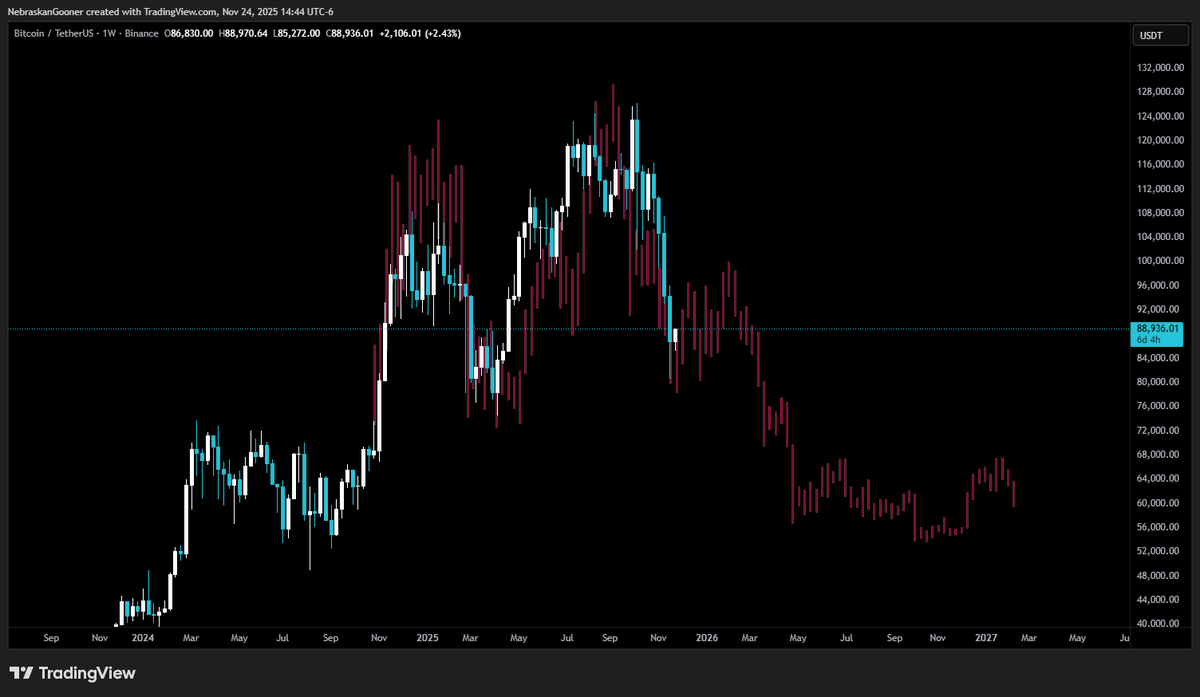
#Bitcoin
Fractal bounced right where it was supposed to.
If we continue to follow along then we'll see some choppy PA here sub $100k before another leg down.
Or, we'll break above $100k and invalidate the fractal.
What do you guys think will happen?
📝 SIMPLE WAY TO IDENTIFY IF AN ALTCOIN IS IN BULLISH OR BEARISH TREND:
1. Open the daily time frame chart on Tradingview
2. Add two indicators:
- Gooner EMA
- Smoothe Moving Average (change
value to 99)
3. Observe chart
BULLISH TREND 📈:
Both Gooner EMAs and candlesticks are ABOVE 99smma
BEARISH TREND 📉:
Both Gooner EMAs and candlesticks are BELOW 99smma
Please retweet and follow me for more simple tips and tricks to help you conquer the markets 🙌
BUYING BULLISH STRUCTURE CHARTS AND AVOIDING BEARISH STRUCTURE CHARTS FOR BETTER RESULTS 🧵
It never fails that altcoins (or other charts) in bearish structure are heavily shilled on Twitter because "they are due" when in reality, the trend can not only last longer than you realize but also a chart can die and never recover into bullish trend.
So what are we looking for exactly when buying dips and what do we want to avoid?