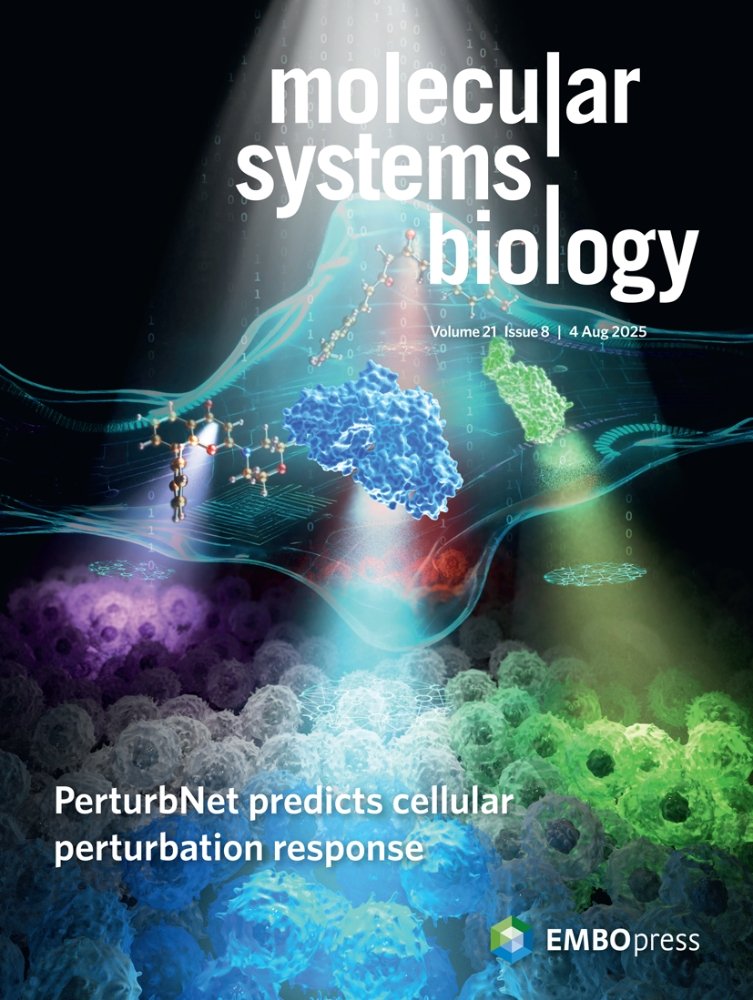
Our PerturbNet paper is the cover article for Molecular Systems Biology! The image depicts our genAI model that predicts how cellular perturbations—including chemicals, gene knockdown or overexpression, and protein mutation—shift single-cell gene expression. 🧵
@HengshiY and I developed a method for predicting the distribution of cell states induced by unseen drugs, gene perturbations, and CRISPR sequence edits. Key insight: learn mapping function from perturbations to cell states (1/n)
https://t.co/a1PScc09tm
Thrilled for my student @HengshiY who defended his dissertation this morning! First PhD student from @LabWelch. After graduation, he will work as a Data Scientist at Google.
MichiGAN, from @HengshiY & @LabWelch, combines the strengths of variational autoencoders and generative adversarial networks to sample from disentangled representations of scRNA-seq data. It can be used to predict single cell response to drug treatment https://t.co/bPqRTVdzhc
Deep generative models (e.g., VAEs, GANs) disentangle latent factors of variation and produce high-quality samples of images. In a new preprint, @HengshiY and I leverage these properties to generate high-quality single-cell gene expression profiles.
https://t.co/lSsTKO87GL