The EU Deforestation Regulation (EUDR), effective by late 2025, poses a significant and even unfair challenge for #Ethiopia’s 5 million smallholder coffee farmers, requiring traceable, deforestation-free exports. Andrew & I propose a market solution! https://t.co/MeFYTZ7wUs
I've just returned from Seychelles, which the New York Times named to its 2026 world's top 52 destinations to visit. Seychelles' success is real and hard earned. Tourism there was not an accident but a deliberate development strategy, executed well.
What's more interesting, though, is how that success is now reshaping prices, livelihoods, and policy choices. I found it to be a useful case study in what happens after tourism "succeeds".
Check out my latest article: What Seychelles Teaches Us About Tourism as a Development Strategy https://t.co/NqeooxBqJ3 via @LinkedIn
#Africa’s infrastructure problem isn’t technology. It’s architecture.
Across Africa, we keep seeing the same pattern: strong founders, real demand, successful pilots. And then a plateau.
Health-tech stalls when clinics lose power. Ag-tech struggles when irrigation is financed like a consumer appliance. Mobility startups can’t scale when every charger sits on a fragile balance sheet.
The issue isn’t a lack of innovation. It’s that we’re asking companies to scale on top of infrastructure that was never designed for a distributed, informal, climate-exposed economy.
We’re trying to run a mobile-first economy on a landline infrastructure model.
In this essay, I argue that Africa’s real bottleneck is infrastructure architecture—how assets are designed, governed, and financed—not which technologies we adopt next. The piece explores why telecoms and digital finance scaled, why infrastructure hasn’t, and what it would take to move from perpetual pilots to durable scale.
If you’re working in policy, development finance, climate finance, or infrastructure investing, this framing matters.
https://t.co/l1pY7JpvPA
#Africa’s digital systems have advanced quickly, but the interface layer still doesn’t match how people communicate. Most daily interactions happen through speech — multilingual, fast, and shaped by context — yet institutions still rely on text-heavy channels.
Voice AI is infrastructure that is beginning to change this: localized data, adapted models, and enterprise integrations that allow banks, telcos, and public agencies to understand real African speech at scale. The early work is demanding, but the payoff is clear. As accuracy improves and costs fall, voice becomes a practical way to expand service reach and lower the barriers faced by low-literacy or multilingual users.
Africa is part of a wider Global South pattern, but the continent’s linguistic density makes the shift especially meaningful. Voice won’t replace text or call centers, but it will make digital systems more accessible — and bring millions closer to the institutions they rely on.
Check out my latest article: Language as Infrastructure: How Voice AI Is Reshaping Access in Africa https://t.co/F11T0pz2D8 via @LinkedIn
Development still treats planning as progress. But real transformation comes from learning: fast, honest, adaptive learning.
Nature has always known this. Evolution works by trying, failing, and keeping what works. Africa’s systems must do the same: build feedback, not just frameworks; reward adaptation, not just execution.
Ethiopia’s reforms are live experiments. Their value lies not in perfection, but in what they teach the system next.
The future will belong to those who learn fastest.
Check out my latest article: Learning Like Nature: Why Africa’s Development Must Evolve, Not Just Plan https://t.co/wdj8JYTFQS via @LinkedIn
@JMichael_Smith Miners are buyers of last resort. There’s a way to have our cake and eat it too. Unfortunately, the current approach ain’t it. This will cost the country in lost revenue unfortunately. Perhaps more than $100M by next year.
The Financial Times Business Book of the Year shortlist adds up to one thing: advantage in shaping the future will belong to those who control the key bottlenecks of production such as compute, industrial depth, supply chains, and the institutions able to execute at scale.
One of the shortlisted titles, Chokepoints, is explicitly about how control over supply chains translates into real power. The emphasis is shifting from stories of growth to the machinery that enables it. Power is consolidating around those who can build.
The real test of digital transformation is better livelihoods! Can power, data, and finance work together so every connection translates into income, resilience, or dignity?
Ethiopia has built dams to power the nation. Now it’s time for that same public energy to power opportunity.
If we align our energy and digital systems around livelihoods, Ethiopia can turn stranded electrons into engines of inclusion.
From dams to data, digital transformation can become the tool for national transformation.
#Ethiopia #Africa #DigitalTransformation #EnergyTransition #InclusiveGrowth #Innovation #DevelopmentFinance
Check out my latest article: From Digital Access to Digital Livelihoods: Turning Connectivity into Prosperity https://t.co/ADOCsy2JtR via @LinkedIn
Making Irrigation Work for Farmers #Ethiopia#Africa
Twenty-five years ago, Dr. Dessalegn Rahmato argued that lasting irrigation success depends on participation and local ownership.
Ethiopia’s experience since then confirms that scale alone is not enough. With new solar and digital tools, it is now possible to extend irrigation more efficiently and inclusively.
This essay explores how investment priorities can evolve from building infrastructure to strengthening systems that farmers can manage and sustain.
Read the full essay →
https://t.co/hHFgVcCU6k
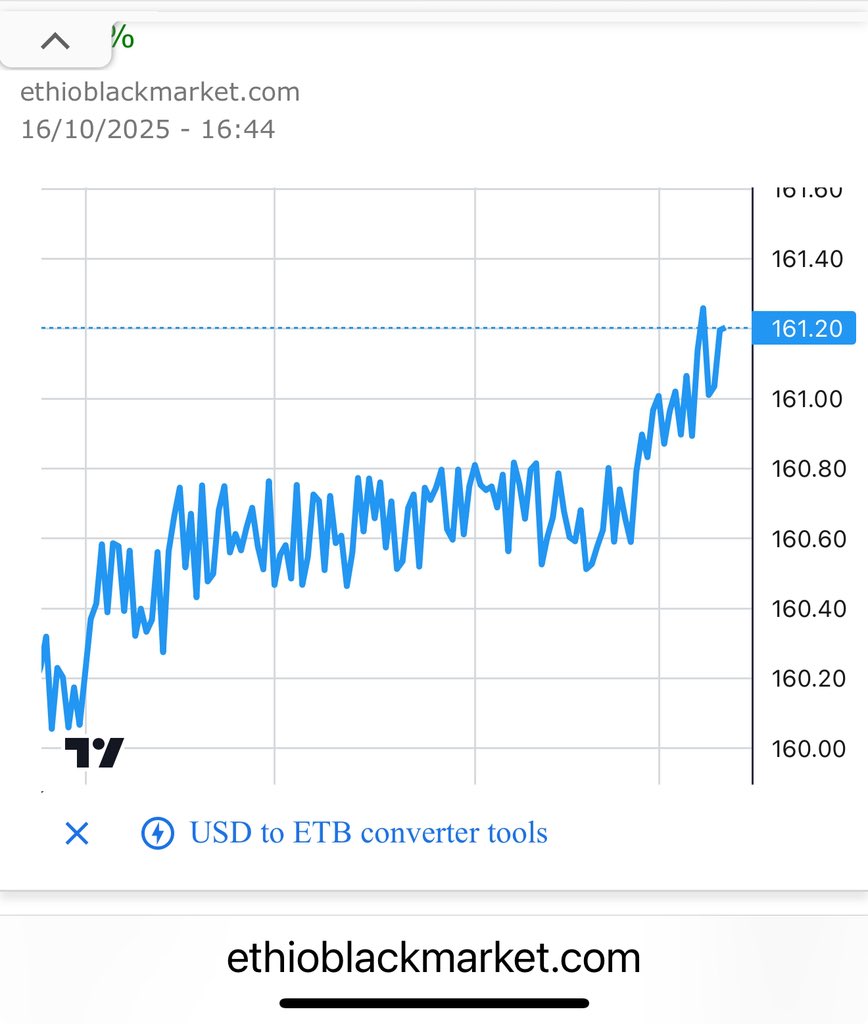
#Ethiopia This guy must be a billionaire by now. All he has to do is: 1) Lower the rate and buy as much dollars as he can. 2) Raise the rate and sell the dollars at a profit. 3) Rinse and repeat.
What world are the rest of us living on?
For the first time in recent history, #Ethiopia’s money is moving in response to market information.
Behind the numbers, a quiet revolution is unfolding.
A financial system once built for storage is beginning to circulate through interbank markets, open-market operations, and yield curves that finally speak the language of price, not decree.
We are witnessing the architecture of a market economy being born slow, disciplined, and deliberate.
Check out my latest article: When Money Learned to Move: Inside Ethiopia’s Quiet Financial Revolution https://t.co/cIzdbKN3c4 via @LinkedIn