@andreaswinckler Typischer Social Media Aufreger: Habeck nutzt hier politische Rhetorik und hält hier kein Proseminar.
Über die Höhe der Umwelt- und Sicherheitsrendite kann man sicherlich viel streiten aber das Vorzeichen und die Größenordnung ist völlig klar.
All this AI yapping and downright false framing just to avoid the important bit.
District heating/cooling works brilliantly, is vastly superior in urban spaces and has been around for decades.
Nothing to do with A/C hate, climate scare or supposed love of centralism.
The French hate air conditioning.
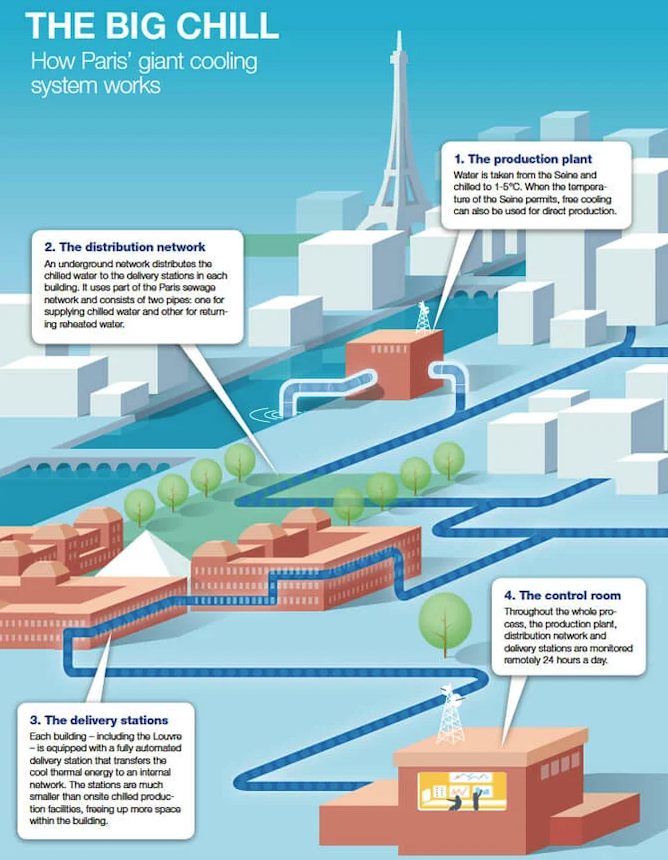
So Paris built a 120-kilometre machine under its streets for producing cold.
It’s called Fraîcheur de Paris, and it does for summer heat what district heating did for winter: centralise the problem.
Instead of every museum, office, hotel, hospital and shop bolting its own cooling plant onto the building, Paris moves cold through pipes.
The network sends water chilled to 2 to 4°C through buried supply lines. The water enters a connected building, absorbs heat through an exchange station, then returns at 12 to 14°C to be cooled again.
It essentially functions with two pipes. One carries the cold out, the other carries heat back.
The production plants cool the circuit from 12°C to 4°C. Some sites use the Seine as a heat sink. In colder periods, the system can use the river’s own temperature for free cooling, which means the machines work less and the electricity demand drops. The Seine water doesn’t become the building water. It stays separate, passing temperature across heat exchangers.
The scale is pretty strange when you see it written down though.
It's got 15 production sites, 4 storage sites, 120 km of underground network with 924 subscribers. This has resulted in 7 million square metres cooled, and 493 GWh of cooling sold.
A cold utility running beneath one of the densest cities in Europe.
The Forum des Halles has been cooled this way since 1979. The Louvre since 1986. Galeries Lafayette, Opéra Garnier, Hôtel de Ville, Station F, La Samaritaine and the National Assembly all sit on the same idea. Tourists stand in the Louvre looking at paintings while a municipal cold loop does part of the dull work below ground.
The boring part is the breakthrough.
Cold can be stored at night in chilled water or ice, then used during daytime peaks. The network is monitored from a control room with more than 125,000 control points. A delivery station inside a building takes 5 to 7 times less space than a standalone cooling installation and avoids the roof and façade clutter that turns cities into compressor farms.
That matters because conventional air conditioning solves heat by moving it somewhere nearby. In a dense city, thousands of private machines mean thousands of outdoor units rejecting heat into streets, courtyards and roofs, plus refrigerants, noise, vibration and maintenance spread across every building.
Paris’s public cooling network has a stated coefficient of performance of 4, against 3 for a wet standalone system and 2 for a dry standalone system. Against an equivalent set of autonomous installations, Fraîcheur de Paris says the network gives 100% higher energy efficiency, 35% less electricity use, 90% fewer refrigerant-fluid emissions and 50% lower CO2 emissions.
The climate backdrop is the real reason this exists.
Paris ran a full crisis exercise called “Paris at 50°C” in 2023. Météo-France’s 2050 reference trajectory for France points to heatwave days becoming five times more frequent, hot nights rising sharply in urban centres, and some local extremes around 48°C becoming possible.
The city signed a 20-year concession in 2022 with Fraîcheur de Paris, owned 85% by ENGIE and 15% by RATP. The contract is worth a projected €2.4 billion. The plan is to extend the network by 158 km by 2042, add 20 production plants and 10 storage sites, and reach more than 3,000 subscribers, including hospitals, nurseries, schools and care homes.
This is basically the infrastructure version of admitting that summer is becoming a public systems problem...
So glad to see this study out. This finding - it is WHAT is processed and how HOW MUCH it is processed that matters for health. This is exactly the argument Gabriel Rosenberg and I made in Feed the People!, looking at many of these same studies.
@HogrefeJens@KlausSeipp Kein Widerspruch. Sage nur, dass bestehende Jobs wegen indiv. Investitionen zB. in Ausbildung, Friktionen im Arbeitsmarkt, politischer Risiken von Strukturwandel etc. einen Wert haben. Gilt für jeden Sektor. Dass das teils überbewertet wird.. Wissen wir alle aus anderen Sektoren.
Remember all the buzz about Chinese coal overcapacity? Utilization down to about 50 pct, generation now slowly approaching structural decline. https://t.co/4VVkCjpvJk
Ohne Verteilnetz keine Energiewende. Die lokalen Netzbetreiber müssen ihre Infrastruktur grundlegend umbauen, doch vielen fehlt das Kapital dafür. Wie das trotzdem gelingen kann und warum die Lösung etwas von Zahlenmagie hat, erklärt die neue Folge #DieGeldfrage. 🧵
@TECleveland @cremieuxrecueil Despite some bogus grants, a lot of government is like this cartoon. I bet this "small team" would find a line item for "screwworm sterilization" and delete it, not knowing that they just devastated American farming: https://t.co/OAnAkxDSEK
@KlausSeipp@HogrefeJens Ich würd's so betrachten: Bestehende Arbeitsplätze sind nicht nur Kosten, denn sie stellen Lebensunterhalt dar. Gut, dass wir da idR anders drauf blicken.
Umweltökonomisch trotzdem reine Kosten - auch wichtig.
@HogrefeJens Also da muss ich mal deutlich widersprechen: „Environmental Economy“ ist nicht gleichbedeutend mit „Energiewende“. 😉
Ansonsten Zustimmung, auch wenn ich den Denkfehler selbst lange gemacht habe.
#Industrienetzentgelte
Ich habe das Material jetzt 5x gelesen. Soll das heißen:
1. Entgelt auf jährlich vereinbarte Bezugsmenge (EUR/kWh) oder
2. Entgelt auf jährliche Durchschnittsleistung (EUR/kW) ?
Evtl. bin ich zu blöd, aber mindestens die Einheit macht keinen Sinn.
@bnetza@maurerchr weiß das bestimmt sofort.. Ist es einfach das gleiche, was für Speicher geplant ist - Statt ex-post-Messung der Spitzenlast einfach ex-ante-Vereinbarung der "Nennlast"?
Mir bewusst, dass es mathematisch im Prinzip das gleiche wäre. Aber es gibt doch eben auch fundamental nur zwei Wege zu bepreisen: Leistung und Energie. Das @bnetza Material macht es zumindest mir schwer, das zu durchsteigen..
Neue Studie: Das EU-CO2-Grenzausgleichsystem #CBAM kann einen positiven Dominoeffekt bewirken, so PIK-Forscherin Leonie Wenz: „CBAM könnte nicht nur die Wettbewerbsfähigkeit garantieren sondern auch den Kilmaschutz international stärken.“
https://t.co/ZOPi5RNRXM
@NewLeftEViews@Rory_Johnston I think part of the story (genuinely) is upside surprise on demand flexibility - something I wouldn’t have expected to be saying a few weeks ago. But obviously not an oil analyst nor the smartest guy in the room