The Nestoil-Neconde vs First Bank Debt Saga: A Classic Nigerian Big-Boy Wahala Explained
In the high-stakes world of Nigerian oil, banking, and elite power, few stories capture the drama quite like the ongoing battle between Nestoil/Neconde Energy and the First Bank-led lending consortium. When Kene Okonkwo (daughter of Nestoil/Neconde promoter Ernest Azudialu-Obiejesi, also known as Obi Jackson) took to Instagram to celebrate a Supreme Court victory while shading a rival’s “bicycle rides abroad and paid publicity,” Nigerians instantly connected the dots. This isn’t just another court case, it’s a window into how big money, massive debts, aggressive enforcement, and personal legacies collide in Nigeria’s economy.
Here’s a clear, no-jargon breakdown for every learned Nigerian who wants to understand what’s really at stake.
The Players
• The Borrowers: Nestoil Limited (oil services and engineering) and Neconde Energy Limited (upstream oil producer with interests in OML 42, a joint venture with NNPC). Promoters include the Azudialu-Obiejesi family. These are serious indigenous players in the oil sector who grew through contracts, asset acquisition, and financing.
Seven companies that committed to payment (total ~$37.4 million / ₦58 billion by August 2025):
• Belema Oil
• Pan Ocean Oil Nigeria Ltd
• Newcross Exploration & Production Ltd
• Dubri Oil Company Ltd
• Chorus Energy
• Amni International
• Network Exploration
Examples from non-compliant or disputed lists (partial, with some amounts where specified):
• Neconde Energy Ltd. (~$325.7 million)
• Continental Oil & Gas Ltd. (~$57 million)
• Aiteo Ltd. (~$34.8 million)
• Energia Ltd. (~$19.5 million)
• Others: Conoil, Pillar Oil, Waltersmith, Millennium Oil & Gas, Frontier, Aradel/Niger Delta, Seplat entities, Chevron/Star Deep (disputed figures), Eroton, etc. https://t.co/hvmf6eAWRw
Nine companies contested liabilities and sought reconciliation (e.g., Chevron, Seplat, Aradel).
6. ~$2.9 Billion in Refinery Rehabilitation Contracts
Foreign contractors for Port Harcourt, Warri, and Kaduna projects are accused of breaching terms. EFCC probes into past spending (historically billions with limited results) are referenced; specific firms in the ASCAB demand are not exhaustively named but include prior contractors like Italy’s Tecnimont/Saipem and others. New MoUs with Chinese firms have raised fresh accountability questions. https://t.co/xO9LvdYwcm
Context and Challenges
These debts overlap (e.g., NEITI figures feed into House probes). IOCs often dispute calculations, citing contract interpretations or ongoing arbitrations. Enforcement has been inconsistent historically, but renewed focus on recovery could reduce borrowing needs if successful. Full details require consulting the latest NEITI Oil & Gas Audit (available on https://t.co/rB8EOJlfnC or NEITI dashboard), House committee reports, and potential court filings if ASCAB proceeds. https://t.co/rB8EOJlfnC
Nigeria’s oil sector remains opaque in parts despite EITI compliance efforts. Greater transparency via NEITI dashboards and parliamentary oversight could aid recovery while deterring future losses. Stakeholders urge swift, evidence-based action to benefit the Nigerian Federation Account.
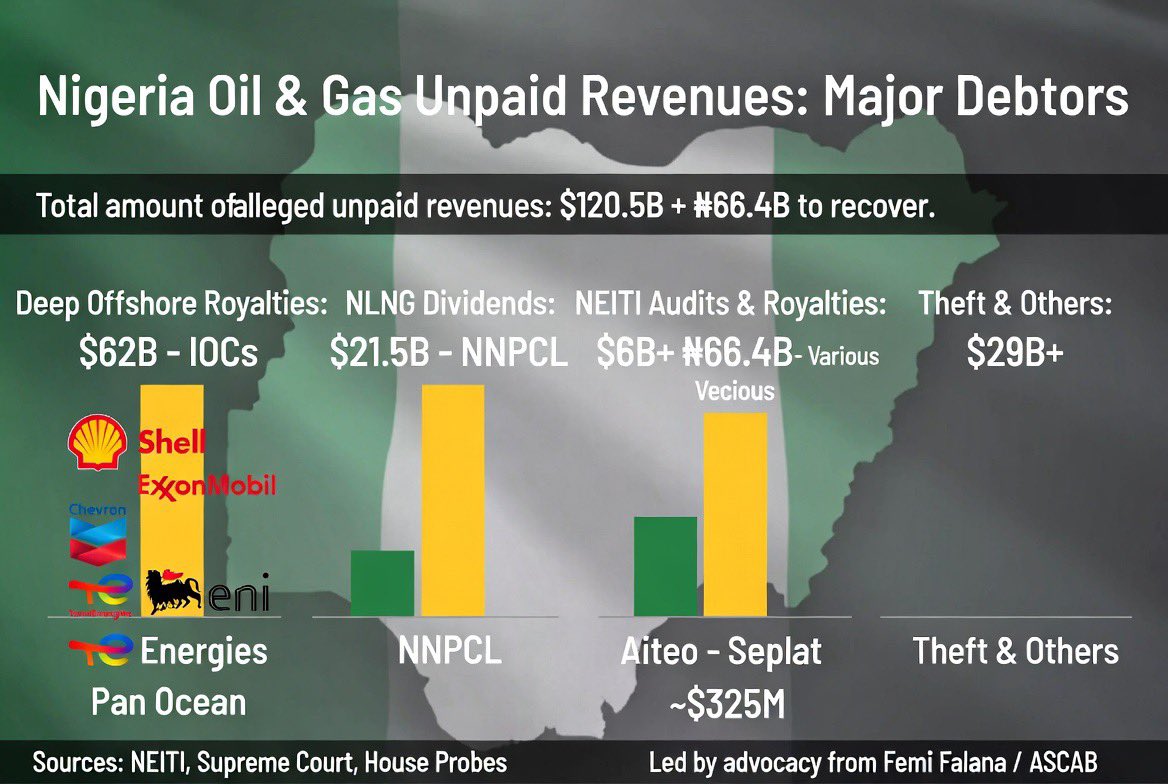
EXPOSED: $120.5 billion and ₦66.4 billion Unpaid Debts: Falana Cautions Debtors, Demands Repayment, Threatens Legal Action
In a high-profile demand led by human rights lawyer Femi Falana on behalf of the Alliance for Surviving COVID-19 and Beyond (ASCAB), the Nigerian government is being urged to recover approximately $120.5 billion and ₦66.4 billion in alleged unpaid revenues from the oil and gas sector. These figures draw from NEITI audits, Supreme Court judgments, National Assembly probes, and other official findings. The Attorney-General has been given 14 days to act, or face legal compulsion.
The claims span multiple categories and involve a mix of international oil companies (IOCs), indigenous operators, the Nigerian National Petroleum Company Limited (NNPCL), and contractors. No single exhaustive public list names every debtor with precise amounts for the full $120B+, but granular details emerge from NEITI reports, House of Representatives investigations, and related probes.
DEBTORS LIST
1. $62 Billion in Uncollected Deep Offshore and Inland Basin Royalties
This is the largest single component. It stems from a failure by IOCs to adjust royalties upward when oil prices exceeded $20 per barrel under 1993 Production Sharing Contracts (PSCs), as affirmed by a 2018 Supreme Court judgment. A Malami-era committee quantified the liability at ~$62 billion. https://t.co/kyGhRdgUYh
Primarily alleged debtors: Six major IOCs with joint operating agreements with NNPC:
• Shell Petroleum Development Company (SPDC) / Shell Nigeria Exploration & Production Co. (SNEPCo)
• Mobil Producing Nigeria Unlimited (ExxonMobil)
• Chevron Nigeria Limited (CNL) / Star Deepwater
• Nigerian Agip Oil Company (NAOC / Eni)
• TotalEnergies (TEPNG)
• Pan Ocean Oil Corporation
Some companies have disputed the full applicability or pursued legal challenges. Recovery would target these majors first for historic deepwater profits.
2. $21.5 Billion in NLNG Dividends Withheld
NNPCL (49% stakeholder in Nigeria LNG Limited) faces accusations of not fully remitting dividends to the Federation Account, despite Senate and House resolutions and NEITI findings. NLNG has paid out ~$44 billion in dividends historically, with the government’s share around $21.5 billion reportedly not properly accounted for in some periods. https://t.co/4eXEtIbSOr
This is largely an internal government/NNPCL issue, though tied to broader sector accountability.
3. ~$29 Billion Linked to Crude Oil Theft and Undeclared Exports
• ~$12.7 billion from ~60 million barrels allegedly discharged in U.S. ports (2011–2014), per NIMASA-linked findings.
• ~$17 billion from unrecorded crude/LNG exports, per House investigations.
Targets: “Indicted oil and shipping companies,” operators, and networks involved in theft/sabotage. IOC facilities have been affected, but direct liability often falls on unnamed traders, shippers, and local actors. EFCC and NIMASA actions are recommended; specific comprehensive lists are not public in the ASCAB context. https://t.co/hvmf6eAWRw
4. $6.071 Billion + ₦66.4 Billion in Outstanding Royalties, Taxes, Penalties, etc. (NEITI Audits)
NEITI’s 2022/2023 Oil & Gas Audit highlights $6.071 billion (plus naira equivalent) in unpaid royalties, gas flare penalties, taxes, and related liabilities owed to NUPRC and others as of mid-2024. Liabilities reportedly rose to ~$6.175 billion by June 2024. NEITI has recovered billions in prior years but flags ongoing shortfalls across dozens of operators. https://t.co/BT584OXpGm
Covered companies: Audits typically involve 60–78 operators (IOCs and indigenous). Major ones frequently referenced in sector reports include Chevron, Shell, TotalEnergies, ExxonMobil, Eni/NAOC, Seplat, Aiteo, Heirs Energies, ND Western, Elcrest, and many others. Company-specific breakdowns appear in full NEITI reports and appendices. https://t.co/rB8EOJlfnC
5. $1.7 Billion (₦2.5 Trillion) in Unpaid Royalties – House of Representatives Probe (45 Companies, as of Dec 2024)
A Public Accounts Committee investigation identified 45 oil and gas companies owing ~$1.7 billion in royalties. https://t.co/hvmf6eAWRw
"How can 42 children be in captivity and we are still acting normal? In some countries, for just one child, they would deploy all the arsenal they have. How did we get here? They behe@ded one teacher"
-Pastor Nathaniel Bassey reacts to the kidn@pping incident in Oyo State, as he also revealed his prophecy of insecurity coming to the South
Yesterday was Dadiyata’s birthday. If he’s not found by August, he’ll be dead under Nigerian law.
Section 164 of the Evidence Act presumes a person dead if they have been missing for 7 years or more and have not been heard from.
All he did was criticize an APC government.
The Nestoil-Neconde vs First Bank Debt Saga: A Classic Nigerian Big-Boy Wahala Explained
In the high-stakes world of Nigerian oil, banking, and elite power, few stories capture the drama quite like the ongoing battle between Nestoil/Neconde Energy and the First Bank-led lending consortium. When Kene Okonkwo (daughter of Nestoil/Neconde promoter Ernest Azudialu-Obiejesi, also known as Obi Jackson) took to Instagram to celebrate a Supreme Court victory while shading a rival’s “bicycle rides abroad and paid publicity,” Nigerians instantly connected the dots. This isn’t just another court case, it’s a window into how big money, massive debts, aggressive enforcement, and personal legacies collide in Nigeria’s economy.
Here’s a clear, no-jargon breakdown for every learned Nigerian who wants to understand what’s really at stake.
The Players
• The Borrowers: Nestoil Limited (oil services and engineering) and Neconde Energy Limited (upstream oil producer with interests in OML 42, a joint venture with NNPC). Promoters include the Azudialu-Obiejesi family. These are serious indigenous players in the oil sector who grew through contracts, asset acquisition, and financing.
“Tinubu must call the Military to account for all the money, it is high time they tell us where all the resources this house has been budgeting for them”
- Sen Sani Musa
BREAKING🚨 GAMESTOP SHORT SELLER FOUND GUILTY OF SECURITIES FRAUD
The short-selling manipulators are going down
Like 👍 if you think Ken Griffin, Doug Cifu, and Charles Gasparino should be investigated next
Criticisms/Overreaches (what courts and observers flagged):
• Heavy use of ex parte orders that disrupted operations before full hearing.
• Receiver overstepping into legal representation and day-to-day control.
• Rapid involvement of police and agencies, creating public spectacles.
• Supreme Court rebuke of the Court of Appeal’s restorative move as jurisdictionally flawed.
This isn’t unique, Nigerian commercial litigation often features “forum shopping” and powerful interim orders but the scale here made it national news.
The Otedola Parallel: From Debtor to Creditor-in-Chief
The irony isn’t lost on Nigerians. Femi Otedola built Zenon Petroleum in the 2000s, borrowed massively (reports of ₦168–220 billion peak, ~$1B+ at the time) for fuel trading, storage, and expansion. The 2008 global crash, oil price drop, and naira issues crushed margins. Banks pursued enforcement; properties like Zenon House on Ajose Adeogun, Victoria Island, faced threats. Some loans went to AMCON. Otedola restructured, settled, surrendered assets where needed, and pivoted brilliantly into power (Geregu) and banking influence.
Today, through First HoldCo/First Bank, his institutions are on the aggressive creditor side. He has spoken openly about learning from those hard times. The public shade (“bicycle PR” vs. real impact) plays on this contrast, but the case remains a commercial debt enforcement matter, not a personal vendetta.
Why This Matters Beyond the Billionaires
• Banking Sector Health: Big oil loans affect dividends, stability, and lending appetite.
• Indigenous Oil Players: Success or failure shapes local content in upstream oil.
• Rule of Law: Supreme Court’s stand reinforces that even powerful creditors must follow process — a win against “oppressive tactics.”
• Elite Dynamics: Reminds us Nigeria’s economy is still driven by a small circle of names, family empires, and recycled capital. Debts this size ripple into politics, contracts, and public perception.
Current Status (June 2026): Nestoil/Neconde have breathing room and control of operations. The underlying debt trial continues at the Federal High Court. Settlement remains possible these matters often end in handshake, not total wipeout.
This saga is pure Naija: oil money, bank power, court drama, social media shade, and lessons in leverage, resilience, and due process. Whether you see it as banks doing their job or overreach against local heroes, one thing is clear, in Nigeria, the real “legacy” is often written in court files as much as in press releases. The full trial will decide who ultimately pays what.
• The Lenders: Led by FBNQuest Merchant Bank Ltd and First Trustees Ltd (entities under the First Bank/First HoldCo group, where Femi Otedola is a major influence as Chairman of First HoldCo). A syndicate of about 16 Nigerian banks plus Afreximbank restructured facilities into “Global Facilities” under a Common Terms Agreement.
• The Asset at Heart: Neconde’s stake in OML 42 (onshore oil block) and various Nestoil assets, including their Victoria Island headquarters. Control of these means cash flow from oil production.
How the Debt Happened (The Business Underbelly)
Nigeria’s oil and gas sector is capital-intensive. Companies borrow heavily in dollars for rigs, vessels, operations, and asset buys, then earn in a volatile mix of dollars and naira. Factors that likely contributed:
• Oil price swings.
• Naira devaluation (making dollar repayments painful).
• High interest and multiple facilities.
• Sector-wide challenges post-restructuring.
By late 2025, the exposure reportedly hit over $1.01 billion (USD) + ₦430 billion (including guarantees). This wasn’t a small loan, it was syndicated, secured by assets and personal guarantees, and restructured in 2022. Similar stories have played out across the industry; non-performing oil loans have pressured bank balance sheets and even blocked dividends at some institutions.
Neconde has argued it wasn’t directly party to certain agreements or that enforcement was wrongful, but the core dispute is over default and repayment.
The Legal Timeline: From Freeze to Supreme Court Drama
1. October 22, 2025: Federal High Court (Justice Dehinde Dipeolu) grants an ex parte Mareva injunction, a powerful freezing order on assets, accounts, and shares across 20+ banks, plus appointment of a receiver/manager (Abubakar Sulu-Gambari SAN). Police seal Nestoil’s HQ. This is standard creditor weaponry but aggressive when done without the other side being heard.
2. November 2025: New judge (Justice Daniel Osiagor) says the ex parte order lapsed by operation of law. Banks appeal.
3. November 29, 2025: Court of Appeal (Justice Yargata Nimpar) grants a restorative injunction ex parte, putting the receiver back in control. Receiver even tried to dictate the companies’ lawyers (e.g., challenging Wole Olanipekun SAN’s team), a move widely seen as overreach.
4. June 2/1, 2026: Supreme Court (5-member panel led by Justice Stephen Adah) unanimously sets aside the Court of Appeal’s orders. Key holdings: Appellate court exceeded jurisdiction, misused ex parte process, and improperly interfered with the trial court. Assets and operations return to Nestoil/Neconde pending full trial on the debt merits.
The Supreme Court essentially said: “Due process matters, even for billionaires.”
First Bank’s Motivations and Visible Overreaches
Motivations (perfectly rational from a creditor view):
• Recover huge exposure threatening their books.
• Enforce security (debentures, charges, guarantees) under the loan agreement.
• Protect the broader syndicate and regulatory standing (CBN cares about NPLs).
• In a tough economy, banks can’t afford to look soft on big defaulters.
The Nestoil-Neconde vs First Bank Debt Saga: A Classic Nigerian Big-Boy Wahala Explained
In the high-stakes world of Nigerian oil, banking, and elite power, few stories capture the drama quite like the ongoing battle between Nestoil/Neconde Energy and the First Bank-led lending consortium. When Kene Okonkwo (daughter of Nestoil/Neconde promoter Ernest Azudialu-Obiejesi, also known as Obi Jackson) took to Instagram to celebrate a Supreme Court victory while shading a rival’s “bicycle rides abroad and paid publicity,” Nigerians instantly connected the dots. This isn’t just another court case, it’s a window into how big money, massive debts, aggressive enforcement, and personal legacies collide in Nigeria’s economy.
Here’s a clear, no-jargon breakdown for every learned Nigerian who wants to understand what’s really at stake.
The Players
• The Borrowers: Nestoil Limited (oil services and engineering) and Neconde Energy Limited (upstream oil producer with interests in OML 42, a joint venture with NNPC). Promoters include the Azudialu-Obiejesi family. These are serious indigenous players in the oil sector who grew through contracts, asset acquisition, and financing.